
Lithium Battery Inverter vs Lead Acid Inverter: Which Is Better?
25 August 2026
Choosing between a Lithium Battery Inverter and a traditional lead acid inverter is one of the most important decisions for homeowners investing in a reliable power backup or solar setup. Both technologies pair with a solar inverter system differently, affecting efficiency, lifespan, and long-term cost. Lento Industries Private Limited compares the two in detail to help buyers identify the best inverter for solar panels and their home energy needs.
Understanding the Core Difference
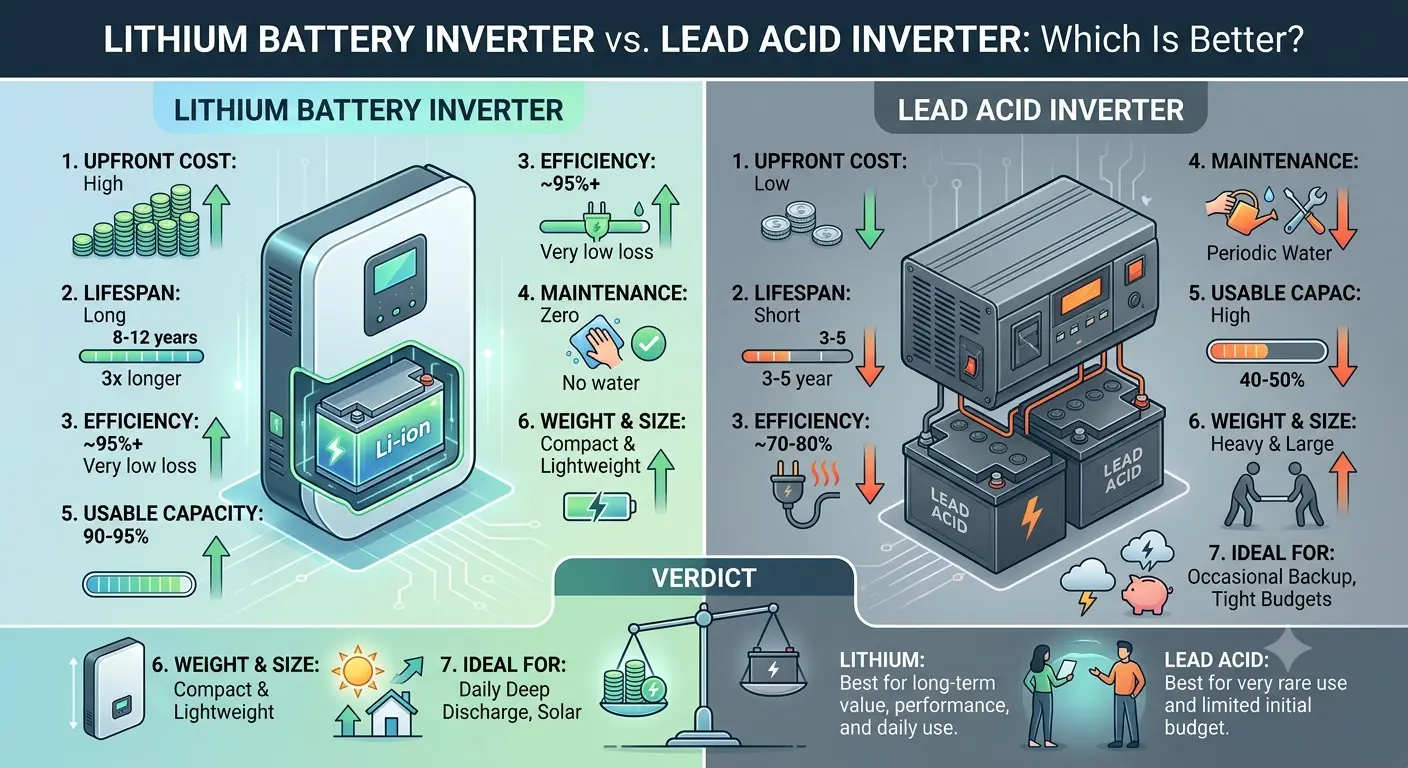
A lead acid inverter relies on flooded or tubular batteries that require regular maintenance, water top-ups, and ventilation, while an inbuilt Lithium Battery Inverter integrates a sealed, maintenance-free lithium-ion battery directly within the unit. This difference in battery chemistry impacts charging speed, backup duration, footprint, and total cost of ownership over the product's lifetime — factors every buyer researching the best inverter in india should weigh carefully.
Efficiency and Charging Performance
Lithium battery inverters charge significantly faster than lead acid alternatives, often reaching full charge in 2–3 hours compared to 6–8 hours for lead acid systems. This faster charge cycle makes lithium technology especially effective when paired with a solar inverter for home setups, since panels generate power only during daylight hours and quicker charging captures more usable solar energy before sunset. Lead acid batteries, while slower to charge, remain a dependable and lower-cost option for buyers prioritizing upfront affordability over long-term efficiency.
Lifespan and Maintenance Comparison
Lithium-ion batteries typically last 8–10 years or 2,000+ charge cycles, compared to 3–5 years or 300–500 cycles for standard lead acid units. Because lithium batteries require no water top-ups and produce no harmful gases, an inbuilt Lithium Battery Inverter demands far less maintenance than lead acid systems, making it a strong choice for buyers seeking the best inverter with minimal upkeep over its service life.
Size, Weight, and Installation
Lithium battery inverters are considerably lighter and more compact than lead acid units of equivalent capacity, since lithium-ion cells store more energy per kilogram. This makes them easier to install in space-constrained homes and apartments. Buyers comparing the top 5 solar inverters in india or a wider top 10 solar inverters list will often find lithium-based models positioned as premium, space-saving options suited to modern residential installations.
Cost Considerations: Upfront vs Long-Term
Lead acid inverters carry a lower upfront price, making them attractive for budget-conscious buyers. However, when factoring in replacement frequency, maintenance costs, and charging efficiency over a 10-year period, lithium battery inverters often deliver better long-term value. This total-cost perspective is essential when evaluating offerings from any best solar inverter company in india, since the cheapest unit upfront is not always the most economical choice over time.
Which Option Suits Grid-Connected Homes?
For households using a best on grid solar inverter in india setup with net metering, battery backup requirements may be lower since excess power is exported to the grid rather than stored. In such cases, either lithium or lead acid battery banks can work, but lithium remains preferable where frequent outages require rapid backup switching and longer daily battery cycling.
How Much Solar Panel Capacity Do You Need?
Regardless of battery type, sizing starts with your electricity consumption. Estimating how much solar panel required for home use typically means a 2–3kW system for 300 units/month consumption, scaling up to 4–5kW for higher usage households. A qualified best inverter company in india can assess your load profile to recommend the right combination of panel capacity and battery chemistry.
Frequently Asked Questions
- Which is better, lead-acid or lithium battery?
Lithium batteries are generally better for longer life, faster charging, higher efficiency, and low maintenance, while lead-acid batteries are usually more affordable upfront. - Which type of inverter is better, a lithium inverter or a normal inverter?
A lithium-compatible inverter is better when using lithium batteries because it supports efficient charging, battery communication, and better battery management. - Which type of battery is best for inverters?
Lithium batteries are a good choice for most modern inverter systems due to their long lifespan, fast charging, and high efficiency. - What are the disadvantages of a lithium-ion inverter battery?
The main disadvantages are higher initial cost, the need for a compatible inverter, and dependence on a built-in Battery Management System (BMS). - What is the biggest disadvantage of a lithium-ion battery?
The biggest disadvantage is its higher upfront cost compared with traditional lead-acid batteries. - Which battery is best for an inverter, lead acid or lithium?
Lithium is generally the better option for long-term use, while lead-acid can be suitable when the initial purchase budget is the main consideration.
Conclusion
Both lithium and lead acid inverters have a place in India's home energy market, but the right choice depends on budget, maintenance tolerance, and long-term efficiency goals. A Lithium Battery Inverter offers faster charging, a longer lifespan, and a lower total cost of ownership, while lead acid remains a reliable, budget-friendly entry point. Lento Industries Private Limited helps homeowners evaluate both technologies and select the best inverter and solar panel combination suited to their household's power needs and long-term energy savings.
Contact Lento Industries Private Limited
Solar Inverter Manufacturer & Solutions Provider
International: +91 9810173869
Toll-Free: 1800 313 0746
Sales & General Enquiries: info@lentoindia.com
Read More:-
Why Is My Inverter Showing a Red Light? Common Causes and Solutions
How Much Electricity Does a Solar Panel Generate?
Solar Panel Maintenance Guide
How to reset an Inverter a step by step guide?