
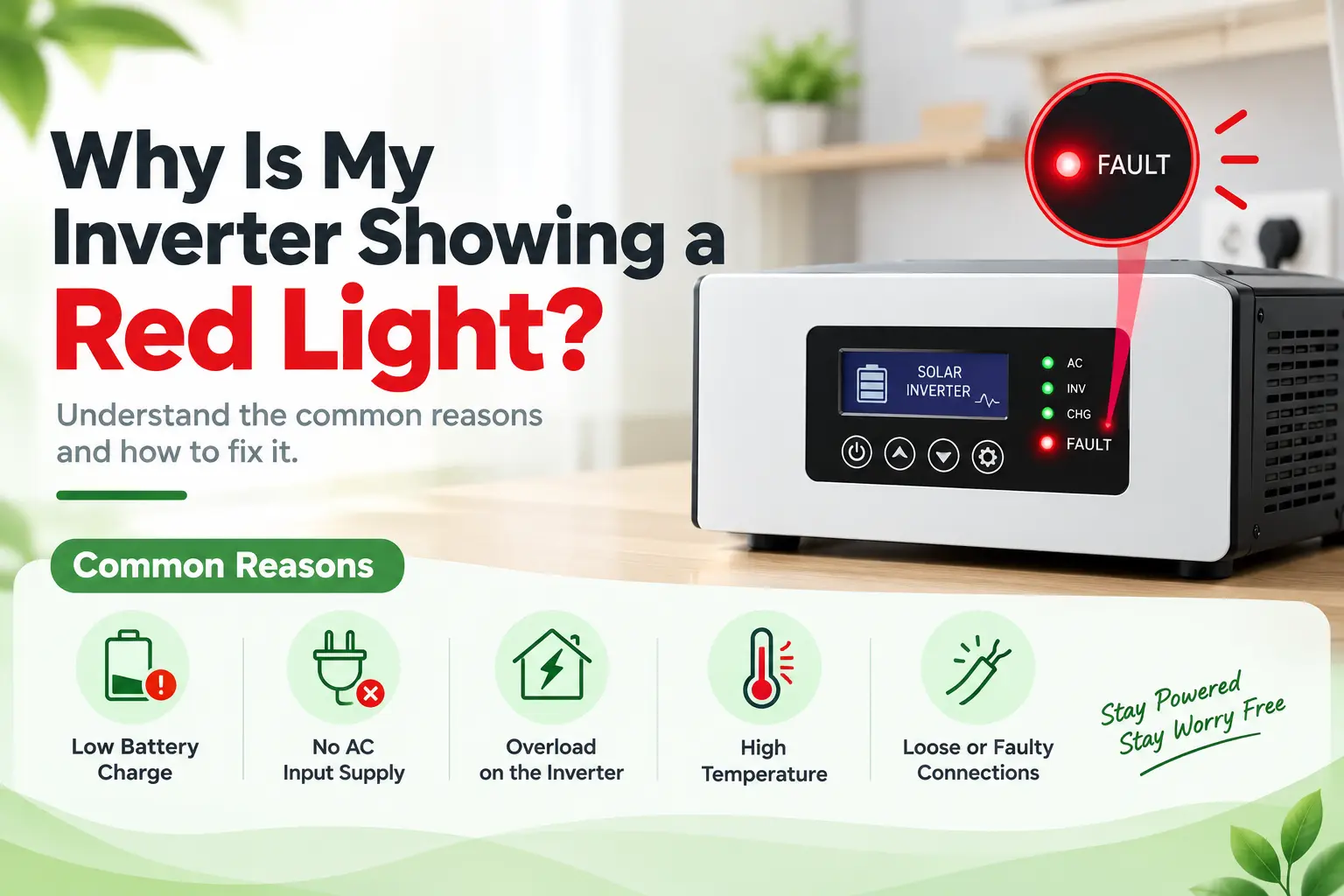
Why Is My Inverter Showing a Red Light? Inverter Red Light Meaning, Causes & Solutions
19 November 2025
Few things are more worrying than a power cut followed by an inverter red light. If you’re asking “why is my inverter showing a red light?”, you’re not alone. The inverter red light problem is one of the most common inverter issues reported by homes and businesses.
In simple terms, the inverter fault light is your system’s way of saying something is wrong. Your inverter converts DC power from a tubular battery or SMF battery into usable AC power, so a red light problem needs attention quickly.
This guide covers the inverter red light meaning, the most common causes, and the inverter red light solution for each one. It also explains how to fix inverter red light faults safely and when to go for inverter repair.
Inverter Red Light Meaning: What Does It Indicate?
The inverter red light is a warning light that the inverter has detected an inverter fault. Depending on the model, the light may be:
- Solid red: a continuing fault such as low battery, overload, or overheating.
- Inverter red light blinking: a specific error light pattern, often paired with an inverter alarm (a beep). The number of blinks usually maps to a fault code in your manual.
Whether you call it an inverter warning light, inverter error light, or inverter fault light, the message is the same: the inverter is protecting itself and your appliances. Don’t ignore it.
Common Causes of an Inverter Red Light (and How to Fix Them)
1. Low Battery Voltage
This is the most common cause of an inverter fault light. When your tubular or SMF battery falls below a safe level, the inverter shuts down to prevent deep discharge. You may also hear the inverter alarm.
Inverter red light solution:
- Check the battery with a multimeter. A healthy 12V battery should read about 12.6–12.8V when fully charged.
- Recharge the battery completely.
- If the red light returns, the battery may be near the end of its life and need replacement. Read how long an inverter battery lasts and our guide to the best inverter battery for home.
2. Overload Condition
If too many appliances are connected, the inverter reaches its wattage limit and enters overload protection. This often causes an inverter red light blinking pattern along with an alarm.
How to fix inverter red light from overload:
- Switch off a few high-power appliances.
- Make sure your total load is within the inverter’s rating.
- If your power needs have grown, upgrade to a higher-capacity Lento pure sine wave inverter. You can also check how many 200Ah batteries a 3kVA inverter needs.
3. Overheating
An inverter in a poorly ventilated spot, or one running long hours under heavy load, will overheat and trigger the inverter warning light.
Solution:
- Place the inverter in a cool, well-ventilated area.
- Clean dust from the vents regularly.
- If overheating happens often, get the cooling fan checked.
4. Loose or Faulty Wiring
Loose battery terminals, corroded cables, and damaged connections cause voltage fluctuations, which lead to an inverter fault.
Solution:
- Inspect all wiring between the inverter, battery, and load.
- Tighten loose terminals and clean corrosion with a baking soda and water mix.
- If you aren’t sure, don’t attempt it yourself. Call a qualified technician for inverter repair.
5. Input Voltage Variations
If the input from the solar panels or battery bank is too low or too high, the inverter may shut down for protection and show an inverter error light.
Solution:
- Check input voltage with a multimeter.
- In solar systems, keep panels clean for better sunlight capture. Our guide on which type of solar inverter is right for you explains on-grid, off-grid, and hybrid options.
- Make sure the batteries are healthy and fully charged.
6. Internal Component Failure
If everything external looks fine, the red light may point to an internal failure in the capacitor, transformer, or circuit board.
Solution:
- Check your manual for error codes.
- Try a reset as per the instructions.
- If the red light problem continues, contact an authorised Lento service centre for professional inverter repair.
Quick Troubleshooting Checklist
- Switch off the inverter and disconnect the load.
- Check battery voltage and charge level.
- Inspect terminals and cables.
- Check ventilation and temperature.
- Reconnect a lighter load and restart.
- If the red light remains, look up the error code or call support.
Preventive Tips to Avoid Inverter Faults
- Routine care: Wipe the vents, inspect terminals, and check connections monthly. See how to maintain your battery for long life.
- Load management: Avoid running a heavy load for long hours without a break.
- Battery care: Keep your tubular or SMF battery charged and in good condition. Learn more in our tubular battery meaning and maintenance guide.
- Proper installation: Install the inverter in a cool, well-ventilated place and fasten it securely. A wall-mounted inverter is a good space-saving option.
Why Choose Lento Inverters?
Lento India is a leading manufacturer of inverters, Online UPS systems, solar panels, and batteries. Our products deliver pure sine wave output, which protects your appliances.
- Advanced overload and short-circuit protection, so you see fewer inverter warning light events
- Compatible with tubular, SMF, and solar batteries
- High conversion efficiency for lower energy loss
- Ideal for home and commercial use
- Strong after-sales support for any inverter repair need
Explore our range: best inverter for home use, inverter with battery for home, best inverter for home in India with battery, and top inverter brands in India.
Our Global B2B Reach
Lento India exports inverters, UPS, and solar power products to 24 countries, including Mexico, Chile, Peru, Ecuador, Dominican Republic, Afghanistan, Nigeria, Iraq, Uganda, Yemen, Syria, Iran, Oman, Morocco, Egypt, and Kuwait.
Interested in bulk orders or distribution partnerships? [Fill out our business inquiry form]([INQUIRY FORM URL]). Our export team will respond within 24 hours with pricing, logistics, and market guidance. You can also read about the No. 1 inverter battery company in India.
Conclusion
An inverter red light is a valuable warning that protects your system from further damage. Whether it’s low battery voltage, overload, overheating, loose wiring, or an internal inverter fault, most causes have a simple inverter red light solution. Regular maintenance, correct installation, and a trusted brand like Lento India keep your power backup running smoothly.
FAQs
1. Why is there a red light on my inverter?
A red light on an inverter usually indicates a warning or fault, such as a low battery, overload, overheating, or a charging problem. The exact meaning depends on the inverter model and its indicator symbols.
2. What does it mean when my power inverter has a red light?
A red light generally signals that the inverter needs attention. It may indicate a battery fault, excessive load, low input voltage, or an internal error. Check the display or user manual to identify the specific issue.
3. Does a blinking red light mean charging?
Not necessarily. A blinking red light may indicate a fault, low battery, overload, or another operating status. Charging indicators vary by manufacturer, so check the indicator guide for your inverter model.
4. Why is my inverter beeping continuously with a red light?
Continuous beeping with a red light can indicate a low battery, overload, overheating, or an inverter fault. Switch off unnecessary appliances and check the display for an error code. If the warning continues, contact a qualified technician.
5. How to fix a red light on an inverter?
-
Check whether the battery is low or disconnected.
-
Reduce the connected load if the inverter is overloaded.
-
Ensure the inverter has adequate ventilation and is not overheating.
-
Check the mains supply and visible cable connections.
-
Restart the inverter only if the manufacturer's instructions allow it.
If the red light remains on, arrange professional inspection rather than opening the inverter yourself.
6. What does a solid red light mean on an inverter?
A solid red light often indicates an active warning or fault, but its meaning varies by model. It may signal an overload, battery problem, overheating, or internal malfunction. Refer to the user manual or display code to determine the cause accurately.
Read More
Which Brand Tubular Battery Is Best? Buying Guide for Indian Homes
How to Revive a Dead Tubular Battery
Can You Revive a Completely Dead Battery?
How to Revive a Dead Tubular Battery at Home: Safe Step-by-Step Guide
Top 10 Inverter Batteries in India: Best Tubular, SMF and Lithium Options for Home Backup
150Ah Battery Backup Time Calculator: How Many Hours Will It Run? (Formula + Chart)
Inverter Capacity for 200Ah Battery: Formula, Chart & Calculator
Suitable Inverter for 200Ah Battery: The 6-Point Compatibility Guide