
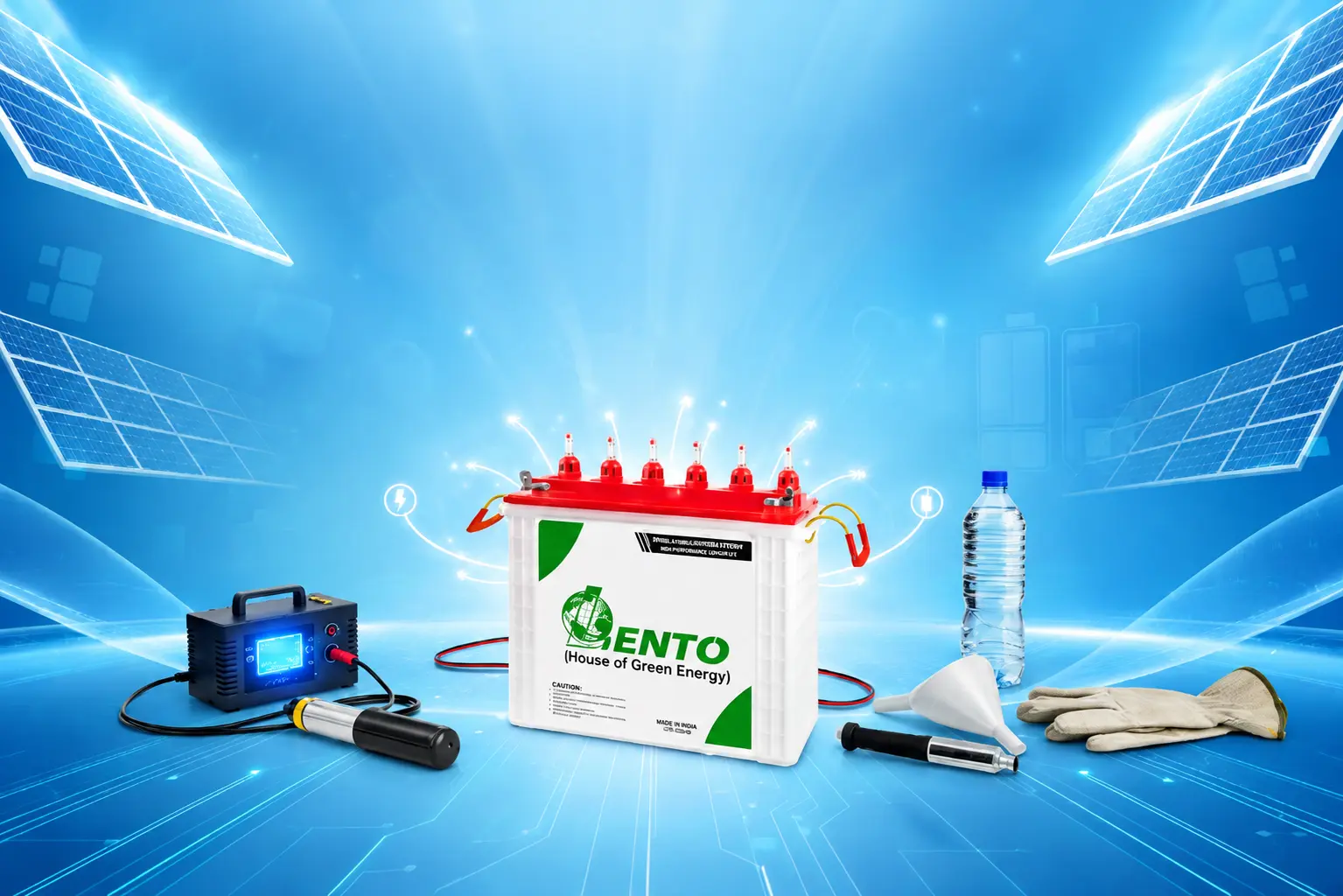
How to Revive a Dead Tubular Battery at Home: Safe Step-by-Step Guide
15 October 2026
Quick Answer: How Do You Revive a Dead Tubular Battery at Home?
To revive a dead tubular battery at home: (1) inspect it for swelling, cracks, or leaks, (2) clean the terminals, (3) top up with distilled water if plates are exposed, (4) charge it slowly with a dedicated charger until voltage and specific gravity stop rising, and (5) retest under load. This works when the battery is dead from low water, corrosion, deep discharge, or mild sulfation. It does not work on physically damaged or very old batteries.
Key Takeaways
- Most home revivals need only a multimeter, distilled water, baking soda, a brush, safety gear, and a suitable charger.
- Always inspect first. A swollen, cracked, or leaking battery must be replaced, not revived.
- Use only distilled water. Never add acid at home.
- Charge slowly and watch temperature. Stop if the battery becomes hot.
- If the battery fails to recover after one full careful cycle, it is likely beyond dead battery repair.
Is Your Battery Really Dead? Check Before You Start
Many “dead” batteries are actually an inverter, wiring, or overload problem. Before you attempt tubular battery repair, confirm the symptoms:
- Tubular battery backup drops to a few minutes
- Battery not charging even after hours on the inverter
- The inverter shows a constant low-battery alarm
- A rotten-egg smell while charging
- Bulging, cracks, or leakage
For a deeper look at the signs, see our guide on whether you can revive a completely dead battery (update link to the live URL once published). To judge whether your backup is genuinely poor, compare it with our battery backup time calculator.
What You Need to Revive a Dead Inverter Battery at Home
| Item | Purpose |
|---|---|
| Digital multimeter | Measure resting and charging voltage |
| Hydrometer | Check electrolyte specific gravity |
| Distilled water | Top up electrolyte safely |
| Baking soda, water, and a plastic brush | Clean terminal corrosion |
| Safety goggles and acid-resistant gloves | Protect eyes and skin |
| Dedicated charger for flooded tubular batteries | Slow, controlled recharge |
| Spanner or wrench | Disconnect and tighten terminals |
| Clean cloth and a funnel | Wipe up and refill without spills |
Safety Rules Before You Begin
Batteries contain sulfuric acid and release hydrogen gas while charging. Follow these rules:
- Work in a well-ventilated space, away from sparks, flames, and smoking
- Wear goggles and gloves at all times
- Remove metal jewellery to avoid accidental short circuits
- Never place tools across the terminals
- Never add or mix acid at home
- Keep baking soda nearby to neutralise any acid spills
- Stop immediately if the battery heats up, smells strongly, or bulges
Do not attempt revival if the case is swollen, cracked, or leaking. Replace the battery.
How to Revive a Dead Tubular Battery at Home: Step-by-Step
Step 1: Disconnect and Inspect
Switch off the inverter and disconnect the battery. Look for swelling, cracks, leaks, and acid residue. If any are present, stop here.
Step 2: Test the Resting Voltage
Let the disconnected battery rest for a few hours, then measure with the multimeter. For a 12V battery, typical readings are:
| Resting voltage | What it usually means |
|---|---|
| About 12.6 to 12.8V | Fully charged, healthy |
| About 12.0 to 12.4V | Partly discharged |
| Below about 11.8V | Deeply discharged |
| Near or below 10.5V | Serious damage or a dead cell likely |
A very low reading does not always mean the battery is lost, but it lowers the odds of recovery.
Step 3: Clean the Terminals and Connections
Corrosion blocks current flow and can make a good battery look dead.
- Remove the cables (negative first, then positive)
- Brush the corroded areas with a baking soda and water paste
- Wipe clean and dry completely
- Reconnect cables tightly (positive first, then negative)
This simple step fixes many cases of tubular battery issues.
Step 4: Check and Top Up the Electrolyte
- Open the vent caps one by one
- Look at the plates. If they are exposed, the level is too low
- Add distilled water until the plates are just covered
- Refit the caps
Complete the final top-up to the indicator level after charging, because electrolyte level rises during charging. Never use tap water, as its minerals damage the plates.
Step 5: Recharge the Dead Tubular Battery Slowly
This is the most important step in how to recharge a dead tubular battery.
- Use a dedicated charger suited to flooded tubular batteries and set to the correct voltage
- Use a low charging current. A commonly used guideline is about 10% of the battery’s Ah rating, but follow your manufacturer’s specification
- Charge continuously until voltage and specific gravity stop rising. Large batteries can take well over 12 hours, so do not rely on a fixed timer
- Check the battery temperature regularly. If it becomes too hot to touch comfortably, disconnect and let it cool
Avoid fast chargers and jump-starting from a vehicle. High current can overheat and damage the plates.
Step 6: Retest Voltage and Specific Gravity
After charging, disconnect the battery and let it rest for a few hours. Then check:
- Resting voltage: It should recover close to 12.6V or above
- Specific gravity: Healthy cells typically read about 1.240 to 1.280
- Cell consistency: All cells should read similarly. A large gap points to a failing cell
Step 7: Run a Load Test on the Inverter
Reconnect the battery and run a typical household load for a while. Compare the backup time with what the battery should deliver. If backup is still very short, the battery has likely lost capacity permanently.
Step 8: Repeat Once, Then Decide
If results improve but are not complete, a second careful charge cycle can help. If there is no improvement after two cycles, further effort is rarely worthwhile.
Quick Reference: Problem, Cause, and Home Fix
| Problem | Likely cause | Home fix |
|---|---|---|
| Battery not charging | Corroded or loose terminals | Clean and tighten connections |
| Battery drains very fast | Low electrolyte or sulfation | Top up water, slow charge |
| Inverter beeps low battery | Deep discharge | Slow charge with external charger |
| Backup drops after power cuts | Overloading | Reduce load, check inverter sizing |
| Battery gets very hot | Overcharging or internal fault | Stop charging, seek professional help |
| Swollen or leaking case | Internal damage | Replace the battery |
If overloading may be the cause, review our guide on inverter capacity for a 200Ah battery and the suitable inverter for 200Ah battery compatibility guide.
Common Mistakes to Avoid
- Using tap water or any liquid other than distilled water. Minerals and impurities damage plates.
- Adding acid. Overfilling or mixing acid at home is dangerous and usually unnecessary.
- Fast charging a deeply discharged battery. It can overheat and warp the plates.
- Trusting unverified “hacks.” Additives such as Epsom salt are widely shared online, but results are inconsistent and not recommended by manufacturers. Check with the battery maker first.
- Ignoring physical damage. A bulging or leaking battery is a safety hazard.
- Stopping charging by the clock. Judge by voltage and gravity readings instead.
- Reviving a very old battery repeatedly. Past about 5 years, plate wear usually makes repair temporary at best.
What Not to Do at Home: Leave These to a Professional
| Task | Why it needs a technician |
|---|---|
| Equalization charge | Higher voltage can overheat a battery if done wrongly |
| Electrolyte replacement | Involves handling concentrated acid |
| Pulse desulfation | Needs correct equipment and settings |
| Cell replacement or internal repair | Requires workshop tools |
When to Stop Repairing and Replace
Replace your battery if:
- The case is swollen, cracked, or leaking
- One cell stays far below the others after charging
- Backup remains poor after two full, careful charge cycles
- The battery is more than about 5 years old and keeps failing
- The cost and effort of repeated repairs approach a new battery
When you replace, compare options in our guide on which brand tubular battery is best or the top 10 inverter batteries in India. Lento’s C10 tubular batteries suit regular home use, while the C20 range offers longer cycle life for heavier loads. You can view the complete Lento lead acid tubular battery range or contact the Lento team for help choosing the right size.
Tubular Battery Maintenance: Keep It From Dying Again
Regular tubular battery maintenance is the simplest form of battery troubleshooting:
- Check water levels every 2 to 3 months, more often in summer
- Top up only with distilled water
- Clean terminals every few months
- Keep the battery in a cool, ventilated place
- Recharge fully after long power cuts
- Avoid overloading the inverter
- Give an idle battery a full charge every 2 to 3 months
- Track backup time regularly
Frequently Asked Questions (FAQs)
1. How to bring a completely dead battery back to life?
A completely dead battery may recover if it is deeply discharged but not internally damaged. Check the terminals and charger, then use a compatible charger according to the manufacturer's instructions. If the battery does not respond, get it tested by a qualified technician.
2. What is the lifespan of a tubular battery?
A tubular inverter battery typically lasts around 3–5 years, depending on battery quality, usage, maintenance, charging conditions, and discharge cycles. Proper maintenance and avoiding repeated deep discharges can help extend its lifespan.
3. How to revive a battery that won't charge at home?
First, check the power supply, charger compatibility, and battery connections. If the battery still does not charge, it may have excessive discharge, sulphation, or internal damage. Avoid opening the battery or adding chemicals; seek professional testing if basic checks do not help.
4. How to wake up a dead battery?
If a rechargeable battery has entered a low-voltage safety state, it may need a manufacturer-approved charging procedure. For lithium batteries, the battery management system (BMS) may have disconnected the battery for protection. Do not bypass the BMS or use an incompatible charger.
5. Can a totally dead battery be recharged?
Yes, a deeply discharged battery may be rechargeable if its cells are still in good condition. However, prolonged deep discharge can cause permanent damage. Use the correct charger and have the battery tested if it does not accept a charge.
6. How do I reset a battery that won't charge?
Most batteries do not have a universal reset button. Check the charger, connections, and inverter error indicators first. If a lithium battery's BMS has shut it down, follow the manufacturer's recovery procedure. Do not bypass the BMS or force-charge the battery.
Conclusion
Knowing how to revive a dead tubular battery at home can save money and give your inverter battery a second life. Inspect first, clean the terminals, top up with distilled water, charge slowly, and retest. Most recoverable batteries respond within one or two careful cycles.
If there is no improvement, or the battery is damaged or old, replacement is the safer choice. Explore Lento tubular batteries for dependable backup when it is time to upgrade.
Read More
-
Which Brand Tubular Battery Is Best? Buying Guide for Indian Homes
-
Can You Revive a Completely Dead Battery?
-
Top 10 Inverter Batteries in India: Best Tubular, SMF and Lithium Options for Home Backup
-
150Ah Battery Backup Time Calculator: How Many Hours Will It Run? (Formula + Chart)
-
Inverter Capacity for 200Ah Battery: Formula, Chart & Calculator
-
Suitable Inverter for 200Ah Battery: The 6-Point Compatibility Guide