
150Ah Battery Backup Time Calculator: How Many Hours Will It Run? (Formula + Chart)
14 October 2026
150Ah Battery Backup Time Calculator: The Quick Answer
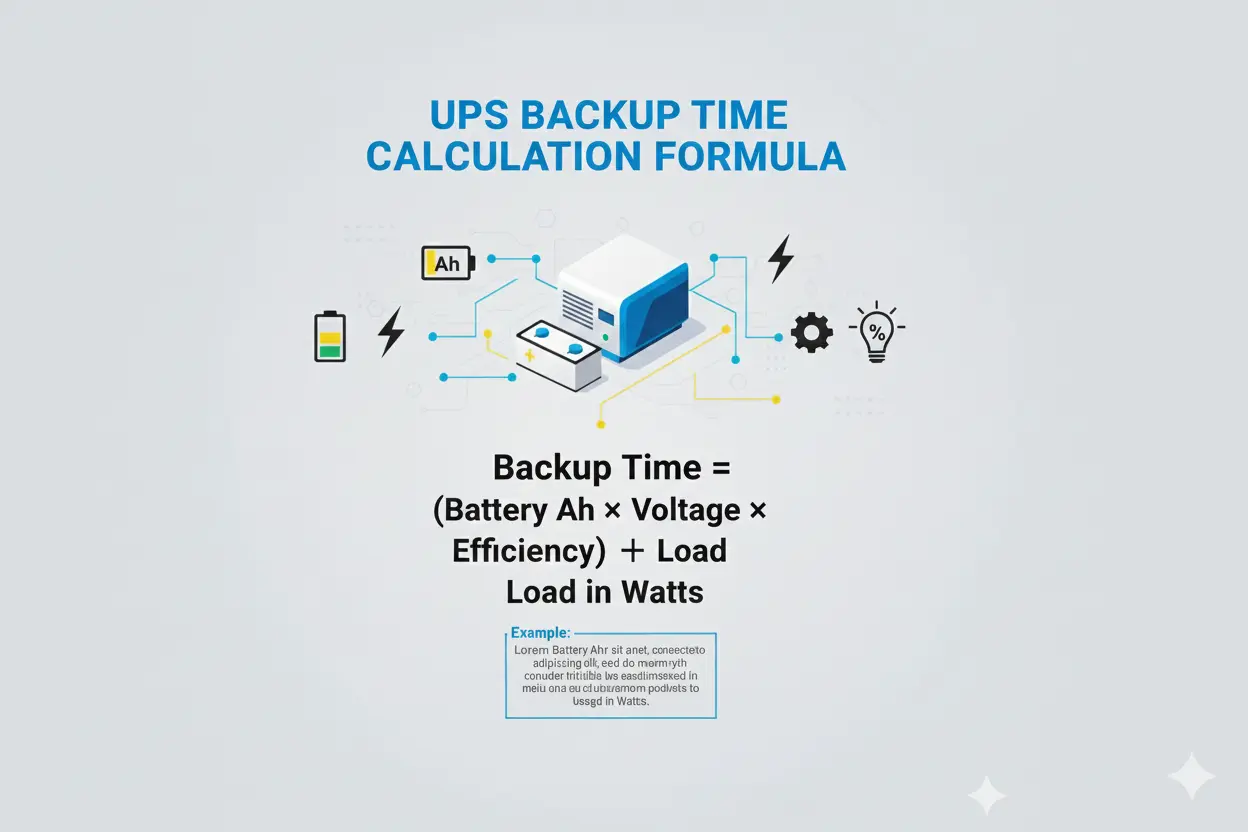
A 12V, 150Ah battery runs a 300W load for about 4.8 hours at 80% efficiency. Divide 1,440 usable watt-hours by your load in watts to get backup hours for any load.
\text{Backup time (hours)} = \frac{150 \times 12 \times 0.8}{\text{Load (W)}} = \frac{1440}{\text{Load (W)}}
Fast answers for common loads: 100W gives 14.4 hours, 200W gives 7.2 hours, 300W gives 4.8 hours, and 400W gives 3.6 hours.
If you are asking "how long will a 150Ah battery last?" or "mera 150Ah battery kitna backup dega?", add up the watts of the appliances you will run and divide 1,440 by that number. The sections below explain the numbers, give a full load chart, and show how to extend the backup.
How Much Energy Does a 150Ah Battery Store?
A 12V, 150Ah battery stores 1,800 watt-hours (Wh), found by multiplying 150Ah by 12V. At 80% efficiency, about 1,440Wh reaches your appliances.
|
Quantity |
Value |
|
Rated capacity |
150Ah |
|
System voltage |
12V |
|
Stored energy (150 × 12) |
1,800Wh (1.8kWh) |
|
Usable energy at 80% efficiency |
1,440Wh |
|
Usable energy at 70% efficiency |
1,260Wh |
|
Usable energy at 85% efficiency |
1,530Wh |
Efficiency covers losses in the inverter and battery. It typically falls between 0.70 and 0.85.
Depth of discharge: how much of the 150Ah should you use?
The table above assumes you drain the battery fully. Lead-acid batteries last longer when you use only part of their capacity. A common planning figure is 50% depth of discharge (DoD) for lead-acid and 80% or more for lithium. At 50% DoD, a 150Ah lead-acid battery gives about 720Wh of usable energy, so halve every backup time in the chart below if you want to protect battery life. Check the battery datasheet for its recommended DoD.
How to Calculate 150Ah Battery Backup Time in 4 Steps
- Find your total load. Add the watts of every appliance you will run together.
- Calculate stored energy. 150Ah × 12V = 1,800Wh.
- Apply efficiency. 1,800Wh × 0.8 = 1,440Wh usable (use 0.7 for an older system, 0.85 for a good one).
- Divide by the load. 1,440 ÷ load in watts = backup time in hours.
Worked example: a 250W load gives 1,440 ÷ 250 = 5.76 hours, so plan for about 5.5 hours.
Reverse calculation: to find the maximum load for a target backup, divide 1,440 by the hours you want. For 6 hours of backup, the maximum load is 1,440 ÷ 6 = 240W.
Using amps instead of watts: if you know the current drawn from the battery, backup time is roughly 150Ah × 0.8 ÷ amps. At 20A, that is 150 × 0.8 ÷ 20 = 6 hours.
150Ah Battery Backup Time Chart (12V, 80% Efficiency)
Use this 150Ah battery load chart for an instant answer. The full-capacity column uses all 1,440Wh; the 50% DoD column shows backup if you use half the battery to protect a lead-acid battery's life.
|
Load (W) |
Full capacity (hours) |
50% DoD (hours) |
|
50W |
28.8 |
14.4 |
|
100W |
14.4 |
7.2 |
|
150W |
9.6 |
4.8 |
|
200W |
7.2 |
3.6 |
|
250W |
5.8 |
2.9 |
|
300W |
4.8 |
2.4 |
|
400W |
3.6 |
1.8 |
|
500W |
2.9 |
1.4 |
|
600W |
2.4 |
1.2 |
|
800W |
1.8 |
0.9 |
|
1000W |
1.4 |
0.7 |
Real-world backup is usually 10% to 20% lower than these figures. For a 400W load, expect roughly 3 to 3.6 hours on a fully charged 150Ah battery.
150Ah Battery Backup for Home, Work and Shop: Real Examples
These examples use typical wattages (fan 65W, LED tube 20W, router 12W, LED TV 100W, desktop 200W, CCTV camera 11W) and 1,440Wh usable energy.
|
Scenario |
Devices |
Load |
Backup |
|
Home essentials |
2 fans, 2 tube lights, router |
182W |
about 7.9 hours |
|
Home with TV |
2 fans, 2 tube lights, router, LED TV |
282W |
about 5.1 hours |
|
Work from home |
Desktop PC, router, 1 fan, 1 tube light |
297W |
about 4.8 hours |
|
Small shop with CCTV |
4 cameras, 2 tube lights, 2 fans, router |
226W |
about 6.4 hours |
|
Heavy load |
Mixed appliances |
400W |
about 3.6 hours |
Check each appliance label for exact watts. Motor loads such as refrigerators and ACs draw extra power at startup, so a 150Ah battery is not a good fit for running an AC.
Why Your 150Ah Battery Gives Less Backup Than Calculated
Real backup is typically 10% to 20% lower than the formula result. Five factors cause the gap:
- Battery age and health. An old battery delivers less than 150Ah.
- Battery type. Tubular batteries give strong backup, lithium gives the highest efficiency, and flat plate gives less.
- Load changes. Switching on one more appliance during an outage cuts backup time immediately.
- Temperature. High heat reduces performance and shortens battery life.
- Inverter efficiency. Cheaper inverters waste more energy as heat, so less reaches your devices.
A full charge before the outage also matters: a battery that starts at 80% charge gives only 80% of the backup.
How to Increase 150Ah Battery Backup Time
The fastest way to extend backup is to cut the load or add stored energy. Options, from cheapest to most involved:
- Reduce the load. Switch to LED lights and run only essential fans. Cutting 300W to 200W raises backup from 4.8 to 7.2 hours.
- Replace an old battery. A weak battery wastes your 150Ah rating.
- Add a second 150Ah battery. Two batteries in parallel on a 12V system give 300Ah, so a 300W load runs about 9.6 hours. Two batteries in series on a 24V system store the same energy (150Ah × 24V × 0.8 = 2,880Wh) and also give about 9.6 hours at 300W. Make sure your inverter supports the system voltage and use identical, same-age batteries.
- Switch to lithium. Lithium allows a deeper usable discharge and higher efficiency than lead-acid.
- Keep the battery cool and charged. Avoid hot rooms and top up before expected outages.
Series wiring adds voltage and keeps Ah the same. Parallel wiring adds Ah and keeps voltage the same. Always match the battery bank voltage (12V, 24V or 48V) to your UPS or inverter.
Looking for a 150Ah Battery? Lento Options
If your calculation shows you need a reliable 150Ah battery, Lento offers batteries built for heavy loads, long-duration backup, off-grid use and solar plus UPS compatibility. Lento states that its high-efficiency design can add 10% to 15% more backup time for the same load.
|
Model |
Capacity |
Type |
Perfect for |
|
Lento 150Ah Tubular |
150Ah |
Tall tubular |
Home UPS, shops |
|
Lento Solar UPS Battery |
12V, 150 to 220Ah |
Tubular |
Solar + UPS combo |
|
Lento 200Ah Tubular |
200Ah |
Tall tubular |
Long backup use |
|
Lento Li-ION UPS Battery |
24V / 48V |
Lithium |
Offices, critical systems |
Lento batteries are highlighted for higher efficiency, longer life cycles, low maintenance, faster charging and pure lead technology for deeper backup. If you need more than a 150Ah battery can give for your load, compare the 200Ah and lithium options above.
150Ah Battery Backup Time FAQs
1. How do you calculate 200Ah battery backup time?
For a 12V 200Ah battery, nominal energy is 2,400Wh. Estimate backup time by dividing usable battery energy by the total load in watts, accounting for inverter losses and battery discharge limits.
2. How long does a 150Ah battery last with 2 fans?
A 12V 150Ah battery may run two typical 50W fans for approximately 7–9 hours with a lead-acid battery. Actual backup depends on fan wattage, battery condition and inverter efficiency.
3. Is there a battery backup time calculation table?
Yes. A battery backup table estimates runtime for different battery capacities and loads. For accurate estimates, include battery voltage, usable capacity, battery type and inverter efficiency.
4. How do you calculate 150Ah lithium-ion battery backup time?
Multiply battery voltage by its Ah capacity to calculate nominal energy in watt-hours. Divide usable energy by the load in watts, accounting for inverter efficiency and the lithium battery’s usable discharge limit.
5. What is the 150Ah battery backup time in India?
Backup time depends on the battery’s voltage, type and connected appliances rather than location. A 12V 150Ah battery stores approximately 1,800Wh of nominal energy.
6. How do you calculate 150Ah battery backup time for a 12V battery?
A 12V 150Ah battery stores approximately 1,800Wh of nominal energy. Divide usable energy by the connected load to estimate backup hours.
7. How long does a 150Ah battery last with 4 fans?
If four fans consume 50W each, the total load is 200W. A 12V 150Ah lead-acid battery may provide around 5–7 hours of practical backup, depending on battery condition and inverter efficiency.
8. How do you calculate 100Ah battery backup time?
A 12V 100Ah battery stores approximately 1,200Wh of nominal energy. Actual backup depends on the load, battery chemistry, usable capacity and inverter efficiency.
Final Takeaway
A 12V, 150Ah battery gives backup hours equal to 1,440 divided by your load in watts.
- 100W runs about 14.4 hours, 200W about 7.2 hours, 300W about 4.8 hours and 400W about 3.6 hours.
- Expect real backup to be 10% to 20% lower than calculated.
- For longer life, use only 50% of a lead-acid battery, which halves the figures.
- To extend backup, cut the load, replace old batteries, add a second battery or move to lithium.
- Match battery bank voltage to your UPS or inverter before upgrading.
Run your own appliance total through the formula before you buy, and you will never have to guess your backup again.
Read More:-
Top 10 Inverter Brands in India (2026)