
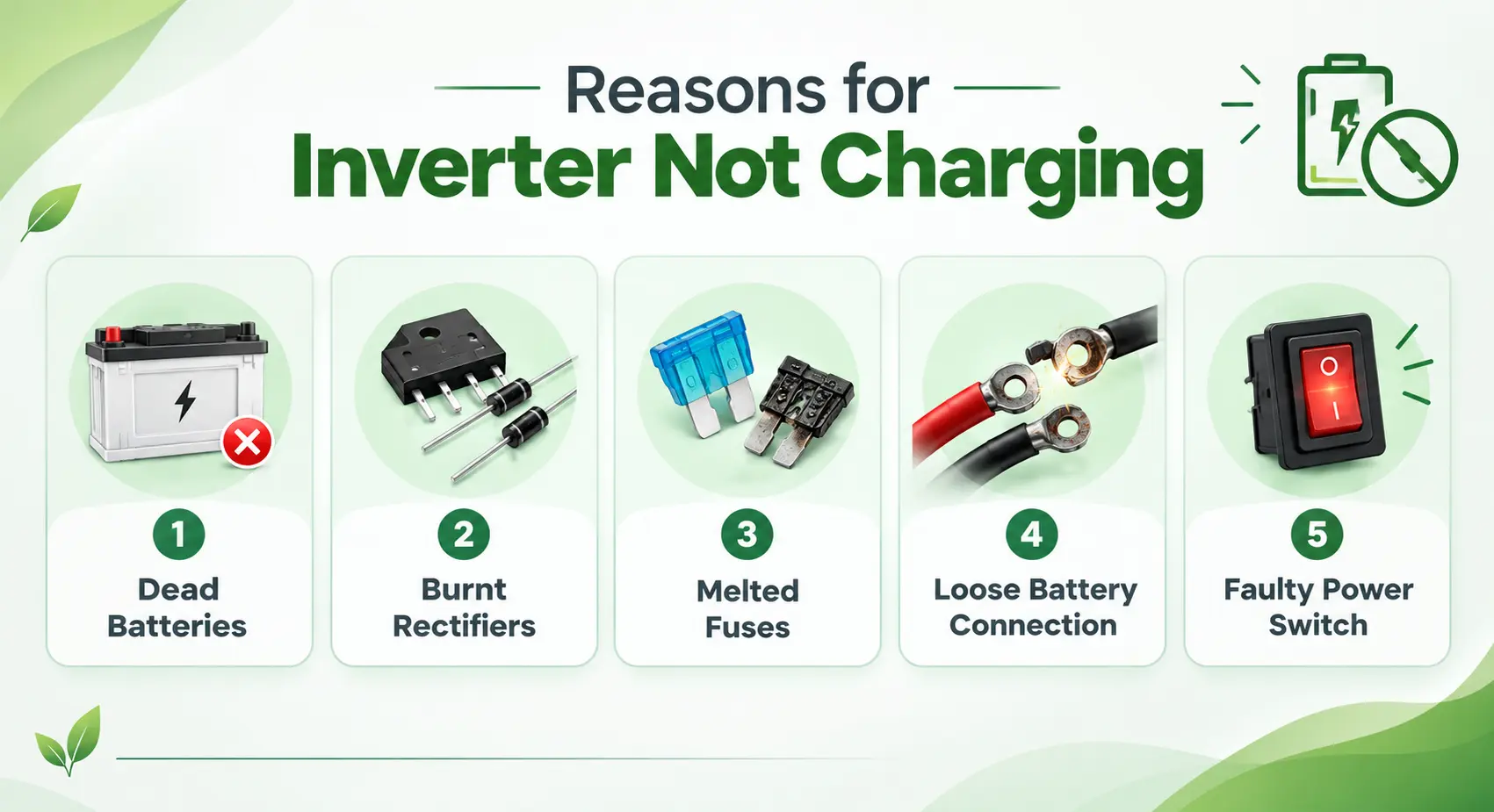
5 Reasons for Inverter Not Charging (and How to Fix Each One)
15 October 2026
Why Is My Inverter Not Charging?
An inverter stops charging its battery for five main reasons: low or unstable grid power, a weak or aged battery, loose or corroded wiring, incorrect settings or overload, and an internal inverter fault such as charging circuit failure. Check them in that order. Most cases are solved at the first three, without replacing the inverter.
What Does “Inverter Not Charging” Mean?
An inverter not charging means the unit is not sending current to the battery while mains (grid) power is available. You may see the battery indicator stuck, shorter backup time, or no charging light. This is also described as an inverter battery not getting charged or a battery charging issue.
An inverter charging problem can come from the grid, the battery, the wiring, the settings, or the inverter itself. Finding the source is the key to inverter troubleshooting.
Common signs:
- Backup time is much shorter than before
- Battery level does not rise with mains on
- Frequent low-battery alarms
- Heat, buzzing, or burning smell
- Error codes or a blinking fault light
Reason 1: Low or Unstable Grid Power
Short answer: If the input voltage is below the inverter’s minimum charging threshold, the inverter may keep running but stop charging the battery.
This is the most overlooked cause of an inverter battery charging problem. People blame the inverter, but the issue starts at the mains supply. Low voltage, heavy fluctuations, or short supply windows prevent proper charging, especially at peak load hours.
How to confirm:
- Check whether lights flicker or heavy appliances struggle to start
- Measure mains voltage with a multimeter or the inverter’s display
- Compare it with the input range in your manual
Solution:
- Install a suitable voltage stabilizer
- Ask your electricity provider about supply quality
- Avoid running heavy loads during short grid windows
Reason 2: Inverter Battery Problem (Age, Water Level, Sulphation)
Short answer: A worn-out, sulphated, or low-water battery can refuse to accept charge, which makes it look like the inverter is at fault.
A large share of inverter battery problem cases come from the battery itself. Plates wear out, electrolyte drops, and capacity falls over time. When this happens, the battery is not charging fully or at all. This is a classic inverter battery fault.
Common battery-related causes:
- Low water level in tubular batteries
- Sulphation from long undercharging
- Internal short circuit or physical damage
- Battery capacity too small for the load
How to confirm: A healthy 12V battery typically rests around 12.6 to 12.8V when fully charged. A reading well below that after hours of charging suggests a weak battery. Always check your manufacturer’s guidance.
Solution:
- Top up distilled water in tubular batteries
- Clean the terminals
- If the battery is four to five years old and keeps failing, replacement usually beats repeated inverter battery repair
Reason 3: Loose, Corroded, or Incorrect Wiring
Short answer: Loose terminals, corrosion, undersized cables, or reversed polarity increase resistance and block charging current.
Poor connections cause many a battery charging problem without shutting the inverter down, so the issue stays hidden. Corrosion at battery terminals restricts current, and thin cables overheat and waste power. Rushed commercial installations often show repeated inverter not charging battery complaints for this reason.
Solution (safe steps):
- Switch off the inverter and disconnect from mains
- Disconnect the battery terminals carefully
- Clean corrosion with a wire brush and a baking soda solution
- Reconnect firmly and confirm correct polarity (+ to +, − to −)
- Check that cable thickness matches the inverter rating
Sometimes this simple fix is the complete inverter battery not charging solution.
Reason 4: Wrong Settings or Excessive Load
Short answer: An incorrect battery type setting or a heavy connected load can reduce or stop battery charging.
Modern inverters allow different charging modes, battery types, and load priorities. Selecting SMF when you use tubular batteries changes the charging voltage and current. A heavy load can also divert power away from the battery, which is a frequent reason behind an inverter battery not charging during short grid supply.
How to fix inverter charging problem caused by settings:
- Confirm the battery type (tubular, SMF, lithium) in the settings
- Switch off non-essential appliances while charging
- Check the charging current limit
- Reset to factory defaults if unsure, then reconfigure
Reason 5: Inverter Fault or Charging Circuit Failure
Short answer: If grid power, battery, wiring, and settings are all fine, the charging circuit or control board inside the inverter has likely failed.
An internal inverter fault is the most serious cause. Overheating, dust, aging components, and voltage spikes can damage the charging circuit. In solar inverters and online UPS systems, sensors and control boards can also halt charging as a protection measure.
Related causes to rule out:
- Overheating: poor ventilation or direct sun triggers thermal protection that pauses charging
- Solar side issues: dirty or shaded panels, damaged cables, or a faulty solar charge controller can stop charging even in daylight
Solution: Do not keep running a faulty unit, since it can worsen the damage. Get a professional diagnosis. Older inverters with a failed charger may be cheaper to replace than repair. Compare options in our inverter range, Online UPS systems, and solar panels.
Inverter Troubleshooting Checklist
| Step | Check | Healthy result |
|---|---|---|
| 1 | Mains voltage | Within the inverter’s input range, stable |
| 2 | Battery age and water level | Under 4–5 years, water at correct level |
| 3 | Terminals and cables | Clean, tight, correct polarity |
| 4 | Battery type setting | Matches installed battery |
| 5 | Connected load | Not overloaded during charging |
| 6 | Temperature and ventilation | Cool, dry, dust-free |
| 7 | Solar panels and controller (if solar) | Clean, unshaded, working |
| 8 | Error codes | None, or documented in the manual |
Call a technician immediately if you notice burning smells, smoke, swelling battery casing, unusual noise, or repeated error codes.
Repair or Replace: Quick Decision Guide
| Situation | Best option |
|---|---|
| Low water, dirty terminals | Basic maintenance and repair |
| Mild sulphation | Try reviving, then retest |
| Battery over 4–5 years, weak backup | Replace the battery |
| Failed charging circuit on an old inverter | Replace the inverter |
| Failed charging circuit on a newer inverter | Professional repair |
Prevent Future Charging Issues
- Check tubular battery water every 3 to 4 months
- Keep terminals clean and tight
- Install in a cool, ventilated space
- Use the correct battery capacity for your load
- Use a stabilizer in low-voltage areas
- Schedule periodic professional inspection
Frequently Asked Questions
1. Why is my inverter showing mains on but not charging?
Your inverter may detect the mains power supply but fail to charge the battery due to a faulty charger circuit, loose connections, incorrect battery settings, or a damaged battery. Check the inverter's charging settings and contact a technician if the issue continues.
2. Why is my inverter charging light not blinking?
The charging light may remain off or stop blinking when the battery is fully charged, charging is disabled, or the inverter has a charging fault. Check the user manual to understand what the indicator means for your inverter model.
3. Why is my inverter not charging due to low voltage?
Low input voltage from the mains supply may prevent some inverters from charging properly. Other possible causes include a deeply discharged battery, loose wiring, or a faulty charging circuit. Check the input voltage and consult a technician if needed.
4. Why is my inverter battery not charging fully?
An inverter battery may not reach full charge because of insufficient charging time, incorrect charging settings, frequent power cuts, sulphation in lead-acid batteries, or reduced battery capacity. Check the battery type and charging settings recommended by the manufacturer.
5. Why is my inverter not charging with electricity?
If mains electricity is available but the battery is not charging, the issue could be a blown fuse, a faulty charging circuit, loose connections, or a damaged battery. Have the inverter and battery tested by a qualified technician.
6. Why is my solar inverter not charging the battery?
A solar inverter may not charge the battery because of insufficient sunlight, faulty solar panel connections, incorrect battery settings, a solar charge controller fault, or a battery protection cutoff. Check the solar generation and inverter error indicators, and arrange professional inspection if the problem persists.
Key Takeaways
- An inverter not charging is usually caused by grid, battery, wiring, settings, or internal faults
- Check the simple causes first: voltage, terminals, water level, and settings
- A battery over four to five years old is the most frequent inverter battery fault
- A failed charging circuit needs professional diagnosis
- Regular maintenance prevents most battery charging problems
Lento India – Global B2B Solar Exporter
Lento India exports solar and power solutions to 24 countries, including Mexico, Chile, Peru, Ecuador, Dominican Republic, Afghanistan, Nigeria, Iraq, Uganda, Yemen, Syria, Iran, Oman, Morocco, Egypt, and Kuwait. We supply solar panels, tubular batteries, SMF batteries, inverters, and Online UPS systems to distributors, OEMs, and large-scale installers.
Share your requirements through our contact form and our export team will respond within 24 hours.
Read More
- Which Brand Tubular Battery Is Best? Buying Guide for Indian Homes
- How to Revive a Dead Tubular Battery
- Can You Revive a Completely Dead Battery?
- How to Revive a Dead Tubular Battery at Home: Safe Step-by-Step Guide
- Top 10 Inverter Batteries in India: Best Tubular, SMF and Lithium Options for Home Backup
- 150Ah Battery Backup Time Calculator: How Many Hours Will It Run? (Formula + Chart)
- Inverter Capacity for 200Ah Battery: Formula, Chart & Calculator
- Suitable Inverter for 200Ah Battery: The 6-Point Compatibility Guide