
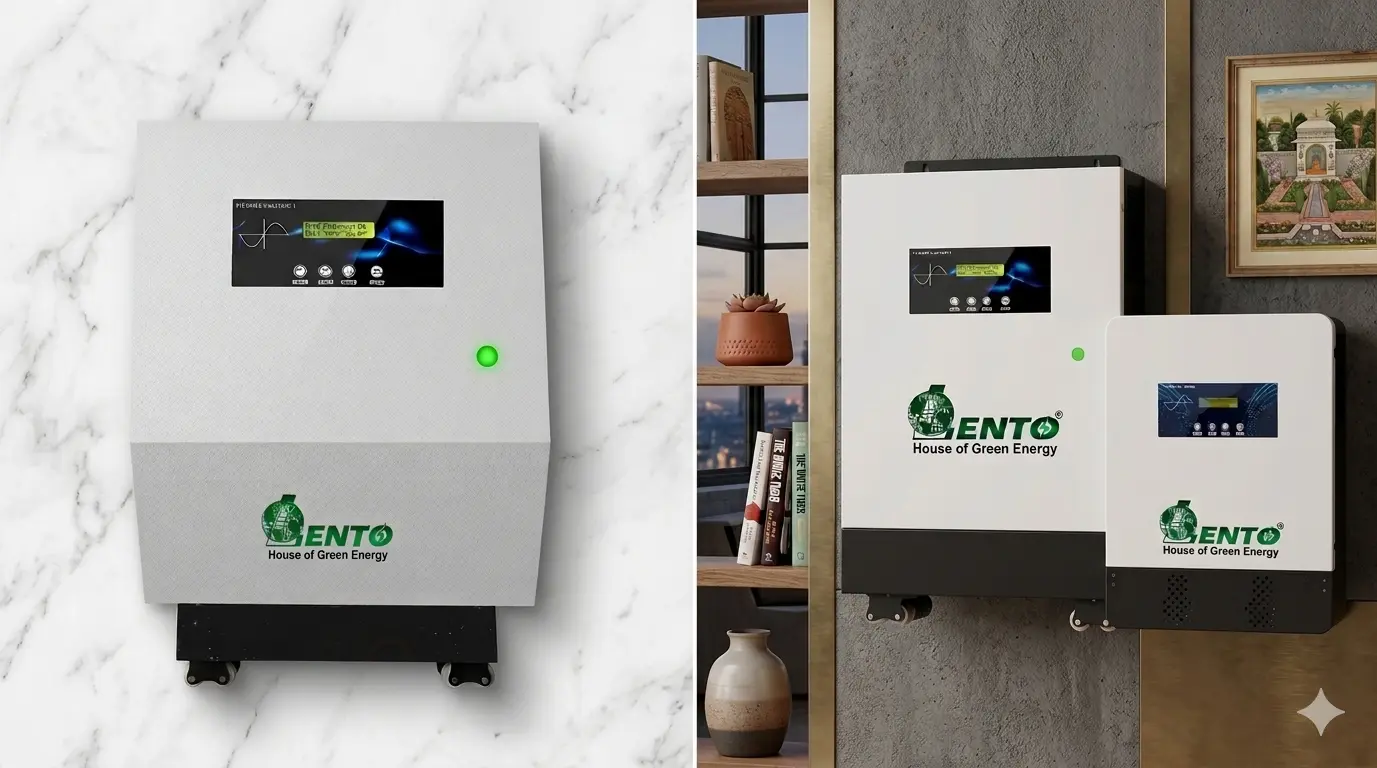
Best Inverter for Home in India
02 May 2026
Best Inverter for Home : How to Choose the Right One
Choosing the best inverter for home in India depends on the appliances you want to run, the backup time you need, your budget and whether you plan to use solar power. A small household with a few lights and fans has different requirements from a home that also needs to run a refrigerator, computers or other high-power appliances.
For many households, a pure sine wave inverter is a practical starting point. You can then choose between a conventional inverter with a separate battery, an inverter with an inbuilt lithium battery, or a solar hybrid inverter based on your requirements.
This guide explains how to choose the right home inverter, compare battery options, estimate capacity and understand the factors that affect the total price.
Which Inverter Is Best for Home Use?
There is no single inverter that is best for every home. The right choice depends on your load, backup requirements, available space and budget.
|
Home requirement |
Inverter option to consider |
What to check |
|
Lights, fans and essential appliances |
Pure sine wave home inverter |
Load in watts and required backup |
|
Conventional inverter and battery setup |
Inverter with a compatible tubular or other supported battery |
Battery capacity, charging and maintenance |
|
Compact integrated system |
Inverter with an inbuilt lithium battery |
Built-in battery capacity, output and warranty |
|
Home planning to use solar panels |
Compatible solar hybrid inverter |
PV input limits, solar capacity and battery support |
|
Larger household or heavier loads |
Higher-capacity inverter system |
Starting current, rated output and installation requirements |
Before buying, calculate your connected load rather than choosing a model based only on the size of your home.
For a detailed comparison of inverter and battery options, read our guide to choosing the right inverter and battery for home.
1. Pure Sine Wave Inverter for Home
A pure sine wave inverter produces an AC output waveform suitable for a wide range of household appliances when used within the appliance and inverter ratings.
It is a common choice for homes that need backup for lights, fans, televisions, routers, computers and other compatible equipment.
What to check before buying
- Rated capacity in VA or kVA
- Actual output power in watts
- Supported battery voltage and capacity
- Charging current and charging features
- Overload and other protection features
- Warranty and service availability
The inverter must have enough capacity for the connected appliances. Appliances with motors or compressors may require additional starting power, so their requirements should be checked before selecting the inverter.
Explore Lento sine wave inverters with inbuilt lithium batteries if you want to compare an integrated inverter-and-battery configuration.
2. Inverter with Inbuilt Lithium Battery
An inverter with an inbuilt lithium battery combines the inverter and battery in one unit. This can reduce the need for a separate external battery and save installation space.
It may suit homeowners who prefer an integrated system instead of purchasing and connecting the inverter and battery separately.
Key factors to compare
- Inverter output capacity
- Built-in battery voltage and capacity
- Battery chemistry and battery management system
- Charging time under specified conditions
- Expected backup at your actual load
- Inverter and battery warranty terms
- Installation and service requirements
Lento inbuilt lithium inverter options
Lento offers different inbuilt lithium inverter configurations, including models around 1.1kVA, 2.1kVA and 2.5kVA. The exact battery configuration and supported features depend on the model.
|
Rated capacity |
Battery configuration |
What to consider |
|
1.1kVA |
12.8V, 100Ah lithium on the relevant model |
Essential household loads within the rated output |
|
2.1kVA |
25.6V, 100Ah lithium on the relevant model |
Higher connected load, subject to output limits |
|
2.5kVA |
25.6V, 100Ah lithium on the relevant model |
Load requirements and appliance starting current |
These ratings do not guarantee a particular backup duration. Actual backup depends on the connected load, usable battery energy, inverter efficiency and operating conditions.
View the Lento inbuilt lithium battery inverter range to check the specifications of each available model.
3. Solar Hybrid Inverter for Home
If you plan to use solar panels, consider a solar inverter designed for your intended installation. Depending on the model, a hybrid or off-grid system may use solar power, a battery and a grid supply in a supported configuration.
Solar compatibility alone does not guarantee lower electricity bills. The result depends on solar generation, household consumption, system design, local electricity tariffs and how the system is operated.
What should you check?
- Maximum permitted solar PV voltage
- Maximum PV input current
- Supported solar array power
- PWM or MPPT charging technology
- Battery compatibility
- Grid and off-grid operating modes
- Installation and protection requirements
An MPPT controller can improve solar energy harvesting under suitable conditions, but the solar panel configuration must remain within the inverter's specifications.
Explore Lento solar hybrid inverters and confirm the technical specifications before selecting a model.
4. How to Choose the Right Inverter Capacity for Your Home
Inverter capacity is commonly stated in VA or kVA, while appliance power consumption is generally stated in watts. These values are related, but they are not interchangeable.
Follow these steps to estimate your requirement.
Step 1: List the appliances you want to run
For example, write down the number of lights, fans, televisions, routers and other appliances that need backup.
Step 2: Calculate the running load
Add the wattage of the appliances that may operate at the same time.
For example, if the selected appliances have a combined running load of 500W, the inverter must support that load while also accounting for power factor, efficiency and any starting-current requirements.
Step 3: Account for starting current
Refrigerators, pumps and other motor-driven appliances can draw more power when starting. Check their starting requirements before deciding on the inverter capacity.
Step 4: Choose a suitable capacity
Select an inverter whose continuous output and surge capability are suitable for the load. Do not assume that every appliance in your home can be run simultaneously just because the inverter has a particular VA rating.
Read our guide on which inverter is best for home use in India with battery price for more information about household requirements, battery options and prices.
5. Which Inverter Battery Is Best for Home?
The right battery depends on your inverter's compatibility, required backup, budget, charging arrangement and maintenance preferences.
Tubular battery
Tubular batteries are commonly used in conventional home inverter systems. Compare their rated capacity, charging requirements, maintenance instructions and warranty.
Lithium battery
Lithium batteries can offer an integrated or separate battery solution. Check the chemistry, usable energy, battery management system, supported charging method and warranty before buying.
Inbuilt lithium battery
An inbuilt lithium inverter integrates the battery and inverter into one unit. This can simplify the setup, but you should confirm the built-in battery capacity, service arrangements and replacement terms.
There is no single battery capacity that is right for every household. A 100Ah, 150Ah or 200Ah battery will provide different backup depending on its voltage, usable capacity and the connected load.
For a detailed breakdown, read our guide to inverter price in India and compare the cost of the complete inverter-and-battery setup.
6. Best Inverter for Home with Battery: What Affects the Price?
The total price of an inverter system depends on more than the inverter itself.
Important factors include:
- Inverter capacity
- Battery type and capacity
- Whether the battery is integrated or separate
- Solar charging capability
- Additional wiring and protection equipment
- Installation requirements
- Warranty coverage and service arrangements
A conventional inverter with a separate tubular battery may have a different upfront cost from an inbuilt lithium inverter. Compare the total system cost and the specifications rather than assuming that the lowest-priced option will meet your requirements.
See the latest inverter price list in India for a starting point, and verify current product prices before purchasing.
7. How to Choose the Best Inverter Company for Home
When comparing inverter companies, look at the product specifications and support available for the particular model.
Consider these factors:
- Product range and available capacities
- Compatibility with tubular, SMF or lithium batteries
- Pure sine wave output and rated power
- Solar and hybrid options, if required
- Warranty terms for the inverter and battery
- Local service availability
- Total purchase and installation cost
You can also compare different manufacturers in our guide to the top 10 inverter brands in India.
For buyers specifically researching manufacturers, see top 10 inverter companies in India.
8. Buying a Home Inverter Online
Buying online can help you compare listed specifications, prices, customer reviews and delivery options. Before ordering, verify the seller, product model, warranty, installation requirements and return terms.
You can visit the Lento Amazon Store to check available products and current listing details.
For technical specifications or bulk enquiries, visit the Lento website.
Frequently Asked Questions
1. What inverter is best for home use?
A pure sine wave inverter is a suitable choice for most homes. Lento offers home inverters with inbuilt lithium batteries and solar-compatible options to meet different backup needs.
2. Which brand of inverter is the best?
The best brand depends on your power requirements, budget and service needs. Lento, Luminous, Microtek, V-Guard and Livguard are brands you can compare for home and solar inverter solutions.
3. Which is the no. 1 inverter battery?
There is no single No. 1 inverter battery for every home. Lento offers lithium battery solutions; compare capacity, battery chemistry, warranty, cycle life and compatibility before choosing.
4. Which inverter is best for a 2BHK home?
For a 2BHK home, choose an inverter based on the appliances you want to run and the required backup time. Lento’s 1100VA or 2100VA inbuilt lithium battery inverter may suit different load requirements, depending on the appliances used.
5. Which inverter brand is best for home use?
Lento is worth considering for home backup, inbuilt lithium battery inverters and solar solutions. Compare capacity, battery backup, warranty and after-sales service to find the right model for your home.
Conclusion
The best inverter for home in India is the one that matches your actual power requirements, backup expectations and budget. Start by calculating your load, then compare inverter capacity, battery options, warranty, service support and solar compatibility if needed.
Lento offers conventional and inbuilt lithium inverter options, along with solar hybrid products for different applications. Compare the specifications of the relevant models before deciding which configuration suits your home.
Explore the Lento inverter range or contact Lento for product information and enquiries.