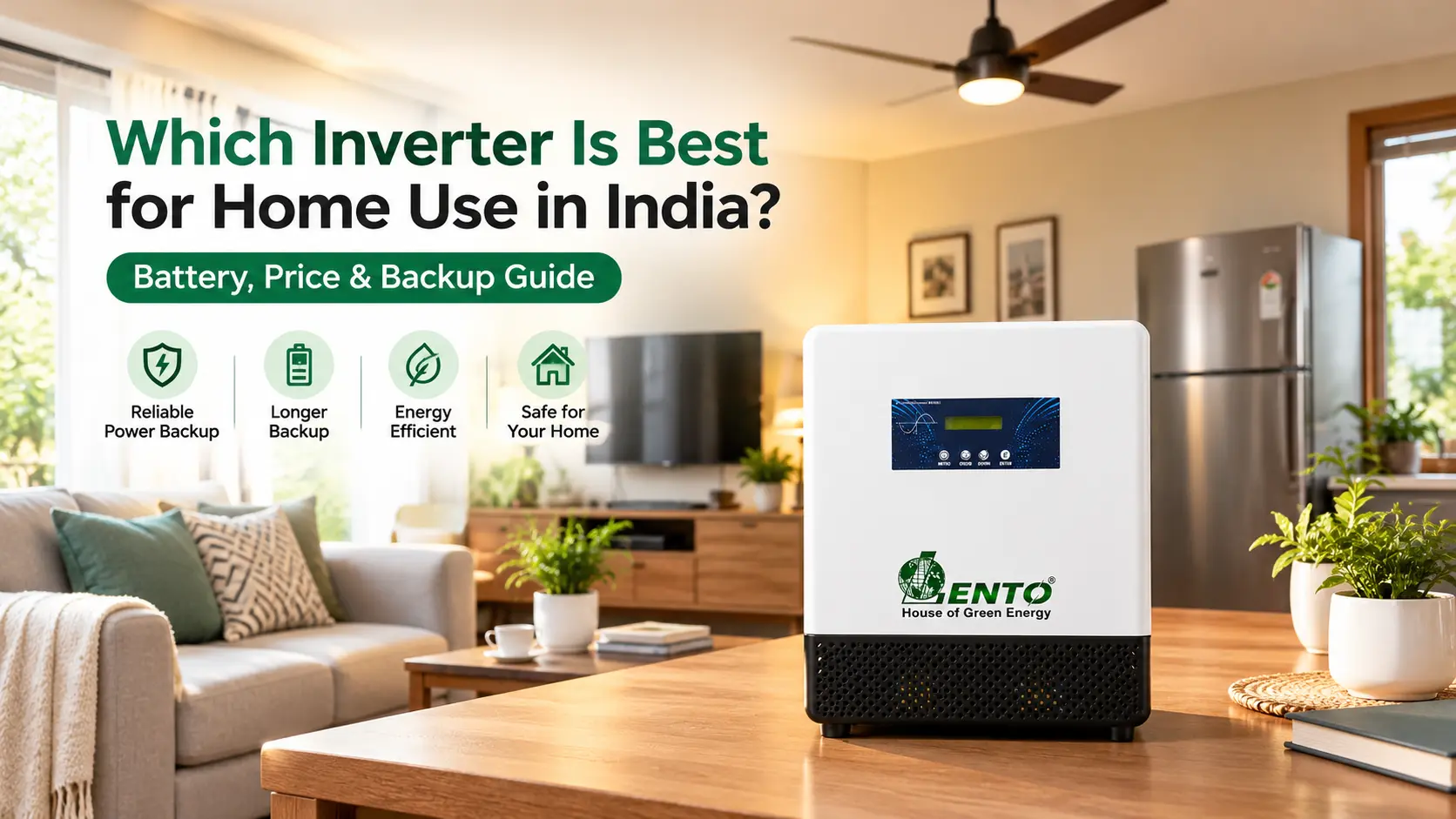
Which Inverter Is Best for Home Use in India? Battery, Price & Backup Guide
23 July 2026
Choosing the best inverter for home use in India depends on four main factors: your total load, required backup time, battery type, and budget.
For many homes, a pure sine wave inverter with a 150Ah or 200Ah tubular battery is a practical combination for regular power backup. An inbuilt lithium battery inverter can be a better option if you want a compact setup, faster charging, and lower routine maintenance.
A typical inverter and battery combination can cost around ₹10,000–₹28,000, depending on inverter capacity and battery size. Inbuilt lithium battery inverter systems generally cost more and may range from around ₹34,000–₹60,000, depending on capacity and configuration.
The right inverter is not necessarily the one with the highest VA rating. It should match the appliances you want to run and the amount of backup you need.
Best Inverter for Home Use: Quick Comparison
| Inverter + Battery Type | Approx. Price | Suitable For |
|---|---|---|
| 1kVA + 100Ah Tubular | ₹10,000–₹15,000 | Small homes and basic backup |
| 1kVA–1.5kVA + 150Ah Tubular | ₹15,000–₹22,000 | Regular home backup |
| 1.5kVA–2kVA + 200Ah Tubular | ₹20,000–₹28,000 | Higher household loads |
| Inbuilt Lithium Battery Inverter | ₹34,000–₹60,000 | Compact, low-maintenance backup |
| Solar + Lithium Inverter | ₹30,000+ | Homes using solar power |
Prices are approximate and can vary according to inverter capacity, battery configuration, technology, features and installation requirements.
Which Inverter Is Best for Home Use in India?
For most homes, a pure sine wave inverter is a suitable choice.
It produces a smoother AC output and can be used with common household appliances such as:
- Fans
- LED lights
- TVs
- Refrigerators
- Wi-Fi routers
- Other household electronics
The battery type is the next major decision.
Choose a Tubular Battery If
A tubular battery can make sense if:
- You want a lower initial purchase cost
- Power cuts are occasional or moderate
- You need conventional home backup
- You have enough space for a separate battery
- You prefer a widely available battery format
Choose an Inbuilt Lithium Battery Inverter If
An inbuilt lithium battery inverter can be considered if:
- You want a compact setup
- Space is limited
- Faster charging is important
- You want lower routine maintenance
- You have frequent power cuts
- You want the inverter and battery integrated into one unit
- You are planning a solar-based backup system
There is no single battery technology that is best for every household. Your usage pattern matters.
Home Inverter Price With Battery
The total price of an inverter with battery depends mainly on inverter capacity and battery capacity.
100Ah Battery + Inverter
A 100Ah battery can be suitable for smaller loads such as:
- 2–3 fans
- LED lights
- TV
- Wi-Fi router
- Small electronics
The actual backup time depends on the connected load, battery technology, battery condition and inverter efficiency.
150Ah Battery + Inverter
A 150Ah battery is a common choice for regular household backup.
It can be suitable for a combination of fans, lights, TV, refrigerator and other moderate loads, provided the total running and starting load remains within the inverter's capacity.
200Ah Battery + Inverter
A 200Ah battery provides more stored energy than a 100Ah or 150Ah battery.
It can be considered when:
- You need longer backup
- More appliances need to operate during a power cut
- Your inverter is suitable for the required battery configuration
However, increasing battery Ah does not automatically mean that every appliance can be connected. The inverter capacity and battery capacity have different functions.
1kVA, 1.5kVA or 2kVA: Which Is Best for Home?
The inverter capacity should be selected according to the appliances you want to run simultaneously.
| Inverter Capacity | Generally Suitable For |
|---|---|
| 800VA–1kVA | Lights, fans, TV and basic loads |
| 1.5kVA | Medium household loads |
| 2kVA | Higher household loads |
| 2.5kVA–3kVA | High-load homes and larger appliances |
Before purchasing, make a list of the appliances you want to operate during a power cut.
For example:
| Appliance | Approx. Load |
|---|---|
| 3 Fans | 210W |
| 4 LED Lights | 40W |
| TV | 100W |
| Wi-Fi Router | 10W |
| Refrigerator | 150W |
| Example Total | 510W |
These figures are only examples. Actual appliance consumption varies by model.
Also consider the starting load of refrigerators, pumps, motors and other appliances before choosing the inverter capacity.
Inverter Capacity vs Battery Capacity: What's the Difference?
This is one of the most important things to understand before buying an inverter.
Inverter VA/kVA tells you how much load the inverter can handle.
Battery Ah tells you how much electrical energy the battery can store.
For example, simply buying a larger 200Ah battery does not mean that the inverter can operate a high load. The inverter must also have sufficient capacity.
Similarly, choosing a very high-capacity inverter with a small battery may not provide the backup duration you expect.
The right system balances:
- Load
- Inverter capacity
- Battery capacity
- Required backup time
- Battery voltage
- Budget
How Much Does a Home Inverter With Battery Cost?
A basic inverter-battery combination can start at around ₹10,000–₹15,000.
A 150Ah–200Ah tubular battery combination can typically fall around ₹15,000–₹28,000.
Inbuilt lithium battery inverter systems generally have a higher initial price and can range around ₹34,000–₹60,000, depending on inverter capacity and battery configuration.
The final price can change based on:
- Inverter capacity
- Battery capacity
- Battery technology
- Pure sine wave technology
- Solar compatibility
- Charging technology
- Protection features
- Warranty
- Installation requirements
So, when comparing inverter prices, compare the complete inverter + battery configuration, not just the inverter price.
Tubular Battery vs Lithium Battery for Home Inverter
Both battery technologies can work well, but they suit different requirements.
| Factor | Tubular Battery | Lithium Battery |
|---|---|---|
| Initial Cost | Lower | Higher |
| Weight | Heavier | Lighter |
| Maintenance | Water top-up required | Low routine maintenance |
| Charging | Standard | Faster charging possible |
| Space | Requires more space | More compact |
| Frequent Use | Suitable | Suitable |
| Solar Integration | Suitable | Suitable |
Lithium batteries generally offer longer cycle life and lower routine maintenance, while tubular batteries remain a practical choice when initial cost and conventional home backup are the main priorities.
What Is the Best Battery for a Home Inverter?
For a conventional home inverter, 150Ah or 200Ah tubular batteries can be considered when more backup is required.
For lithium systems, the required battery capacity depends on the inverter voltage, usable energy and required backup.
The right battery should be selected according to:
- Total appliance load
- Required backup hours
- Inverter capacity
- Battery voltage
- Available space
- Charging requirements
- Budget
Don't choose a battery only because it has a higher Ah rating.
Best Inverter Battery Size for Home
100Ah
A 100Ah battery can be suitable for basic backup requirements such as:
- Lights
- Fans
- TV
- Wi-Fi router
150Ah
A 150Ah battery can be considered when you need more backup than a 100Ah battery and have a moderate household load.
200Ah
A 200Ah battery can be considered when you need greater stored energy and longer backup.
However, Ah alone does not determine backup time.
Actual backup depends on factors such as battery voltage, usable battery capacity, inverter efficiency, battery condition and connected load.
Pure Sine Wave vs Square Wave Inverter
Pure Sine Wave Inverter
- Cleaner AC output
- Suitable for modern electronics
- Better suited to refrigerators and motor-based appliances
- Suitable for most home applications
Square Wave Inverter
- Lower-cost technology
- More limited appliance compatibility
- Not generally preferred for modern household electronics
For a new home backup system, a pure sine wave inverter is generally the more suitable option.
Which Inverter Is Best for a Home With Solar?
If you already have solar panels or plan to install them, a solar or hybrid inverter may be more suitable than a standard backup inverter.
Depending on the system, you can consider:
- Off-grid solar inverter
- Hybrid solar inverter
- Hybrid inverter with lithium battery
- MPPT solar inverter
- On-grid solar inverter
The right option depends on whether you need battery backup, grid connectivity, solar charging, or solar-only generation.
MPPT technology can help extract available solar power more effectively under suitable operating conditions.
Lento Inverter Options for Home Use
Lento offers different inverter and battery configurations for residential and solar applications.
Pure Sine Wave Home Inverter
A standard pure sine wave inverter can be paired with an external tubular or lithium battery.
Sine Wave Inverter – Household
Inverter With Inbuilt Lithium Battery
An inbuilt lithium battery inverter combines the inverter and lithium battery into one unit, making it suitable for users who want a compact backup system.
Sine Wave Inverter With Inbuilt Lithium Battery
Available configurations include:
- 1100VA / 12.8V
- 2100VA / 25.6V
- 2500VA / 25.6V
Hybrid Solar Inverter
For homes that want solar charging along with battery backup, a hybrid solar inverter can be considered.
Hybrid Solar Inverter – Household
Hybrid Solar Inverter With Inbuilt Lithium Battery
An integrated lithium and solar inverter combines battery backup and solar charging in a single system.
Hybrid Solar Inverter With Inbuilt Lithium Battery
MPPT Solar Inverter
For solar applications, MPPT technology can help improve solar power harvesting under suitable operating conditions.
Hybrid Solar Inverter – MPPT Wall Mountable
How to Choose the Right Inverter for Your Home
Before buying, follow these steps:
1. Calculate Your Essential Load
List only the appliances you actually want to run during a power cut.
2. Select the Inverter Capacity
Choose the VA/kVA capacity according to your total running load and appliance starting requirements.
3. Select the Battery Capacity
Choose 100Ah, 150Ah, 200Ah or a suitable lithium configuration according to the backup duration you need.
4. Decide Between Tubular and Lithium
Choose tubular if initial cost is the main priority. Consider lithium if compact size, charging speed and lower routine maintenance are more important.
5. Check Solar Requirements
If you want solar charging, check whether the inverter supports the required solar input and charging technology.
6. Compare the Complete System Price
Compare the inverter, battery, warranty, features and installation requirements rather than comparing inverter prices alone.
Frequently Asked Questions
What inverter is best for home use?
Lento pure sine wave inverters are suitable for home use, with options for different household loads. For homes needing a compact backup system, Lento also offers inbuilt lithium battery inverter options.
Which inverter is best for a big home?
For a big home, a 2kVA–3kVA inverter may be suitable when multiple appliances need to run during a power cut. The exact capacity should be selected according to the total running and starting load rather than the size of the house alone.
What is the best inverter for home in India?
Lento pure sine wave and inbuilt lithium battery inverters are options for home backup. The best choice depends on your appliance load, required backup time, battery type, solar requirements and budget.
Which brand inverter is best in India?
There is no single inverter brand that is best for every home. Lento, Microtek, Luminous, Livguard and V-Guard are among the brands buyers can compare based on inverter capacity, battery compatibility, warranty, service and price.
Which type of inverter is best for a home?
A pure sine wave inverter is generally the best type for most homes because it is suitable for common appliances including fans, TVs, refrigerators and other electronics. For users wanting a compact setup, an inbuilt lithium battery inverter is another option.
One important change: I would not write “best inverter in India in 2026” in the answer just because the question contains 2026. Keep the content evergreen. Google also advises against unnecessary/repetitive title wording and search-engine-first content.
Conclusion
The best inverter for home use in India depends on your actual power requirement rather than simply choosing the highest VA or Ah rating.
For conventional home backup, a pure sine wave inverter with a 150Ah or 200Ah tubular battery can be a practical choice. If you want a more compact system with lithium technology, an inbuilt lithium battery inverter can be considered.
If solar is part of your plan, look at a suitable solar or hybrid inverter and check its solar input, battery compatibility and charging technology.
Before buying, calculate your essential load, decide how much backup you need, select the appropriate inverter capacity and then choose the battery.
For current pricing and different capacity options, compare the latest inverter price list in India.