
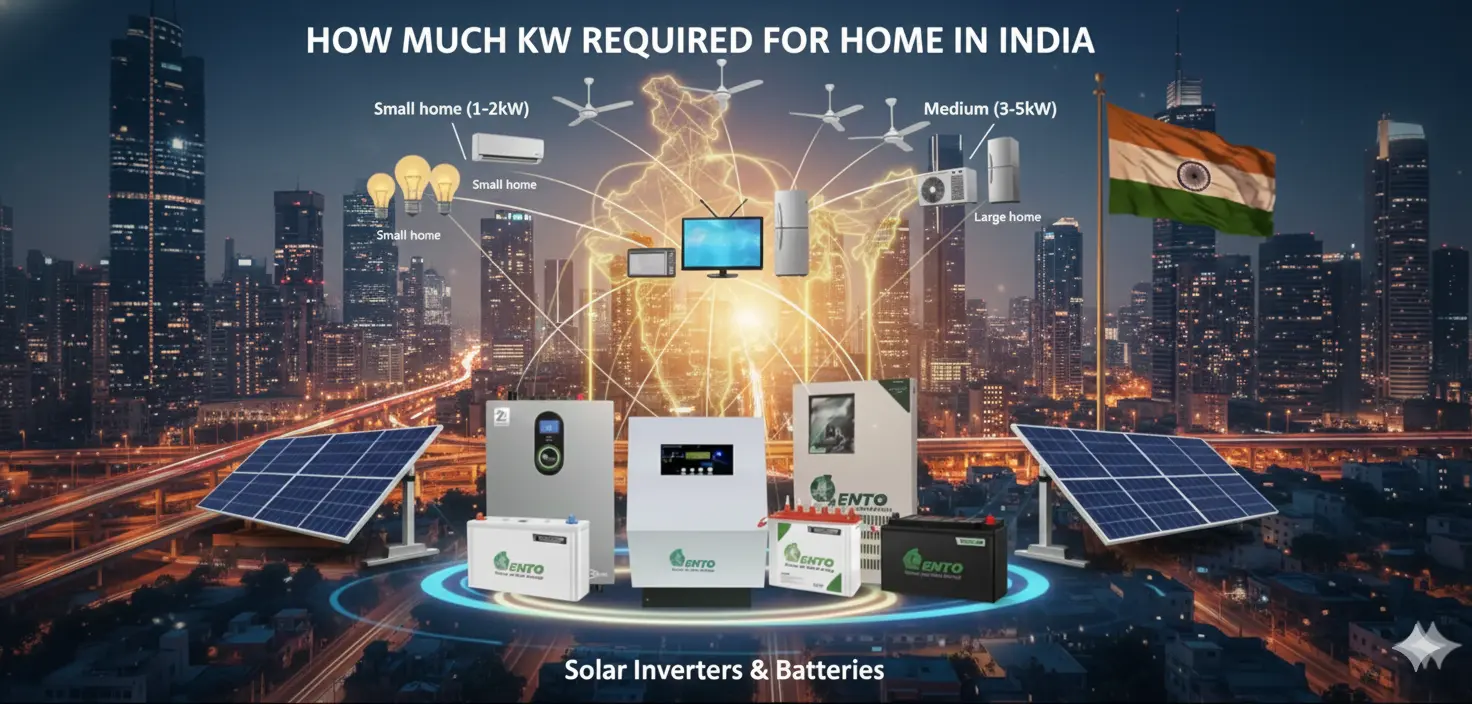
How Much kW Required for Home in India
05 December 2025
Understanding how much kilowatt (kW) power a home in India truly needs has become an essential question—especially as more families shift toward solar energy, energy-efficient appliances, and backup solutions like inverters and online UPS systems. As someone who closely works with homeowners, installers, and dealers, I’ve learned that most people are confused due to inconsistent advice, unclear calculations, and rapid changes in power consumption habits.
In this detailed guide, I’ll break everything down in a simple, conversational way. Whether you are planning a new home, upgrading your inverter, installing solar panels, or simply trying to optimize your electricity usage, this blog will help you accurately understand your home’s kW requirement.
Throughout this blog, I will also touch upon how reliable backup solutions from an online ups manufacturer, online ups supplier, and online ups trader make your energy setup more robust—especially in regions with power cuts and voltage fluctuations.
Understanding What kW Means for a Home
Before calculating the requirement, I always tell customers that kW simply means the rate at which your household consumes electricity. The higher the number of appliances and their wattage, the more kW your home needs.
But here’s the catch—your home doesn’t use all appliances at once. So the actual running load is always less than the connected load. Understanding both is crucial.
Typical Power Consumption Patterns in Indian Homes
Over the years, I’ve observed that Indian electricity usage varies widely. Urban homes use more gadgets, while rural homes focus mainly on essentials like lights, fans, and refrigerators.
Here’s a quick look at average consumption:
-
Small home (1 BHK): 1–2 kW
-
Medium home (2–3 BHK): 2–4 kW
-
Large home (4–5 BHK): 5–8 kW
-
Homes with heavy appliances (ACs, geysers, pumps): 5–10+ kW
But to know the exact number for your home, let’s go deeper.
How to Calculate kW Requirement for Your Home
I like to use a simple approach:
Add up the wattage of all essential appliances you normally use at the same time.
Step 1: Listing Common Appliances
Below is an example of typical wattage:
-
LED lights – 10 to 20 W each
-
Fans – 60 to 75 W
-
TV – 120 to 150 W
-
Refrigerator – 250 to 350 W
-
AC (1.5 ton) – 1500 to 1800 W
-
Washing machine – 500 to 800 W
-
Water pump – 750 to 1500 W
-
Geyser – 1500 to 2000 W
-
Laptop – 50 to 100 W
Step 2: Calculate Simultaneous Load
Suppose you are running:
-
6 lights
-
3 fans
-
1 LED TV
-
1 refrigerator
-
1 AC
-
1 laptop
Your total load would be:
-
Lights: 6 × 15 = 90 W
-
Fans: 3 × 70 = 210 W
-
TV: 150 W
-
Refrigerator: 300 W
-
AC: 1600 W
-
Laptop: 80 W
Total Running Load = 2430 W = 2.43 kW
For safety, I always recommend adding a 20–25% buffer.
So your required load becomes:
2.43 × 1.25 ≈ 3 kW
This method works for almost every home.
How Many kW Does an Average Indian Home Need?
After years of working in energy planning, here’s what I’ve observed:
For Small Homes (1 BHK)
Most require:
1.5–2 kW
For Medium Homes (2–3 BHK)
Most families fall in:
2–4 kW
For Large Homes (4 BHK and above)
Consumption usually reaches:
5–8 kW
If multiple ACs, pumps, or kitchen appliances run regularly, the requirement may exceed 10 kW.
How kW Requirement Affects Solar System Sizing
Homeowners often ask me, “If I know my kW requirement, can I directly choose a solar system?”
The answer is yes—because solar systems are sized based on your running load and monthly consumption.
Example Solar Sizing
If your home needs:
-
2 kW load → 2.5–3 kW solar system
-
3 kW load → 4–5 kW solar system
-
5 kW load → 6–8 kW solar system
Factors affecting solar sizing include:
-
Hours of peak sunlight in your area
-
Whether you want on-grid, off-grid, or hybrid
-
Battery backup requirements
-
Energy efficiency of appliances
A good online ups manufacturer or online ups supplier can help ensure your system is protected against voltage fluctuations and power failures.
Why Backup Solutions Matter While Calculating Home Load
Many customers underestimate the importance of backup systems. But in India, with frequent power cuts in semi-urban and rural regions, reliable backup is essential.
I always recommend pairing your home system with:
-
A robust online UPS
-
Pure sine wave inverter
-
High-capacity tubular or lithium battery
An online ups trader can guide you toward combinations that fit your home’s wattage and backup duration.
How Many kW Is Required for Solar With Battery Backup?
If you want a home solar system that can run essentials even during outages, you must calculate two things:
Your Daily Energy Use (kWh)
Example:
If you consume 12 units per day (12 kWh) → You need a 3 kW solar system.
Your Backup Requirement
If you want:
-
3–4 hours of backup → medium battery
-
6–8 hours → high-capacity battery
-
10–12 hours → lithium battery system
I’ve personally seen that lithium batteries work extremely well for modern homes, especially paired with a reliable online UPS.
Common Mistakes People Make While Calculating kW Requirement
Over the years, I’ve noticed a few repeated mistakes:
-
Adding connected load instead of running load.
-
Not accounting for AC startup surge.
-
Ignoring future appliance addition.
-
Selecting undersized solar or inverter systems.
-
Not consulting an online ups supplier for voltage-protection needs.
Avoiding these mistakes keeps your home safe and your energy bills low.
How kW Requirement Affects Inverter and UPS Choice
Your inverter capacity should always be higher than your running load. For example:
-
2 kW load → 2.5–3 kVA inverter
-
3 kW load → 3.5–4 kVA inverter
-
5 kW load → 6–7.5 kVA inverter
If voltage fluctuations are common in your area, a reliable online ups manufacturer can help you choose a system that gives uninterrupted protection.
Lento India – Global B2B Solar Exporter
Lento India proudly exports solar and power solutions to 24 countries including Mexico, Chile, Peru, Ecuador, Dominican Republic, Afghanistan, Nigeria, Iraq, Uganda, Yemen, Syria, Iran, Oman, Morocco, Egypt, and Kuwait.
We supply solar panels, tubular batteries, SMF batteries, inverters, and Online UPS systems to global distributors, OEMs, and large-scale installers.
Lento India – Powering industries, homes, and communities across continents with trust and technology.
Conclusion
Understanding how much kW your home needs is the first and most important step in building an efficient, reliable, and cost-effective power setup. Whether you’re planning an inverter, solar system, or online UPS solution, accurate kW calculation ensures you make the right investment for the long term.
At Lento, we’ve helped thousands of homeowners and business owners select the right energy systems based on real calculations—not guesswork. With professional guidance, high-quality products, and a growing dealer network, we are committed to ensuring every home in India enjoys reliable and uninterrupted power.
FAQ
1. How many kW is enough for a small home in India?
Most 1 BHK homes require 1.5–2 kW, depending on the number of appliances.
2. How much kW is needed to run 1 AC?
A 1.5-ton AC usually needs 1.5–2 kW including startup surge.
3. Can a 3 kW home load run on a 3 kW solar system?
Yes, but it’s better to install a 4–5 kW solar system to cover cloudy days and consumption spikes.
4. How much kW do I need if I use two ACs?
Most homes with 2 ACs require 5–7 kW total load.
5. Does an online UPS help reduce electricity usage?
An online UPS doesn’t reduce consumption but protects appliances, prevents fluctuations, and ensures uninterrupted power.
6. How much kW meter is required for a house in India?
A house in India typically requires a 3 kW to 5 kW single-phase connection for basic needs like fans, lights, and appliances. For larger homes with multiple high-power appliances like air conditioners and geysers, a higher load of 5 kW to 7 kW or more may be necessary. The exact requirement depends on the size of the home, the number of occupants, and the types and quantity of appliances used.
7. Is 7.5 kW enough to run a house?
Yes, a 7,500W (7.5kW) generator should output enough electricity to power most American homes. But it's essential to perform a home energy audit to make sure.