
How to Choose an Inverter and Battery for Home: Load, Capacity & Backup Guide
23 July 2026
Choosing an inverter and battery for your home is not simply about buying the highest VA inverter or the largest Ah battery. The right combination depends on how much load you want to run, how long you need backup, your battery preference, available space and budget.
For a typical home, the selection process starts with calculating the appliances you want to operate during a power cut. After that, you can select the appropriate inverter capacity and battery size.
A pure sine wave inverter is generally suitable for modern household appliances. For the battery, you can choose between a conventional tubular battery and a lithium battery depending on your budget, backup requirements and maintenance preferences.
This guide explains how to calculate your load, select inverter capacity, choose battery size and compare tubular and lithium battery options.
Quick Guide: Which Inverter and Battery Should You Choose?
|
Home Requirement |
Inverter Range to Consider |
Battery Option |
|
Basic backup |
800VA–1kVA |
100Ah |
|
Regular home backup |
1kVA–1.5kVA |
150Ah |
|
Higher household load |
1.5kVA–2kVA |
150Ah–200Ah |
|
Higher load with more appliances |
2kVA–3kVA |
200Ah or suitable lithium system |
|
Compact integrated backup |
According to load |
Inbuilt lithium battery |
|
Solar backup |
According to load and solar requirement |
Tubular or lithium |
These are starting points, not fixed rules. The actual inverter and battery should be selected according to your appliance load, battery voltage, backup requirement and inverter specifications.
Step 1: Make a List of the Appliances You Want to Run
Start by deciding which appliances should operate during a power cut.
For example:
|
Appliance |
Approximate Running Load |
|
LED light |
10–20W |
|
Ceiling fan |
60–75W |
|
TV |
80–150W |
|
Wi-Fi router |
10–15W |
|
Refrigerator |
Around 100–200W while running* |
*Actual consumption varies by appliance model and operating conditions.
You don't necessarily need to include every appliance in your home.
For example, during a power cut you may want to run:
- 3 fans
- 4 lights
- TV
- Wi-Fi router
- Refrigerator
Add their approximate running wattage to calculate your connected load.
Example Load Calculation
Suppose your backup load is:
- 3 fans = 210W
- 4 LED lights = 40W
- TV = 100W
- Wi-Fi router = 10W
- Refrigerator = 150W
Total example load = 510W
This is only an example. Actual appliance loads should be checked from the appliance label or manufacturer's specifications.
Step 2: Choose the Right Inverter VA Capacity
Inverters are commonly rated in VA (Volt-Amperes), while appliances are generally rated in watts.
A simple way to estimate the required VA is:
Required VA ≈ Total Load in Watts ÷ Power Factor
For example, if your estimated load is 700W and you use a power factor of 0.75:
700 ÷ 0.75 ≈ 933VA
You would then normally look at the next suitable inverter capacity rather than choosing an inverter that operates continuously at its maximum rating.
However, this calculation is only a starting point.
You also need to consider starting or surge loads from appliances such as:
- Refrigerators
- Pumps
- Motors
- Some compressors
This is why two homes with similar running wattage may still require different inverter capacities.
Step 3: Understand Inverter VA and Battery Ah
This is where many buyers get confused.
VA/kVA and Ah do different jobs.
Inverter Capacity
The inverter capacity determines how much electrical load it can handle.
Battery Capacity
Battery Ah indicates the battery's rated capacity. The available backup also depends on:
- Battery voltage
- Connected load
- Battery technology
- Usable battery capacity
- Inverter efficiency
- Battery condition
- Operating temperature
Therefore, a 200Ah battery does not automatically mean longer backup for every situation. The actual backup depends on how much power your appliances consume.
Step 4: Estimate the Battery Capacity You Need
A simplified energy calculation can be used as a starting point:
Energy Required (Wh) = Load (W) × Backup Time (hours)
For example:
500W × 4 hours = 2,000Wh
But the battery should not be selected by simply dividing this number by battery voltage because real-world systems have conversion losses and usable-capacity limits.
A more practical estimate should account for inverter efficiency and the battery's usable energy.
This is why the final battery selection should be checked against the inverter manufacturer's specifications.
100Ah, 150Ah or 200Ah: Which Battery Is Right for Home?
100Ah Battery
A 100Ah battery can be considered for smaller backup requirements such as:
- Lights
- Fans
- TV
- Wi-Fi router
- Small electronics
It can be suitable when the number of appliances and required backup time are limited.
150Ah Battery
A 150Ah battery is a common choice for regular household backup.
It can be considered when you need more stored energy than a 100Ah battery and have a moderate household load.
200Ah Battery
A 200Ah battery provides more rated capacity than a 150Ah battery and can be considered when you need more backup energy.
However, the inverter must also be compatible with the battery voltage and required configuration.
The best battery size is therefore not determined by the house size alone.
Tubular Battery vs Lithium Battery
The choice between tubular and lithium depends on how you use your backup system.
|
Factor |
Tubular Battery |
Lithium Battery |
|
Initial cost |
Generally lower |
Generally higher |
|
Weight |
Heavier |
Lighter |
|
Space |
Requires separate battery space |
More compact options available |
|
Routine maintenance |
May require water maintenance |
Generally lower routine maintenance |
|
Charging |
Standard charging |
Can support faster charging depending on system |
|
Frequent cycling |
Suitable |
Suitable for systems designed for frequent cycling |
|
Solar applications |
Suitable |
Suitable |
Choose a Tubular Battery If:
- Your initial budget is limited
- You have enough space for a separate battery
- Power cuts are occasional or moderate
- You prefer a conventional battery system
- Easy availability and servicing are important
Choose Lithium If:
- You want a compact backup system
- Space is limited
- Lower routine maintenance is important
- Faster charging is a priority
- You expect frequent battery cycling
- You want an integrated inverter and battery system
Lithium does not automatically make an inverter system better for every home. Its higher initial cost should be compared with the features and usage pattern of the complete system.
Which Type of Inverter Is Best for Home?
For most household applications, a pure sine wave inverter is a practical choice.
It is suitable for common appliances such as:
- Fans
- Lights
- TVs
- Refrigerators
- Wi-Fi routers
- Other household electronics
When selecting an inverter, also check the inverter's rated capacity and compatibility with the battery you plan to use.
What Size Inverter Do You Need?
A general starting point is:
|
Inverter Capacity |
Typical Use |
|
800VA–1kVA |
Basic home loads |
|
1.5kVA |
Moderate household loads |
|
2kVA |
Higher household loads |
|
2.5kVA–3kVA |
Larger loads and more appliances |
These ranges should not be treated as fixed rules.
For example, a small home with a refrigerator, multiple fans and other appliances may require a larger inverter than a larger home where only lights and fans are backed up.
Choose according to the load, not simply according to the number of rooms.
How to Choose an Inverter for a 1BHK, 2BHK or 3BHK Home?
The number of bedrooms is useful as a starting point, but it does not determine the inverter size.
1BHK
If you only need backup for lights, fans, TV and a router, an 800VA–1kVA inverter may be enough depending on the total load.
2BHK
A 1kVA–1.5kVA inverter may be suitable for moderate loads, but calculate the actual appliance load before purchasing.
3BHK
If more fans, lights, refrigerator and other appliances need to operate together, you may need a 1.5kVA–2kVA or higher inverter.
If you plan to run heavy appliances such as pumps or other motors, account for their starting load separately.
How to Choose an Inverter Battery for Long Backup?
If you want longer backup, don't look at battery Ah alone.
Check these five things:
- Total appliance load
- Required backup hours
- Battery voltage
- Usable battery capacity
- Inverter efficiency
For example, reducing the number of appliances running during a power cut can significantly increase backup time without changing the battery.
This is why an essential-load backup strategy is often more useful than simply buying a larger battery.
Should You Buy a Normal Inverter or an Inbuilt Lithium Inverter?
A conventional inverter uses a separate battery.
An inbuilt lithium battery inverter integrates the inverter and battery into one system.
Separate Inverter + Tubular Battery
Best suited when:
- Initial cost is important
- You have space for the battery
- You want a conventional setup
- You need flexibility in battery selection
Inbuilt Lithium Battery Inverter
Can be considered when:
- Space is limited
- You prefer a compact system
- Lower routine maintenance is important
- You want the inverter and battery integrated together
- You prefer a cleaner installation
The right choice depends on your priorities rather than one technology being universally better.
How to Choose an Inverter for Solar Backup?
If you want to use solar panels along with battery backup, look for a solar or hybrid inverter that supports your required solar input and battery configuration.
You may come across:
- PWM solar inverters
- MPPT solar inverters
- Off-grid solar inverters
- Hybrid solar inverters
- Solar inverters with inbuilt lithium batteries
MPPT technology can improve solar energy harvesting under suitable operating conditions, but the correct choice also depends on the panel configuration, voltage range, battery voltage and inverter specifications.
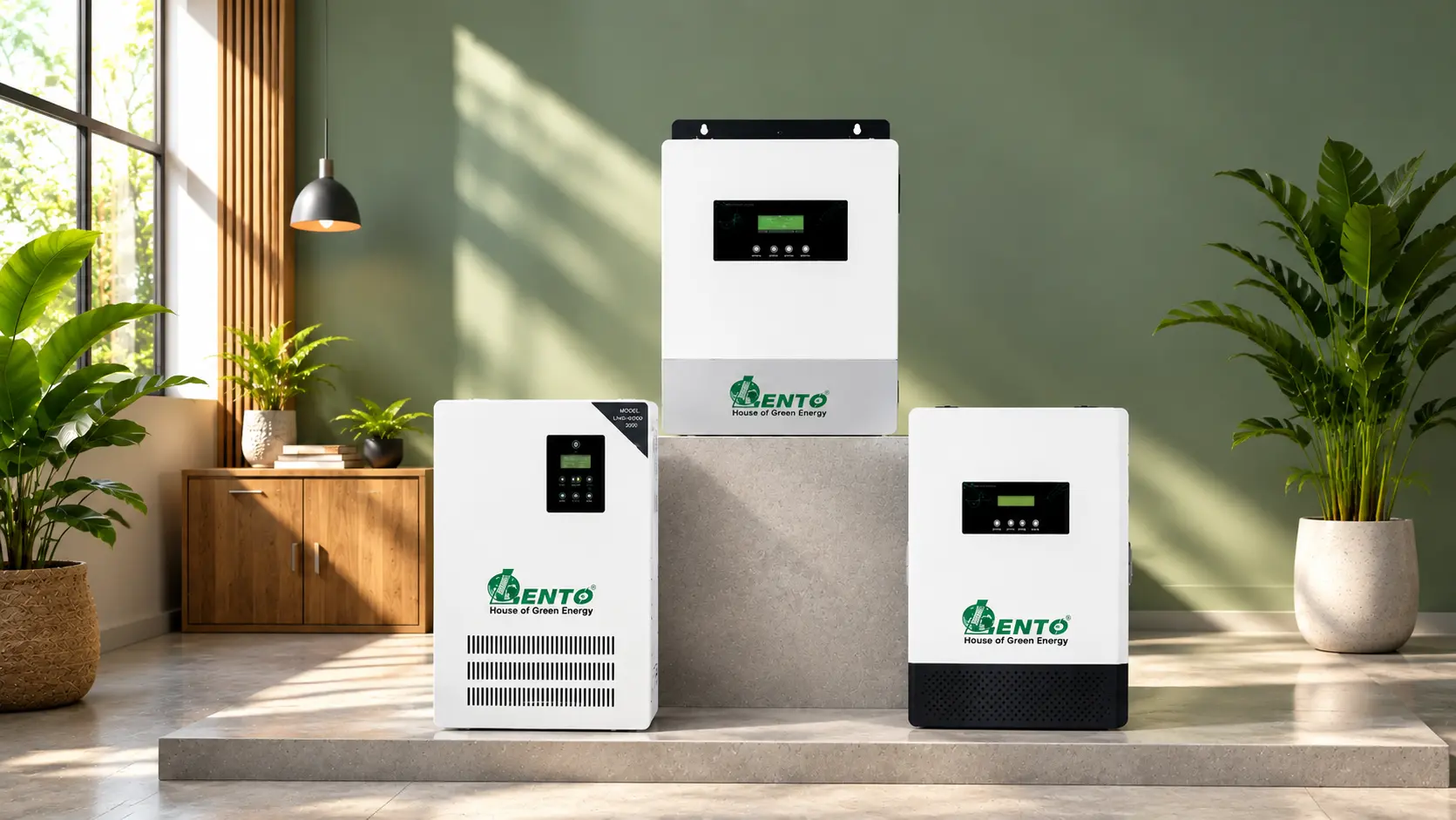
Lento Inverter Options for Home Use
Lento offers different inverter configurations for household and solar applications.
Pure Sine Wave Home Inverter
A standard pure sine wave inverter can be used with a compatible external battery.
Sine Wave Inverter – Household
Inverter With Inbuilt Lithium Battery
An inbuilt lithium battery inverter combines the inverter and battery into one unit.
Sine Wave Inverter With Inbuilt Lithium Battery
Available configurations include:
- 1100VA / 12.8V
- 2100VA / 25.6V
- 2500VA / 25.6V
Solar and Hybrid Inverters
For homes using solar energy, Lento also offers solar and hybrid inverter configurations.
Hybrid Solar Inverter – Household
Hybrid Solar Inverter – MPPT Wall Mountable
7 Things to Check Before Buying an Inverter and Battery
Before purchasing, check:
1. Total Load
Calculate the appliances you actually want to operate.
2. Inverter Capacity
Make sure the inverter can handle both running and relevant starting loads.
3. Battery Capacity
Select the battery according to the required backup time.
4. Battery Voltage
Make sure the battery voltage matches the inverter specification.
5. Battery Technology
Compare tubular and lithium according to cost, space and usage.
6. Solar Compatibility
If solar is planned, check solar input voltage, power rating and charging technology.
7. Warranty and Service
Check warranty terms and service availability before buying.
Common Mistakes When Buying an Inverter
Buying Only by VA Rating
A higher VA rating isn't automatically better. It should match your actual load.
Buying Only by Battery Ah
A bigger Ah rating does not tell you the complete backup time.
Ignoring Starting Load
Refrigerators, pumps and motors can have higher starting requirements.
Choosing Battery Before Inverter
First determine your load and inverter capacity, then select a compatible battery.
Buying More Capacity Than You Need
An oversized system can increase your initial cost without providing a practical benefit for your actual backup requirements.
Frequently Asked Questions
What is the best inverter and battery combination for a home?
Lento offers inbuilt lithium battery inverter systems that combine the inverter and LiFePO4 battery in one unit. For larger loads, Lento also offers inverter systems with separate battery options.
Which is better, a 150Ah or a 200Ah battery?
A 200Ah battery provides more stored energy and generally longer backup than a 150Ah battery, provided both have the same voltage and battery technology. Lento offers battery solutions based on different backup and load requirements.
Should I get a 5kW or 10kW battery?
A 10kW system is suitable when you need higher energy storage or longer backup, while 5kW can be sufficient for lower energy requirements. Lento offers lithium energy-storage solutions that can be selected according to load and backup requirements.
What size inverter battery is best for a home?
The right battery size depends on your connected load and required backup time. Lento offers inbuilt lithium battery inverter options such as 1100VA, 2100VA and 2500VA, along with separate battery solutions for higher requirements.
How long will a 150Ah battery last with an inverter?
Backup time depends on battery voltage, inverter efficiency and connected load. For example, a 150Ah battery can provide substantially different backup times at 300W, 500W or 1000W loads, so the load should be calculated first.
How to choose the right inverter and battery for your home?
First calculate your total load and required backup time, then select the inverter capacity and compatible battery voltage/Ah accordingly. Lento offers home inverter, inbuilt lithium and solar inverter options for different load and backup requirements.
Conclusion
Choosing the right inverter and battery for home starts with your actual electricity requirement.
First calculate your essential load. Then select the inverter capacity according to the running and starting loads. After that, choose a compatible battery based on the backup time you need, available space, battery technology and budget.
For conventional backup, a pure sine wave inverter with a suitable tubular battery can be a practical option. If you prefer a compact integrated system, an inbuilt lithium battery inverter can be considered.
If you plan to use solar power, compare suitable solar or hybrid inverters according to their solar input, battery compatibility and charging technology.
The goal is not to buy the biggest inverter or battery. The goal is to choose a system that matches your actual load, backup requirement and usage pattern.
Related Guides
- Best Inverter Price in India
- Latest Inverter Price List in India
- Which Inverter Is Best for Home Use in India?
- How Much kW Is Required for a Home in India?
- What Is MPPT in Solar Inverters?