How Does an Inbuilt Lithium Battery Inverter Work?
31 August 2026
Understanding how an inbuilt Lithium Battery Inverter actually works helps buyers make smarter decisions when comparing backup power options. Unlike traditional setups with separate battery banks, this design integrates the lithium-ion cells directly inside the inverter casing, creating a compact, efficient Lithium Battery Inverter system. Lento Industries Private Limited, a manufacturer and exporter to 24+ countries, breaks down the working mechanism step by step, helping households identify the best inverter for their home or business.
The Core Working Principle
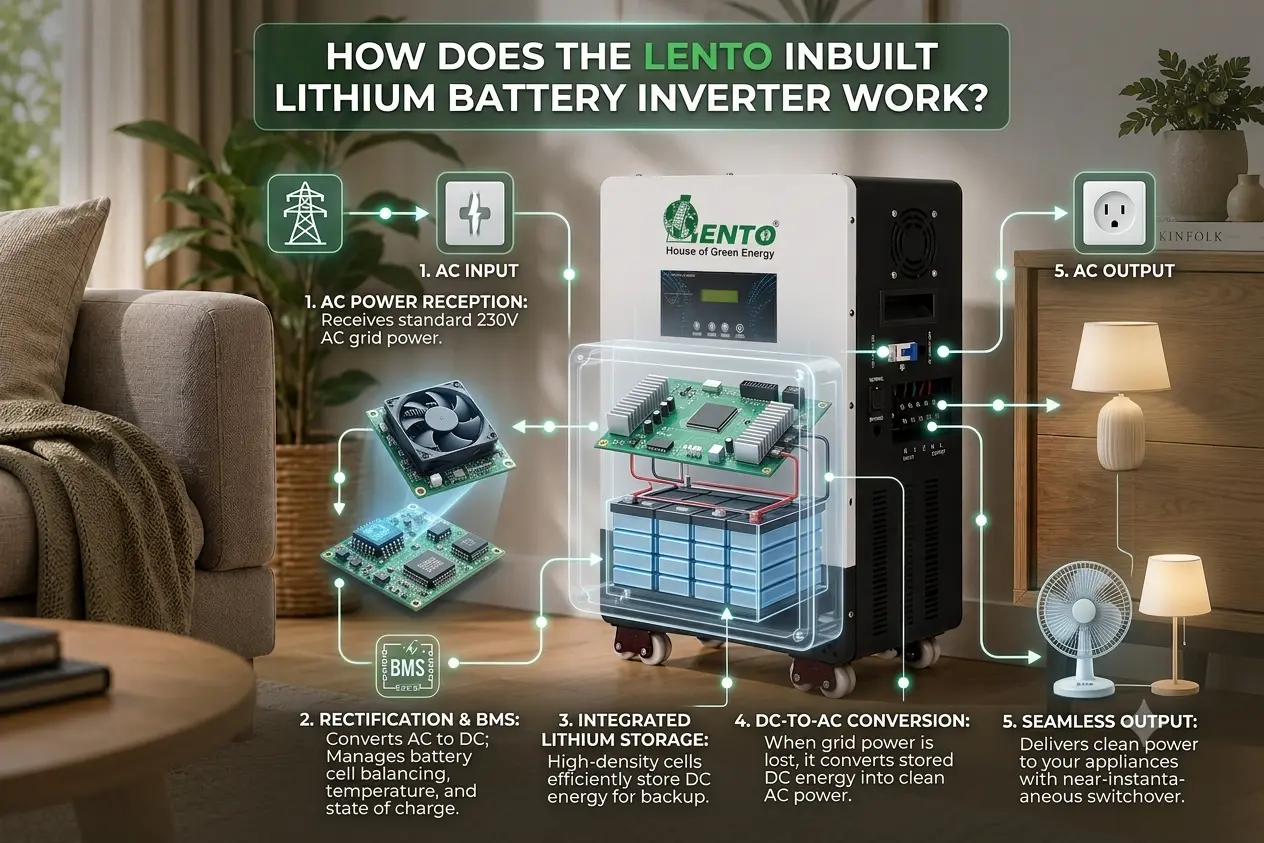
At its core, a solar inverter with an inbuilt lithium battery performs three continuous functions: charging the battery from an input source (grid power or solar panels), storing that energy in lithium-ion cells, and converting stored DC power into usable AC electricity during a power cut or scheduled backup use. This all happens within a single sealed unit, eliminating the need for external wiring between the battery and inverter — a major advantage over older systems when searching for the best inverter in india.
Step 1: Charging the Lithium Battery
The inverter's built-in charge controller regulates current flow from the grid or solar panels into the battery, preventing overcharging and optimizing charge speed. Lithium-ion cells accept charge far faster than lead acid batteries, which is why an inverter for home use built on lithium technology typically reaches full charge in a fraction of the time required by older systems.
Step 2: Energy Storage in Lithium-Ion Cells
Once charged, energy is stored in the lithium-ion battery pack, monitored continuously by an internal Battery Management System (BMS). The BMS tracks temperature, voltage, and charge cycles, protecting the battery from overheating, overdischarge, and short circuits — a built-in safety layer that sets quality units apart when comparing the top 5 inverter companies in india.
Step 3: DC to AC Power Conversion
When mains power fails or scheduled backup is triggered, the inverter draws stored DC energy from the battery and converts it into AC electricity using power electronics circuitry. Higher-quality units produce a pure sine wave output, ensuring safe operation of sensitive electronics, while lower-grade inverters may produce a modified sine wave that can affect appliance performance over time.
1. Sine Wave Inverter with Inbuilt Lithium Battery
A pure sine wave inverter is essential for sensitive electronics like computers, medical devices, and modern appliances. Lento's sine wave range delivers clean, stable output power throughout the entire discharge cycle.
|
Model |
Battery Voltage |
Rated Capacity |
Compatible Battery |
Typical Applications |
|
Li-ion 1100VA/12V |
12.8V DC |
1100 VA |
Lithium 100AH |
Household & Commercial |
|
Li-ion 2100VA/24V |
25.6V DC |
2100 VA |
Lithium 100AH |
Commercial, Hybrid Solar |
|
Li-ion 2100VA/24V |
25.6V DC |
2500 VA |
Lithium 100AH |
Commercial & Household |
2. Hybrid Solar Inverter with Inbuilt Lithium Battery (Off-Grid PWM)
For those beginning their solar journey, the PWM-based hybrid solar inverter is a cost-effective off-grid option that integrates solar charging directly into the unit, working the same core charge-store-convert cycle but drawing input primarily from solar panels.
|
Model |
Battery Voltage |
Rated Capacity |
Compatible Battery |
Typical Applications |
|
Li-ion 1100VA/12.8V |
12.8V DC |
1100 VA |
Lithium 100AH |
Household |
|
Li-ion 2100VA/25.6V |
25.6V DC |
2100 VA |
Lithium 100AH |
Household |
|
Li-ion 2100VA/25.6V |
25.6V DC |
2500 VA |
Lithium 100AH |
Household |
3. Hybrid Solar Inverter with Inbuilt Lithium Battery (Off-Grid MPPT)
The MPPT inverter is the gold standard for maximising solar energy harvest. Maximum Power Point Tracking technology continuously adjusts the electrical operating point of solar panels to extract up to 30% more energy compared to PWM, making it the best solar inverter choice for homes with higher energy demands.
|
Model |
Battery Voltage |
Rated Capacity |
Compatible Battery |
Typical Applications |
|
Li-ion 1100VA/12V |
12.8V DC |
1100 VA |
Lithium Battery |
Household |
|
Li-ion 2100VA/24V |
25.6V DC |
2100 VA |
Lithium Battery |
Household & Commercial |
|
Li-ion 2500VA/24V |
25.6V DC |
2500 VA |
Lithium Battery |
Household & Commercial |
How Solar Panels Fit Into the Working Cycle
When paired with solar panels, the inverter's charge controller prioritizes solar input over grid power whenever sunlight is available, reducing electricity costs and extending battery life. Estimating how much solar panel required for home use depends on inverter capacity — generally 1–1.5kW panels for 1100VA units and 2–4kW panels for 2100VA–2500VA models — and this sizing directly affects how efficiently the working cycle operates as a best on grid solar inverter in india setup with net metering.
Why Working Efficiency Varies by Brand
Not every unit performs this charge-store-convert cycle with equal efficiency. Buyers comparing the top 5 solar inverters in india or a wider top 10 solar inverters list should evaluate BMS quality, charge controller type, and conversion efficiency ratings — details a genuine best inverter company in india will disclose transparently rather than relying on generic marketing claims.
Frequently Asked Questions
What are the disadvantages of a lithium-ion inverter battery?
Lithium-ion batteries have a higher upfront cost than traditional lead-acid batteries. They also require proper battery management and compatible charging systems.
Is a lithium battery inverter safe?
Yes, lithium battery inverters are generally safe when they use a reliable Battery Management System (BMS) and are installed correctly.
How long do lithium inverter batteries last?
A good lithium inverter battery can typically last 8–10 years or around 2,000–5,000+ charge cycles, depending on usage and quality.
Does a lithium battery need a special inverter?
Not always, but the inverter must be compatible with lithium batteries and support the required charging voltage and BMS communication, if applicable.
Which is better for an inverter, a lithium battery or a regular battery?
Lithium batteries generally offer longer life, faster charging, lower maintenance, and better usable capacity than traditional lead-acid batteries.
What is the biggest problem with lithium batteries?
The biggest drawback is usually the higher initial cost. Proper charging, temperature control, and BMS protection are also important for safe and long-term use.
Conclusion
An inbuilt lithium battery inverter works through a continuous three-step cycle: charging, storing, and converting energy, all managed within a single compact unit supported by an internal Battery Management System. Understanding this process helps buyers appreciate why lithium technology outperforms older systems in speed, safety, and efficiency. Lento Industries Private Limited manufactures and exports sine wave, PWM hybrid, and MPPT hybrid lithium battery inverters to 24+ countries, giving households and businesses a dependable, well-engineered choice for reliable backup power and solar integration.
Contact Lento Industries Private Limited
Lithium Battery Inverter Manufacturer & Exporter to 24+ Countries
International: +91 9311811396
Toll-Free: 1800 313 0746
Sales & General Enquiries: info@lentoindia.com
Read More:-
Top 10 Inverter Brands in India (2026)
Inverters Price List in India 2026 – A Complete Expert Guide
Lithium Battery Inverter Manufacturer in India
What Is Inbuilt Lithium Battery Inverter?