
A Guide to Choose the Right Inverter Size for Home
22 July 2026
Choosing the right inverter size for your home begins with understanding your actual electricity usage and backup requirements. Selecting an inverter that's too small can result in frequent overloads and shorter backup times, while an oversized inverter may increase your overall cost without providing any real benefit. By calculating your home's power load correctly, you can choose an inverter that delivers reliable performance and efficient backup during power cuts. This guide explains how to calculate the ideal inverter size and compares the two most popular inverter battery options—lithium and tubular—to help you find the best solution for your home.
Step 1: List the Appliances You Want to Back Up
Start by listing every appliance you want running during a power cut, along with its wattage:
- LED bulbs/tubes: 10–20W each
- Ceiling fans: 60–75W each
- TV: 80–150W
- Refrigerator: 150–200W (higher on startup)
- WiFi router: 10–15W
Add up the total wattage. This is your Load.
Step 2: Calculate Inverter VA Rating
Inverters are rated in VA (Volt-Amperes), not watts. Use this formula:
Inverter VA = Total Load (Watts) ÷ Power Factor (typically 0.7–0.8)
Example: If your total load is 700W, divide by 0.75 → you need roughly a 930VA inverter. Round up to the nearest standard size (usually 1000VA or higher) to leave headroom for appliance startup surges — especially with a refrigerator or motor-based device.
Step 3: Calculate Battery Capacity (AH)
Battery capacity determines how long your backup lasts. Use this formula:
Battery AH = (Load in Watts × Backup Hours Required) ÷ Battery Voltage
Example: For a 700W load needing 4 hours of backup on a 12V battery: (700 × 4) ÷ 12 ≈ 233 AH
This tells you whether a single battery or multiple batteries in parallel/series are needed, and helps you choose between a tubular battery or a lithium ion battery for inverter.
Tubular Battery vs Lithium Battery: Which Should You Choose?
A tubular battery in India is the traditional, budget-friendly choice — reliable, widely serviced, but heavier and requiring water top-ups. A lithium battery (specifically LiFePO4 battery chemistry) costs more upfront but is maintenance-free, more compact, and lasts significantly longer.
|
Factor |
Tubular Battery |
Lithium Battery (LiFePO4) |
|
Cycle life |
300–500 cycles |
3,000–6,000+ cycles |
|
Maintenance |
Regular water top-up |
None |
|
Weight |
Heavy |
Up to 60% lighter |
|
Charging speed |
Slower |
Faster |
|
Best for |
Budget backup |
Frequent cuts, solar, long-term use |
If you experience frequent or long power cuts, a lithium inverter setup pays for itself faster through lower replacement and maintenance costs. For occasional backup, the best tubular battery in your required AH range remains a solid, economical option.
Best Inverter Options for Home and Solar Use
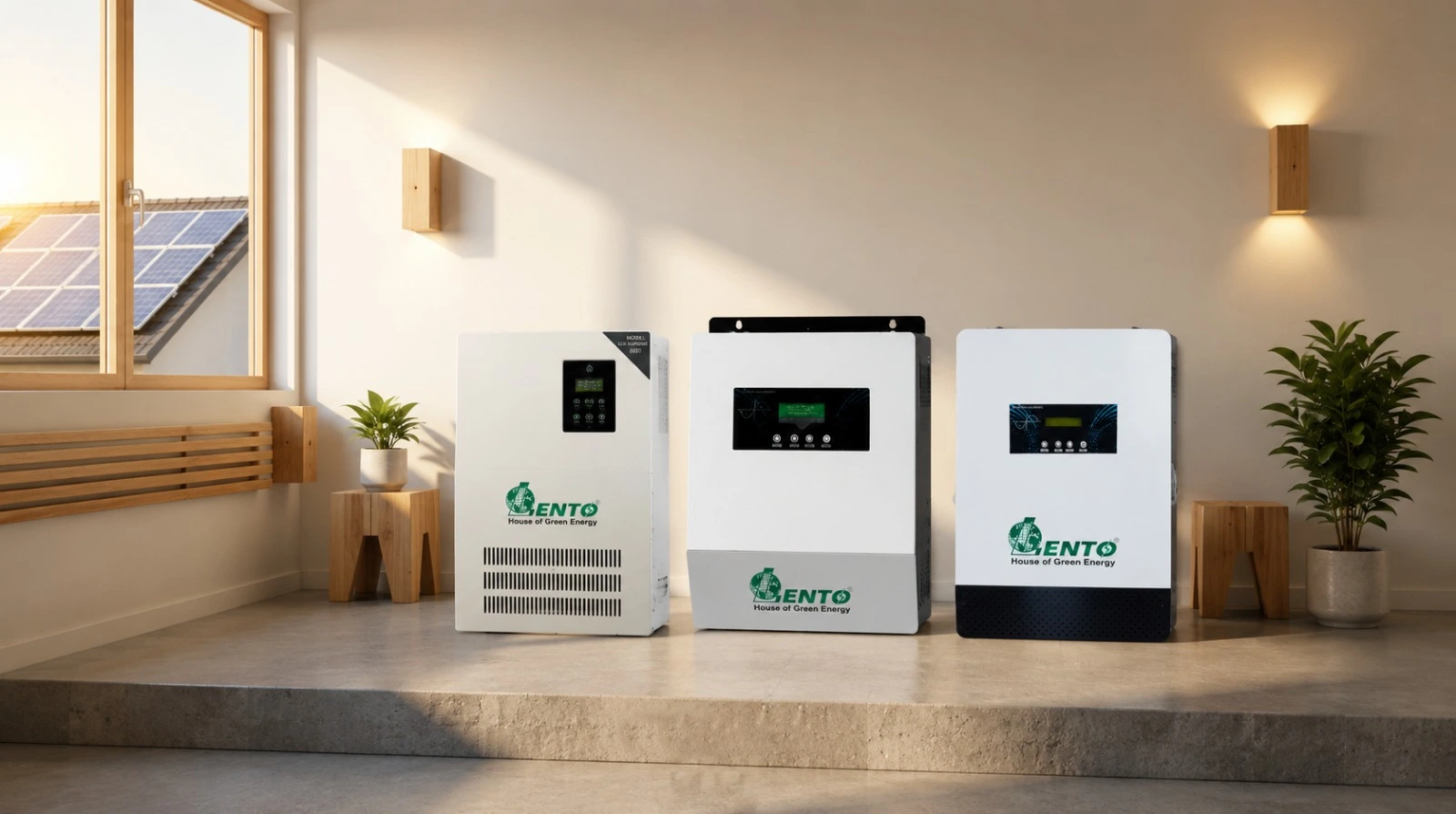
Lento Industries Private Limited manufactures a full range of inverter with lithium battery and standalone inverter systems suited to different home and business needs:
- Sine Wave Inverter – Household — A standard pure sine wave inverter for homes using external tubular or lithium batteries.
- Sine Wave Inverter with Inbuilt Lithium Battery — An inbuilt lithium battery inverter that combines inverter and battery in one compact unit, ideal for space-constrained homes.
- Hybrid Solar Inverter (OffGrid-PWM) – Household — Combines solar charging with backup power for homes.
- Hybrid Solar Inverter with Inbuilt Lithium Battery (OffGrid-PWM) — A solar + lithium ion inverter all-in-one for daily solar cycling.
- Hybrid Solar Inverter (Offgrid-PWM) (Single Phase) – Industrial — Built for industrial and commercial backup loads.
- Hybrid Solar Inverter (Offgrid-MPPT) – Wall Mountable — Higher solar charging efficiency via MPPT technology.
- Hybrid Solar Inverter (Grid-Tie) — Syncs with grid power alongside solar and battery backup.
- On-Grid Solar Inverter (Grid Tie) — For homes primarily offsetting electricity bills via solar.
- Hybrid Solar Inverter with Inbuilt Lithium Battery (Offgrid-MPPT) — Combines MPPT solar charging with an inbuilt lithium battery inverter design.
Battery Options to Pair With Your Inverter
- Lead Acid Tubular Battery (C-10) — Suited for higher-load, quick-discharge needs.
- Lead Acid Tubular Battery (C-20) — Better for longer, steady backup.
- Lithium Ion Batteries (LiFePO4) — Maintenance-free, long-life lithium batteries across multiple voltage and AH options.
FAQs
Q1. How to calculate inverter and battery capacity for home?
Calculate your total running load (in watts) and required backup time (in hours), then choose an inverter with 20–30% extra capacity and a battery that can provide the required backup.
Q2. What size inverter for a 150Ah battery?
A 900VA to 1500VA pure sine wave inverter is generally recommended for a 150Ah battery, depending on the connected load.
Q3. What is the capacity of an inverter for a 200Ah battery?
A 1500VA to 2500VA inverter is commonly paired with a 200Ah battery, depending on your power requirements and backup needs.
Q4. How much battery capacity is good for a home inverter?
For most homes, a 150Ah to 200Ah battery provides a good balance of backup time and performance.
Q5. Is a 200Ah battery enough for a home?
Yes, a 200Ah battery is sufficient for most homes, providing 6–12 hours of backup for essential appliances, depending on the connected load.
Conclusion
Calculating the right inverter for home and battery capacity comes down to your total load, required backup hours, and long-term usage pattern. Whether you choose a best tubular battery for affordability or a lithium battery inverter for longevity and zero maintenance, Lento Industries Private Limited offers both standalone and inbuilt lithium battery inverter solutions, along with tubular and LiFePO4 batteries to match — making it easier to build the right backup system for your home or business.
Read More:-
Top 10 Inverter Brands in India (2026)
How Much kW Required for Home in India
Best Inverter to Run Air Conditioner in India
Inverter Not Charging – These Might Be the Reasons
How to Calculate the Right Inverter Size & Battery Capacity for Your Home
Don’t Delay, Join Us Today!
Related Posts
- Lithium Battery Inverter Price in India – Models, Specifications & Buying Guide
- Buy Lithium Battery Inverter in India – Price, Models & Buying Guide
- Best Lithium battery with inverter price in India — what you actually pay, and why
- What is the best inverter with an inbuilt lithium battery for home use?