Which Inverter Is Best for a 200Ah Lithium Battery? Complete Guide
13 October 2026
Quick answer: A pure sine wave inverter with a lithium charging mode is the best match for a 200Ah lithium (LiFePO4) battery. For a 12.8V 200Ah battery, choose a 12V inverter of about 1 kVA to 1.5 kVA. If you want solar charging, choose a hybrid MPPT solar inverter, and for loads above about 1.5 kVA, move to a 24V system. The inverter must be able to charge lithium correctly and cut off at a safe low-voltage level.
Buy a Lento lithium inverter from the official Lento website or on Amazon India, then use this guide to pick the right type and size.
Key Takeaways
- A 12.8V 200Ah LiFePO4 battery stores about 2,560 watt-hours, and you can use most of it.
- That is roughly double the usable energy of a 200Ah lead-acid battery, which should only be discharged to about 50%.
- The inverter must match the battery voltage (12V, 24V, or 48V) and support lithium charging.
- Check the battery’s BMS discharge rating before choosing the inverter size.
- Choose pure sine wave for homes, hybrid MPPT for solar, and industrial models for heavy loads.
Introduction
A 200Ah lithium battery gives longer life, faster charging, and more usable power than a lead-acid battery of the same rating. But it only performs well with the right inverter. A mismatch in voltage, charging profile, or capacity can lead to poor backup, slow charging, or even a battery shutdown. This guide explains which inverter is best for a 200Ah lithium battery, how to size it, how long the backup will last, and what to check before you buy. If you are comparing models more broadly, see our guide to the best inverter for home in India.
What Does a 200Ah Lithium Battery Actually Provide?
Energy is battery voltage multiplied by amp-hours. The common lithium configurations give these totals:
| Battery | Nominal voltage | Capacity | Stored energy |
|---|---|---|---|
| 12.8V 200Ah LiFePO4 | 12.8V | 200Ah | about 2,560 Wh |
| 25.6V 200Ah LiFePO4 | 25.6V | 200Ah | about 5,120 Wh |
| 51.2V 200Ah LiFePO4 | 51.2V | 200Ah | about 10,240 Wh |
Unlike lead-acid, a lithium battery can be discharged deeply, often to 80–90% or more, so most of this energy is usable. Always check your battery’s rated depth of discharge and maximum continuous discharge current.
What to Check Before You Choose
- System voltage: the inverter must match the battery (12V, 24V, or 48V). A 12.8V lithium battery needs a 12V inverter.
- Lithium charging mode: the inverter should have a lithium or LiFePO4 profile, or adjustable charge voltage. Lead-acid charging settings can undercharge or overcharge lithium.
- BMS compatibility: the battery’s built-in battery management system (BMS) limits current. The inverter’s maximum draw must stay within the BMS discharge rating.
- Inverter size: add up your load in watts and pick an inverter slightly above it.
- Waveform: pure sine wave protects TVs, refrigerators, and computers.
- Charge current: a higher charge current fills a 200Ah battery faster, but it must stay within the battery’s maximum charge rating.
- Protection features: low-voltage cutoff, overload, short-circuit, and thermal protection.
- Solar readiness: if you plan to add panels, choose a hybrid inverter with an MPPT controller.
Which Inverter Is Best for a 200Ah Lithium Battery? Top 3 Types
1. Pure Sine Wave Inverters: Best for Homes and Offices
A pure sine wave inverter gives smooth, stable power for TVs, fans, refrigerators, laptops, and medical equipment. Paired with a lithium battery, it is the simplest and most reliable setup for home backup.
Best for: everyday home and office backup.
2. Hybrid Solar Inverters: Best for Solar Charging
A hybrid solar inverter draws from solar panels, the grid, and the battery, which can cut your electricity bill and extend backup.
- An MPPT solar inverter extracts more power from your panels and suits larger systems.
- A PWM household solar inverter is simpler and more budget-friendly for smaller setups.
- A solar inverter with inbuilt lithium battery (MPPT) combines the inverter and battery in one unit.
Best for: homes that want to charge a 200Ah lithium battery from solar. Read about the best solar inverter with lithium battery.
3. Heavy-Duty Industrial Inverters: Best for Business
For shops and factories, choose a single-phase industrial inverter for workshops and small commercial loads, or a three-phase industrial inverter for machinery. Large loads usually need a higher battery voltage than 12V.
Best for: heavy commercial loads.
What Inverter Size Should You Pair with a 200Ah Lithium Battery?
Current rises as voltage falls, so a 12V system handles less power than a 24V or 48V system of the same wattage. Use this as a general rule of thumb.
| System voltage | Suggested inverter size | Notes |
|---|---|---|
| 12V (12.8V battery) | About 0.8–1.5 kVA | 1,000W draws roughly 80–90A, so check the BMS rating |
| 24V (25.6V battery) | About 1.5–3 kVA | Lower current, easier on cables and BMS |
| 48V (51.2V battery) | About 3 kVA and above | Best for larger homes and commercial loads |
These are guidelines, not limits. Always confirm the maximum continuous discharge current of your battery and the inverter’s rated battery voltage and current.
How Long Will a 200Ah Lithium Battery Last with an Inverter?
The estimates below are for a 12.8V 200Ah LiFePO4 battery (about 2,560 Wh), assuming about 90% usable capacity and about 88% inverter efficiency, which gives roughly 2,000 Wh of usable output.
| Load | Estimated backup (12.8V 200Ah) |
|---|---|
| 200W (lights, fans, router) | about 10 hours |
| 400W (light household use) | about 5 hours |
| 800W (fans, TV, more appliances) | about 2.5 hours |
| 1,000W | about 2 hours |
| 1,500W | about 1.3 hours |
A 25.6V 200Ah battery holds twice the energy, so backup times roughly double. Actual backup depends on battery age, temperature, and how the load changes. To estimate your own, divide usable energy in watt-hours by your load in watts.
Lithium vs Lead-Acid at 200Ah
| Feature | 200Ah lithium (LiFePO4) | 200Ah tubular lead-acid |
|---|---|---|
| Usable capacity | About 80–90% or more | About 50% |
| Backup from the same rating | About double | Baseline |
| Charging speed | Faster | Slower |
| Maintenance | None | Water topping needed |
| Upfront cost | Higher | Lower |
For a fuller comparison, read our guides to the best lithium inverter for home and the best inverter with battery for home.
Lento Inverters for Lithium Battery Systems
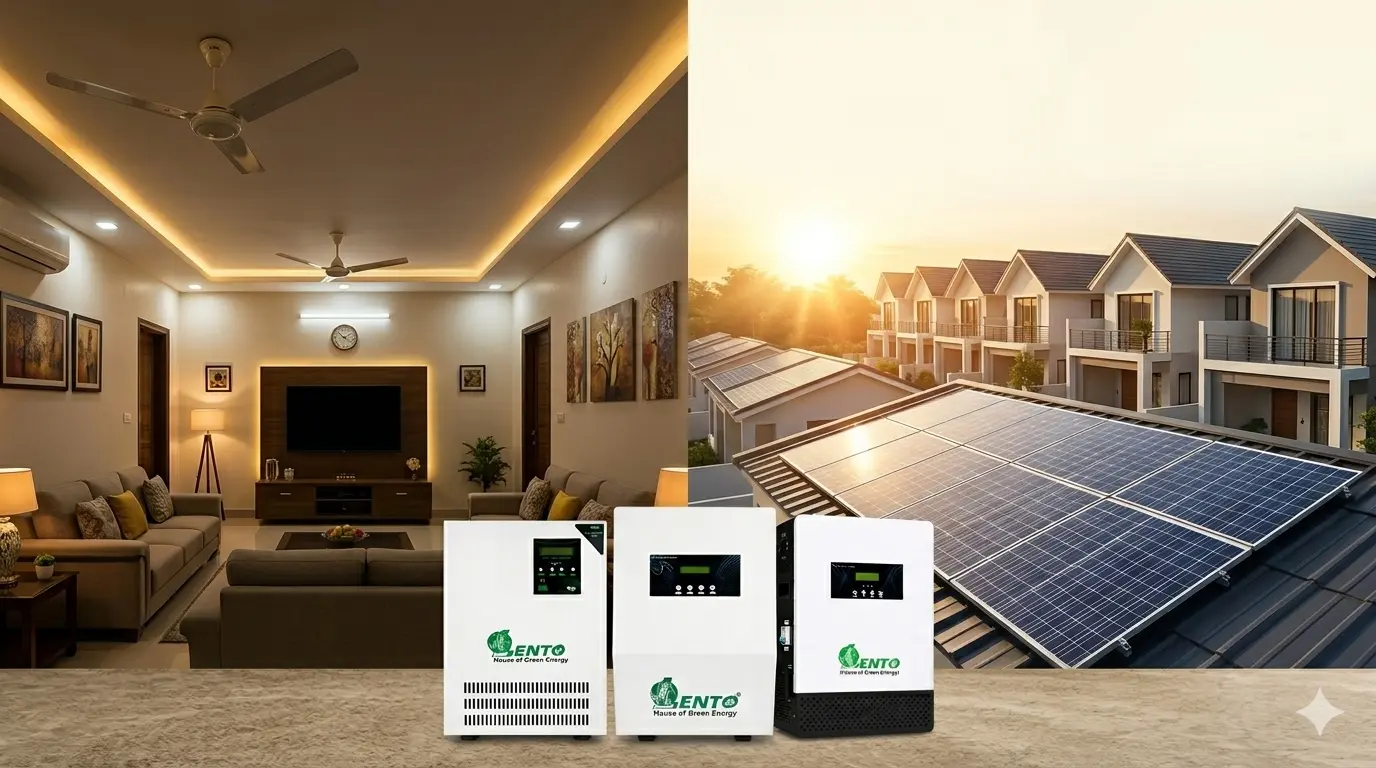
Lento offers pure sine wave, hybrid solar, and lithium-ready inverters. If you would rather buy the inverter and battery as one package, look at the inbuilt lithium models:
- Sine wave inverter with inbuilt lithium battery
- Hybrid solar inverter with inbuilt lithium battery (PWM)
- Hybrid solar inverter with inbuilt lithium battery (MPPT)
Indicative prices (Amazon listings, mid-2026): these appear to be inverter-plus-lithium-battery packages, so confirm what is included before comparing them with inverter-only prices.
| Lento model | Indicative price |
|---|---|
| 1.1 kVA 12.8V lithium inverter | about ₹27,300–₹29,700 |
| 2.1 kVA 25.6V lithium inverter UPS | about ₹44,100–₹53,700 |
| 2100 VA 25.6V solar hybrid lithium inverter | about ₹24,900–₹50,600 |
| 2.5 kVA 25.6V hybrid solar lithium inverter | about ₹40,000–₹57,200 lento 1 1kva 12 8v lithium 8C1kjsG5 +3 |
For more on these options, read about the inverter with inbuilt lithium battery for home, compare an inverter with lithium ion battery for home, see how a lithium inverter with battery works as a package, and read the basics of a lithium inverter for home. You can also browse the best inverter with Li-ion battery in India.
Common Mistakes When Pairing an Inverter with a Lithium Battery
- Using lead-acid charging settings on a lithium battery
- Choosing an inverter that exceeds the battery’s BMS discharge rating
- Mixing 12V and 24V components
- Ignoring the battery’s maximum charge current
- Using thin or poor-quality cables, which cause voltage drop and heat
- Connecting a lithium battery to an inverter that has no lithium mode without checking the manual
- Skipping fuses or breakers on the battery line
Follow both the battery maker’s and inverter maker’s instructions, and use a qualified electrician for installation.
Expert Tips
- Choose a pure sine wave inverter for sensitive appliances.
- Use correctly rated cables, fuses, and connectors.
- Keep the inverter in a dry, well-ventilated place.
- Set the low-voltage cutoff and charge profile as the battery maker recommends.
- Prefer models with solar compatibility and a clear digital display.
- If the inverter acts up, our guide to how to reset an inverter explains the safe steps.
- Using a lead-acid battery instead? Read our guide on which inverter is best for a 200Ah battery.
B2B and Export
Lento India manufactures inverters and supplies 24+ countries. For bulk orders, distributorship, or commercial projects, contact the team through the Lento website with your inverter and battery requirements.
Final Thoughts
So, which inverter is best for a 200Ah lithium battery? For most homes, a pure sine wave inverter with a lithium charging mode and a voltage that matches your battery. For solar, a hybrid MPPT inverter. For larger loads, a 24V or 48V system. Check the BMS rating, size the inverter to your load, and expect realistic backup rather than the textbook figure. Lento’s range covers pure sine wave, hybrid solar, lithium, and industrial inverters, so you can stay with one brand as your needs grow. Ready to buy? Visit the official Lento website or check Lento on Amazon India.
Frequently Asked Questions
1. What is the best inverter for a 200Ah lithium battery?
A pure sine wave inverter with lithium battery compatibility and a suitable Battery Management System (BMS) connection is a good choice. Lento offers inverter solutions for home backup and solar applications; select a model that matches your battery voltage and load.
2. What type of inverter is suitable for a 200Ah battery?
A pure sine wave inverter is suitable for most home applications. For a lithium battery, ensure the inverter supports its chemistry, voltage and charging requirements.
3. What size of inverter is good for a 200Ah battery?
A 900VA–1500VA inverter may suit typical home loads, but the correct size depends on the total wattage of appliances used simultaneously. Check the battery voltage and the inverter’s rated output before purchasing.
4. Which inverter is suitable for a lithium battery?
A lithium-compatible pure sine wave inverter with suitable charging settings and BMS communication, where required, is recommended. Lento offers inbuilt lithium battery inverters and solar inverter options for different backup needs.
5. Which brand of 200Ah lithium battery is the best?
There is no single best brand for every application. Compare Lento, Exide and other established battery brands based on battery chemistry, warranty, cycle life, BMS protection and compatibility with your inverter.
6. Which company's inverter battery is best?
Lento, Exide, Amaron, Luminous and Livguard are brands you can compare for home power backup. Choose according to your required backup time, battery type, warranty and local after-sales support.
Read More
- Best Inverter for Home in India
- Best Inverter with Lithium Ion Battery for Home in India
- Best Lithium Inverter for Home
- Inverter with Inbuilt Lithium Battery for Home
- Best Inverter with Battery for Home
- Best Solar Inverter with Lithium Battery
- Lithium Inverter for Home
- Lithium Inverter with Battery
- Best Inverter with Li-Ion Battery in India