Buy Inbuilt Battery Inverter
20 May 2026
Ready to Buy an Inbuilt Battery Inverter? Read This First.
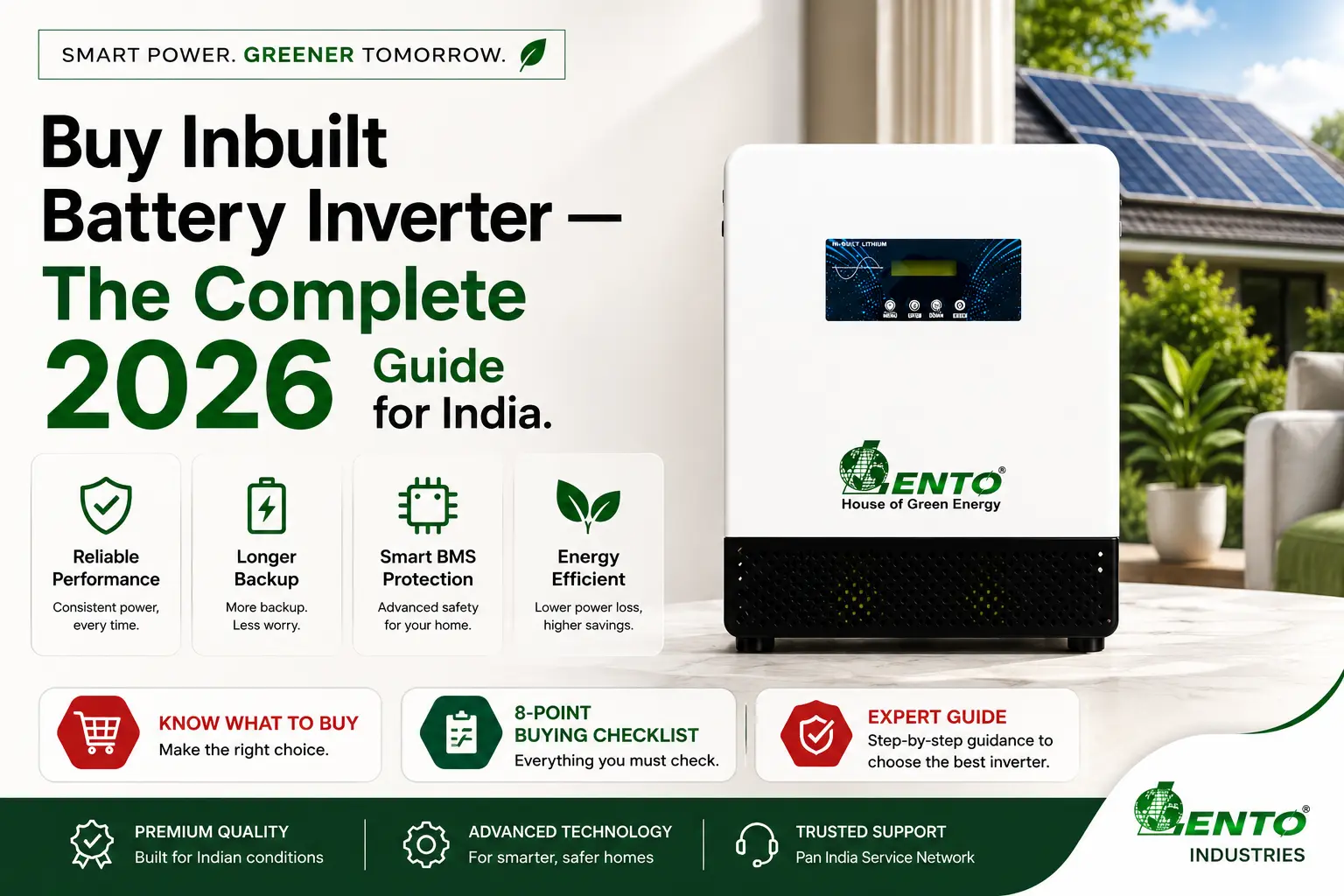
The decision to buy a lithium battery inverter, a solar inverter, or any power inverter for home has never been more consequential — or more rewarding — than in 2026. Indian homeowners who invest in an inbuilt battery inverter are not just buying backup power; they are buying freedom from maintenance schedules, freedom from repeat battery replacements, and increasingly, freedom from high electricity bills through solar integration. Whether you are buying a hybrid solar inverter for a new home, replacing an ageing lead-acid system, or purchasing the best inverter with battery for home for the first time, this guide by Lento Industries Private Limited gives you the complete buyer's roadmap — what to look for, what to avoid, what questions to ask, and which lithium ion battery for inverter system delivers the best value for your specific needs in India this year.
Why Buy an Inbuilt Battery Inverter Over a Conventional Setup?
Before choosing which inbuilt inverter to buy, it helps to understand precisely why the inbuilt approach outperforms the traditional "separate inverter + external battery" purchase:
|
Buying Factor |
Inbuilt Battery Inverter |
Separate Inverter + Battery |
|
Purchase complexity |
One product decision |
Two separate product decisions |
|
Compatibility risk |
Zero — factory matched |
High — requires technical verification |
|
Installation |
Plug and play — minutes |
Professional wiring — hours |
|
Space required |
Single compact unit |
Two components, larger footprint |
|
Warranty |
Single integrated warranty |
Two separate warranties |
|
BMS calibration |
Factory optimised for inverter |
Generic — often mismatched |
|
Total cost |
Lower when all factors counted |
Higher when installation added |
|
Solar upgrade |
Built in on PWM and MPPT models |
Requires additional controller |
The inbuilt advantage is not simply convenience — it is a technically superior approach that delivers better battery life, higher efficiency, and lower lifetime cost than buying components separately.
The Inbuilt Battery Inverter Buyer's Checklist: 8 Things to Verify Before You Buy
Use this checklist when evaluating any inbuilt battery inverter purchase — including Lento's range:
1. Pure Sine Wave Output Confirm the inverter produces pure sine wave AC — not modified sine wave. Modified sine wave damages refrigerator compressors, variable-speed fans, medical devices, and sensitive electronics over time.
2. LiFePO4 Battery Chemistry Verify the inbuilt battery uses LiFePO4 (Lithium Iron Phosphate) — not generic NMC lithium-ion. LiFePO4 is thermally stable to 60°C, non-flammable, and delivers 3,000–5,000 cycles vs 1,000–1,500 for NMC.
3. Smart BMS Inbuilt The Battery Management System must be factory-calibrated for the paired inverter. Confirm it includes: overcharge protection, over-discharge protection, temperature monitoring, cell balancing, and short-circuit protection.
4. Correct Voltage for Your Load 12.8V systems suit inverters up to 1100VA. 25.6V systems are required for 2100VA and 2500VA models. Mismatching voltage to load reduces efficiency and battery life.
5. Inverter Capacity Matches Your Home Load Calculate your total appliance wattage during a power cut. Add 20% safety margin. Select the inverter VA rating that covers this total.
6. Solar Compatibility If you have or plan rooftop solar panels: confirm PWM (for 1–3 panels) or MPPT (for 4+ panels) solar charging is built into the unit — not sold as a separate add-on.
7. Warranty Coverage Minimum 2 years on the complete integrated system — inverter and battery together under one warranty. Less than this is a red flag.
8. Pan-India Service Network Verify the manufacturer has dealer and service presence in your city or state. An inbuilt system requires manufacturer-authorised service, not a generic inverter repair shop.
What to Buy: Lento Industries Inbuilt Lithium Battery Inverter Range
Lento Industries manufactures three certified inbuilt lithium battery and inverter systems — each a complete, factory-matched unit covering a specific home and commercial power profile.
Buy Option 1 — Sine Wave Inverter with Inbuilt Lithium Battery
What you get: A single compact unit delivering pure sine wave AC backup from a factory-integrated LiFePO4 battery. No external battery required. No solar charging. Maximum simplicity.
|
Model |
Battery Voltage |
Rated Capacity |
Compatible Battery |
Applications |
|
Li-ion 1100VA/12V |
12.8V |
1100 VA |
Lithium Battery (100AH) |
Household and commercial |
|
Li-ion 2100VA/24V |
25.6V |
2100 VA |
Lithium Battery (100AH) |
Commercial spaces, hybrid solar |
|
Li-ion 2100VA/24V |
25.6V |
2500 VA |
Lithium Battery (100AH) |
Commercial and household |
Buy this if: You need reliable grid-backup power for a 1–3 BHK home or small office. No current solar plans. Want the simplest, most maintenance-free inbuilt inverter available.
Price range: ₹18,000 – ₹38,000 Backup duration: 3–6 hours depending on load and battery size selected.
Buy Option 2 — Hybrid Solar Inverter with Inbuilt Lithium Battery (Off-Grid PWM)
What you get: A grid + solar backup system in one inbuilt unit. The built-in PWM solar charge controller manages 1–3 rooftop panels — reducing your electricity bill from the first day of installation without any additional hardware.
|
Model |
Battery Voltage |
Rated Capacity |
Compatible Battery |
Applications |
|
Li-ion 1100VA/12.8V |
12.8VDC |
1100 VA |
Lithium Battery (100AH) |
Household |
|
Li-ion 2100VA/25.6V |
25.6VDC |
2100 VA |
Lithium Battery (100AH) |
Household |
|
Li-ion 2100VA/25.6V |
25.6VDC |
2500 VA |
Lithium Battery (100AH) |
Household |
Buy this if: You have 1–3 solar panels installed or plan to add them soon. Want solar electricity bill savings at the most affordable solar-entry price point. Value simplicity and cost over maximum solar yield.
Price range: ₹22,000 – ₹40,000 Electricity bill reduction: 25–40% with a 1–3 panel array.
Buy Option 3 — Hybrid Solar Inverter with Inbuilt Lithium Battery (Off-Grid MPPT)
What you get: Lento's most advanced inbuilt li ion inverter — MPPT technology continuously optimises solar panel output, harvesting up to 30% more energy than PWM from the same rooftop installation. The highest-performance inverter with lithium battery for Indian homes with serious solar ambitions.
|
Model |
Battery Voltage |
Rated Capacity |
Compatible Battery |
Applications |
|
Li-ion 1100VA/12V |
12.8V |
1100 VA |
Lithium Battery |
Household |
|
Li-ion 2100VA/24V |
25.6V |
2100 VA |
Lithium Battery |
Household and commercial |
|
Li-ion 2500VA/24V |
25.6V |
2500 VA |
Lithium Battery |
Household and commercial |
Buy this if: You have 4+ solar panels or are commissioning a serious solar installation. Want the maximum return on every rupee spent on panels. Running a large home, clinic, or commercial property with heavy backup requirements.
Price range: ₹28,000 – ₹55,000 Electricity bill reduction: 40–70% with a 4–8 panel array.
Amazon Availability (Single Unit Purchase)
Lento inverters are available on Amazon, allowing you to:
- Buy single units
- Compare features and pricing
- Check customer reviews
- Get home delivery
This makes Lento a convenient option for the best inverter with battery for home in India.
How to Calculate the Right Capacity Before You Buy
Step 1 — List your essential appliances: Note the wattage of every appliance you need during a power cut — ceiling fans (75W each), LED lights (10W each), television (100W), refrigerator (150W), Wi-Fi router (15W), laptop charger (65W).
Step 2 — Total the wattage: A typical 2BHK home running 3 fans + 6 lights + TV + fridge + Wi-Fi = approximately 600–750W.
Step 3 — Add 20% safety margin: 750W × 1.2 = 900W minimum inverter real power output required.
Step 4 — Convert to VA: Divide by power factor (0.8): 900W ÷ 0.8 = 1,125 VA minimum. Choose the next model up — 2100VA for comfortable headroom.
Step 5 — Choose battery capacity for required backup hours: Required energy = 750W × 5 hours = 3,750Wh. A 25.6V 150Ah lithium battery stores 3,840Wh — exactly right.
Recommended purchase: Lento MPPT 2100VA / 25.6V + 25.6V 150Ah LiFePO4 battery.
Inbuilt Battery Inverter Price Guide — What to Budget in 2026
|
What You Are Buying |
Lento Model |
Budget Required (INR) |
|
Basic home backup — 1BHK |
Sine Wave 1100VA |
₹18,000 – ₹28,000 |
|
Standard home backup — 2BHK |
Sine Wave 2100VA |
₹28,000 – ₹38,000 |
|
Solar starter — any home |
PWM 1100VA–2100VA |
₹22,000 – ₹40,000 |
|
Serious solar — 2–3 BHK |
MPPT 2100VA |
₹32,000 – ₹42,000 |
|
Large home / commercial solar |
MPPT 2500VA |
₹38,000 – ₹48,000 |
|
Add 150Ah battery to any system |
25.6V 150Ah LiFePO4 |
₹38,000 – ₹55,000 |
|
Add 200Ah battery to any system |
25.6V 200Ah LiFePO4 |
₹55,000 – ₹85,000 |
5 Mistakes to Avoid When Buying an Inbuilt Battery Inverter
Mistake 1 — Buying on price alone. The cheapest inbuilt inverter often uses NMC cells, a basic BMS, and no solar compatibility. A ₹12,000 unit that lasts 3 years costs more than a ₹28,000 unit that lasts 10.
Mistake 2 — Choosing the wrong capacity. Undersizing causes the inverter to run at high load continuously — degrading both the inverter and battery faster. Always add 20% headroom above your calculated load.
Mistake 3 — Ignoring solar compatibility. If there is any chance you will add solar panels in the next 5 years, buy the PWM or MPPT model now. Retrofitting solar to a sine-wave-only unit requires buying a new inverter.
Mistake 4 — Overlooking the BMS specification. A basic BMS with only overcharge and over-discharge protection is insufficient for India's temperature range. Insist on temperature monitoring and cell balancing as minimum requirements.
Mistake 5 — Not verifying service availability. A premium inbuilt inverter is only as good as the manufacturer's service network in your location. Confirm dealer presence and warranty service access before purchasing.
Frequently Asked Questions (FAQs)
Q1. What to look for when buying an inverter battery?
Check the battery type, capacity (Ah), backup time, warranty, and cycle life to ensure it meets your power requirements.
Q2. How many hours does an inverter battery last?
An inverter battery can provide 2–10 hours of backup depending on battery capacity and the connected load.
Q2. What are the different types of inverters?
The main types are Pure Sine Wave, Modified Sine Wave, Square Wave, Solar Inverters, and Hybrid Inverters.
Q3. How much battery is required for an inverter?
The required battery size depends on the inverter load and desired backup time, typically ranging from 100Ah to 200Ah for homes.
Q4. How many volts is an inverter battery?
Common inverter battery voltages are 12V, 24V, and 48V, depending on the inverter capacity and system design.
Q5. What are the specifications of a battery?
Key battery specifications include voltage (V), capacity (Ah), energy (Wh), cycle life, charging time, and operating temperature range.
Why Buy From Lento Industries
- Three complete series — Sine Wave, PWM Solar Hybrid, MPPT Solar Hybrid — every home covered
- Factory-integrated inbuilt design — battery, BMS, and inverter as one warranted system
- LiFePO4 standard — 3,000–5,000 cycles, safe for Indian heat
- Pure sine wave across all models — every appliance protected
- Smart BMS — 6-layer protection, factory-calibrated for each inverter
- Prices from ₹18,000 — accessible across every home size and budget
- Pan-India dealer network — buy, install, and service nationwide
Conclusion: Buy Smart. Buy Inbuilt. Buy Lento.
Buying an inbuilt battery inverter in 2026 is one of the smartest home investments an Indian family can make — eliminating maintenance, doubling usable backup capacity, enabling solar savings, and delivering a decade of reliable service from a single compact unit. Lento Industries' three-series inbuilt lithium inverter range makes that investment accessible at every budget, from ₹18,000 for a compact 1BHK backup unit to ₹55,000 for a premium MPPT solar hybrid system for a large home or commercial property.
Use the buying checklist. Calculate your load. Match your solar plans. And buy with confidence — backed by Lento.