
Battery Backup Time Calculator: How to Calculate UPS & Inverter Backup (Formula, Chart & Examples)
02 December 2025
Battery Backup Time Calculator: The Quick Answer
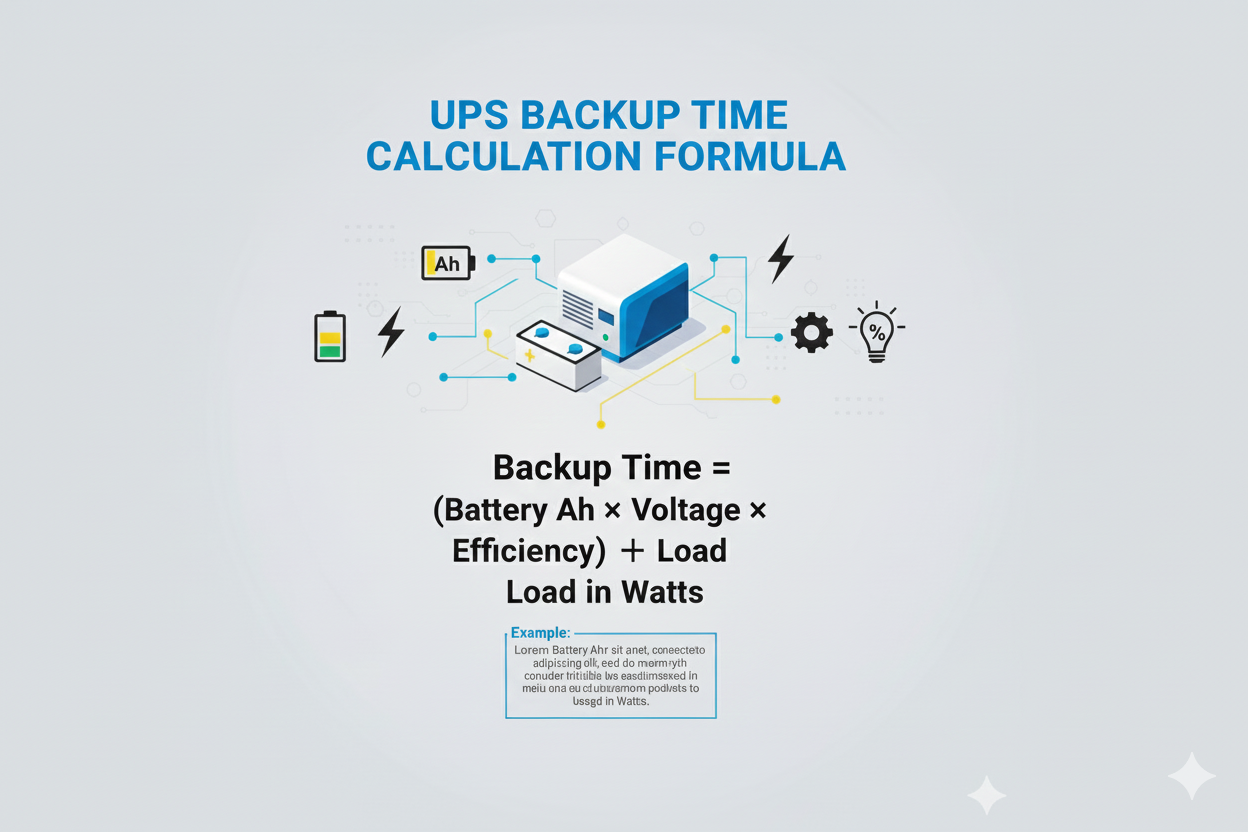
To calculate battery backup time, multiply battery capacity (Ah) by battery voltage (V) and by efficiency (0.7 to 0.85), then divide by your total load in watts. The result is the backup time in hours.
\text{Backup time (hours)} = \frac{\text{Battery capacity (Ah)} \times \text{Battery voltage (V)} \times \text{Efficiency}}{\text{Load (W)}}
Example: a 150Ah, 12V battery at 80% efficiency running a 250W load gives (150 × 12 × 0.8) ÷ 250 = 5.76 hours.
Whether you search "mera UPS kitna backup dega?", "how long will a 150Ah battery last?" or "inverter battery backup time calculation", this is the formula you need. The rest of this guide explains each input, gives ready-made backup charts for 100Ah, 150Ah and 200Ah batteries, and shows how to size a new battery.
What Is Battery Backup Time and Why Does It Matter?
Battery backup time is how long a UPS or inverter battery can power your connected appliances during a power cut. It depends on how much energy the battery stores and how fast your devices use it.
Knowing this number helps you:
- Predict how long fans, lights, a router, a PC or CCTV will run during an outage
- Check whether your current battery is still enough for your needs
- Choose the right battery size when upgrading, instead of guessing
- Avoid overloading the UPS and shutting down unexpectedly
- Avoid paying for an oversized battery you do not need
This applies to home inverters, office UPS systems, shops, CCTV setups and solar backup systems alike.
Battery Backup Time Formula Explained
The formula multiplies three battery values to get stored usable energy in watt-hours, then divides by the load to get hours. Here is what each input means.
|
Input |
Meaning |
Typical value |
|
Battery capacity (Ah) |
Charge the battery stores |
100Ah, 150Ah, 200Ah |
|
Battery voltage (V) |
System voltage |
12V per battery; 24V or 48V when batteries are wired in series |
|
Efficiency |
Share of energy that reaches your appliances after inverter and battery losses |
0.70 to 0.85 |
|
Load (W) |
Total watts of everything running on the UPS |
Add up every appliance |
Capacity × voltage gives watt-hours (Wh). A 150Ah, 12V battery stores 1,800Wh. At 80% efficiency, about 1,440Wh is usable.
Conservative formula with depth of discharge
The basic formula assumes you drain the battery fully. Lead-acid batteries last longer if you use only part of their capacity, so add a depth of discharge (DoD) factor for a safer estimate:
\text{Backup time (hours)} = \frac{\text{Ah} \times \text{V} \times \text{Efficiency} \times \text{DoD}}{\text{Load (W)}}
A common planning figure is 50% DoD for lead-acid and 80% or more for lithium. Check your battery's datasheet for its recommended DoD.
Converting VA to watts
UPS units are rated in VA, not watts. Watts = VA × power factor. If your UPS label shows only VA, multiply by its power factor (often 0.6 to 0.8 for home UPS units) to estimate the real load it can carry.
How to Calculate Battery Backup Time Step by Step
- List your appliances and note the wattage of each (see the wattage table below).
- Add them up to get the total load in watts.
- Multiply battery capacity (Ah) by battery voltage (V).
- Apply efficiency by multiplying by 0.7 to 0.85 (use 0.8 if unsure).
- Divide the result by the total load in watts. The answer is backup time in hours.
Example 1: 150Ah battery, 250W load
(150 × 12 × 0.8) ÷ 250 = 1,440 ÷ 250 = 5.76 hours (plan for about 5.5 hours).
Example 2: 200Ah battery, 300W load
(200 × 12 × 0.8) ÷ 300 = 1,920 ÷ 300 = 6.4 hours (plan for about 6 hours).
Example 3: A typical home load on a 150Ah battery
Two fans (2 × 65W = 130W), two LED tube lights (2 × 20W = 40W), one Wi-Fi router (12W) and one LED TV (100W) add up to 282W.
(150 × 12 × 0.8) ÷ 282 = 1,440 ÷ 282 = about 5.1 hours.
Example 4: Two batteries in series (24V system)
Two 12V, 150Ah batteries in series make a 24V, 150Ah bank. With a 600W load: (150 × 24 × 0.8) ÷ 600 = 2,880 ÷ 600 = 4.8 hours.
Series wiring adds voltage and keeps Ah the same. Parallel wiring adds Ah and keeps voltage the same. Either way, total stored energy (Ah × V) is what counts.
Battery Backup Time Chart: 100Ah, 150Ah and 200Ah (12V)
Use this inverter battery backup chart for a quick lookup. Values are in hours, assume 12V and 80% efficiency, and use the full battery capacity.
|
Load (W) |
100Ah battery |
150Ah battery |
200Ah battery |
|
100W |
9.6 h |
14.4 h |
19.2 h |
|
200W |
4.8 h |
7.2 h |
9.6 h |
|
300W |
3.2 h |
4.8 h |
6.4 h |
|
400W |
2.4 h |
3.6 h |
4.8 h |
|
500W |
1.9 h |
2.9 h |
3.8 h |
|
600W |
1.6 h |
2.4 h |
3.2 h |
Real-world backup is usually 10% to 20% lower than calculated, because of battery age, temperature and inverter losses. If you want to protect a lead-acid battery's life by using only 50% of it, halve every figure in the chart.
Common Appliance Wattage for Load Calculation
Add the watts of every device you plan to run on the UPS. Check the label on each appliance for its exact rating.
|
Appliance |
Typical power (W) |
|
Ceiling or table fan |
60 to 75 |
|
LED TV |
70 to 120 |
|
Wi-Fi router |
10 to 15 |
|
Desktop computer |
150 to 250 |
|
LED tube light |
18 to 22 |
|
Mobile charging |
5 to 7 |
|
CCTV camera (each) |
10 to 12 |
For a ready estimate, 2 fans + 2 tube lights + router + TV is roughly 280W, which a 150Ah battery can carry for about 5 hours.
5 Factors That Change Your UPS Backup Time
The formula gives a theoretical result. These factors explain why real backup differs.
- Battery health. Old or sulfated batteries deliver noticeably less backup than their label capacity.
- Battery type. Tubular batteries give strong backup, lithium batteries offer the highest efficiency, and flat plate batteries give less.
- Load fluctuation. Higher load drains the battery faster. Switching on an extra fan or AC mid-outage shortens backup sharply.
- Temperature. High heat reduces battery performance and shortens battery life.
- UPS or inverter efficiency. Cheaper units waste more energy as heat, so less reaches your devices.
Tubular vs Lithium vs Flat Plate: Which Gives Better Backup?
Lithium delivers the most usable backup per rated Ah, tubular is the best value for long backup, and flat plate gives the least.
|
Battery type |
Backup performance |
Best for |
|
Tall tubular (lead-acid) |
Strong, long-duration backup |
Home inverters, shops |
|
Lithium-ion |
Highest efficiency, deeper usable capacity |
Offices, critical systems |
|
Flat plate (lead-acid) |
Lower backup |
Light, occasional use |
Lithium batteries also allow a deeper discharge. For lithium, a common habit is to charge to 80% for daily use, charge to 100% only when needed, and avoid dropping below 20%.
How to Choose the Right Battery Size for the Backup You Need
To find the battery capacity you need, rearrange the formula: multiply load by the hours of backup you want, then divide by voltage and efficiency.
\text{Required Ah} = \frac{\text{Load (W)} \times \text{Backup hours}}{\text{Voltage (V)} \times \text{Efficiency}}
Example: you want 4 hours of backup for a 400W load on a 12V system at 80% efficiency.
(400 × 4) ÷ (12 × 0.8) = 1,600 ÷ 9.6 = about 167Ah, so choose a 200Ah battery.
If you want to use only half the battery's capacity to extend its life, double the requirement to about 333Ah, for example two 200Ah batteries.
Once you know the size, compare options:
- 100Ah vs 200Ah: a single 200Ah battery is simpler to manage and efficient for larger loads. Two 100Ah batteries suit smaller or distributed setups and give more flexibility.
- Upgrade path: if you regularly need more backup, move to 150Ah, 200Ah or a lithium battery instead of adding load to a weak battery.
- Match the inverter: the battery bank voltage (12V, 24V or 48V) must match your UPS or inverter.
6 Battery Backup Calculation Mistakes to Avoid
- Ignoring efficiency. Dividing capacity by load without an efficiency factor overstates backup by 15% to 30%.
- Mixing up Ah and Wh. Ah is charge; Wh is energy. Multiply Ah by voltage before dividing by watts.
- Confusing VA with watts. A 1,000VA UPS cannot carry 1,000W. Convert using the power factor.
- Using a quick shortcut incorrectly. Dividing Ah by kW gives ampere-hours per kilowatt, not hours. Multiply by voltage as well: (Ah × V × 0.7) ÷ W is a safe quick estimate. For 150Ah, 12V and 300W it gives 4.2 hours.
- Forgetting battery age. A battery near the end of its life may deliver far less than its label capacity.
- Counting only running load. Motors and compressors, such as fridges and ACs, draw extra power at startup.
Reliable UPS Batteries for Longer Backup: Lento Options
If your calculation shows your current battery falls short, Lento offers batteries built for heavy loads, long-duration backup, off-grid use and solar plus UPS setups. Lento states that its high-efficiency design can add 10% to 15% more backup time for the same load.
|
Model |
Capacity |
Type |
Perfect for |
|
Lento 150Ah Tubular |
150Ah |
Tall tubular |
Home UPS, shops |
|
Lento 200Ah Tubular |
200Ah |
Tall tubular |
Long backup use |
|
Lento Li-ION UPS Battery |
24V / 48V |
Lithium |
Offices, critical systems |
|
Lento Solar UPS Battery |
12V, 150 to 220Ah |
Tubular |
Solar + UPS combo |
Key benefits highlighted for Lento batteries: higher efficiency, longer life cycles, low maintenance, faster charging and pure lead technology for deeper backup.
Use the formula in this guide with your own load to pick the model that gives the backup hours you need.
Battery Backup Time FAQs
What is the formula for battery backup time?
Backup time (hours) = Battery capacity (Ah) × Battery voltage (V) × Efficiency ÷ Load (W). For 150Ah, 12V, 0.8 efficiency and 300W, that is 1,440 ÷ 300 = 4.8 hours.
How much backup does a 150Ah battery give at 400 watts?
About 3 to 3.6 hours on a fully charged battery (1,800Wh × 0.7 to 0.8 ÷ 400W). A lower load gives a longer backup.
How long will a 100Ah battery last with a 300W load?
About 3.2 hours at 80% efficiency and about 3.6 hours at 90% efficiency on a 12V system.
How long can a 150Ah battery run a 300W load?
About 4.8 hours at 80% efficiency, and up to roughly 5.7 hours with a highly efficient inverter and a healthy battery. Real-world results are typically 10% to 20% below calculated values.
How long will a 200Ah battery run a 300W load?
About 6.4 hours at 12V and 80% efficiency, so plan for roughly 6 hours.
How long will a 500VA UPS last?
A typical 500VA/500W UPS with a built-in battery gives about 3 to 7 minutes at 80% load. Runtime depends on the connected load. For longer backup, use an inverter with an external battery.
Which is better, a 100Ah or a 200Ah battery?
A 200Ah battery suits larger loads and is simpler to manage. Two 100Ah batteries can be better for smaller or distributed setups because they are more flexible.
What is the 80/20 rule for charging batteries?
For lithium batteries, charge to 80% for daily use, charge to 100% only when needed (such as before a long outage or trip), and avoid discharging below 20%.
Why is my actual UPS backup less than the calculated time?
Battery age, high temperature, a changing load and UPS inverter losses all reduce real backup. Include an efficiency factor and expect 10% to 20% less than the theoretical number.
How can I increase my UPS backup time?
Reduce the connected load, replace an old battery, upgrade to a higher-Ah tubular or lithium battery, keep the battery cool, and use an efficient inverter.
Final Takeaway: Calculate Before You Buy
A battery backup time calculator is just one formula you can run in a minute: Backup (hours) = Ah × Voltage × Efficiency ÷ Load.
- Add up your appliance watts to get the true load.
- Use 0.8 efficiency if you are unsure, and expect real results 10% to 20% lower.
- Use the 100Ah, 150Ah and 200Ah chart above for instant estimates.
- Rearrange the formula to find the battery size for the backup hours you need.
- Choose tubular for value and long backup, or lithium for efficiency and critical systems.
With a simple calculation, you can plan your backup, avoid unexpected shutdowns, pick the right battery and get more life from your UPS system.
Read More:-
Top 10 Inverter Brands in India (2026)
Lithium Battery Manufacturers in India
Lithium Battery Inverter Manufacturer in India
What Is Inbuilt Lithium Battery Inverter?