
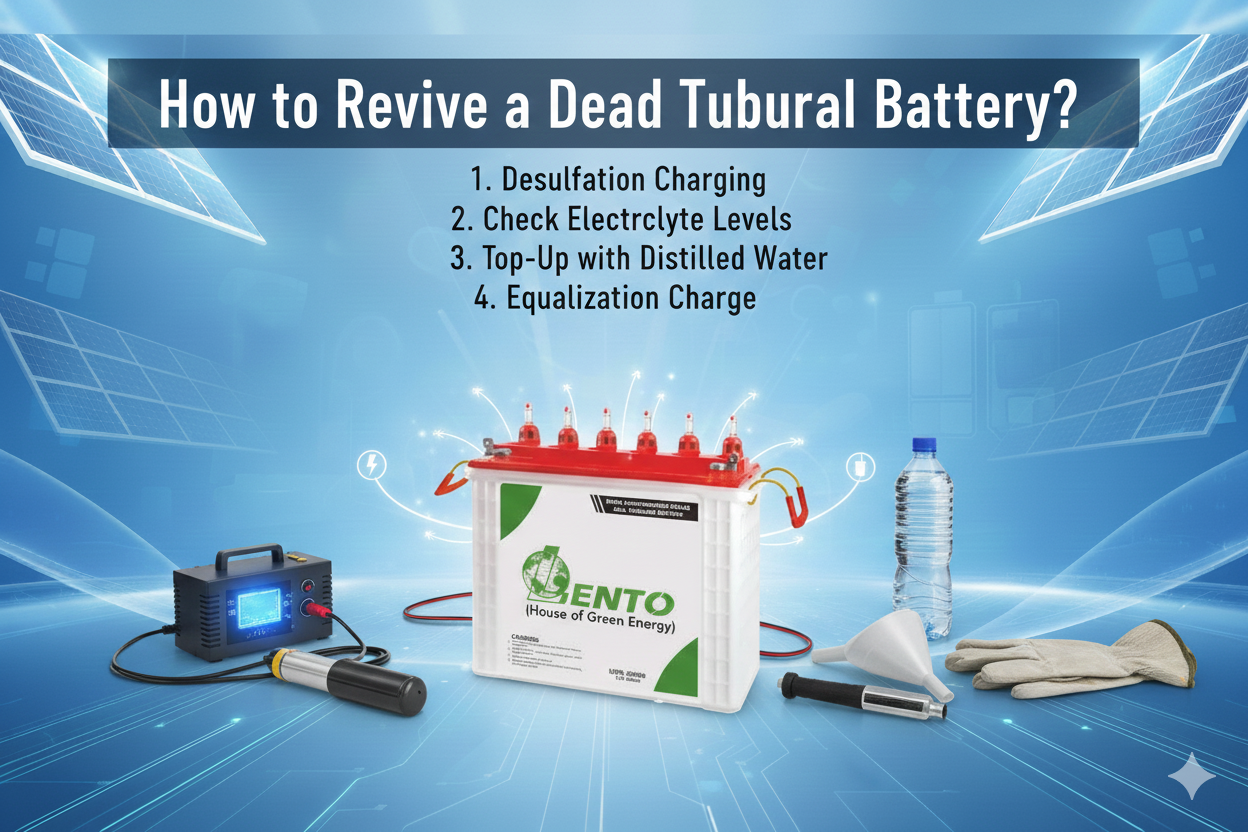
How to Revive a Dead Tubular Battery: A Complete Guide to Repair and Recovery
01 December 2025
The power goes out, you turn to your inverter expecting backup, and nothing happens. No lights, no fan, just silence. In most cases the culprit is a dead tubular battery.
The battery is the heart of your inverter system. Even the most advanced inverter is useless if the battery can’t hold a charge. But before you spend money on a replacement, know that many batteries that seem dead can be restored. Knowing how to revive a dead tubular battery can save you money and extend the life of the battery you already own.
This guide covers:
- Why inverter batteries die
- How to check if a tubular battery is dead
- How to repair and restore a dead tubular battery, step by step
- Tubular battery maintenance tips to prevent the problem from coming back
Why Do Tubular Batteries Die?
Batteries rarely fail overnight. Most tubular battery issues build up slowly:
- Poor maintenance: Skipping distilled water top-ups, letting dirt build up, or leaving connections loose.
- Overcharging or deep discharging: Both shorten the battery’s life cycle.
- Electrolyte problems: Low water levels, acid stratification, or contaminated electrolyte.
- Sulfation: Hardened lead sulfate crystals form on the plates and reduce efficiency.
- Overloading: Connecting more load than the battery and inverter are sized for. Check our guide on inverter capacity for a 200Ah battery to see how to match them.
- Age: Most inverter batteries last 3 to 5 years, and performance drops naturally after that.
Finding the root cause tells you whether dead battery repair is worth attempting or whether replacement is the better option.
How to Check If a Tubular Battery Is Dead
Before you try any fix, confirm the battery is actually the problem. Watch for these signs:
- Tubular battery backup lasts only a few minutes (use our battery backup time calculator to see what backup you should be getting)
- Battery not charging, even when connected to the inverter for hours
- The inverter keeps beeping with a “low battery” warning
- A rotten-egg smell while charging
- Visible swelling, cracks, or leakage
Quick tests you can do:
- Voltage check: With a multimeter, measure the battery’s resting voltage (disconnected, after a few hours’ rest). A healthy 12V battery reads around 12.6 to 12.8V. A reading below about 11.8V suggests deep discharge, and a reading near or below 10.5V suggests serious damage.
- Specific gravity check: A hydrometer shows the electrolyte’s strength. Healthy cells typically read between 1.240 and 1.280. Large differences between cells point to a failing battery.
Safety warning: If the battery is swollen, cracked, or leaking, do not attempt revival. Replace it immediately.
How to Revive a Dead Inverter Battery: Step-by-Step Solutions
Reviving a battery isn’t one quick trick. It means working through each possible issue in order. Start with the simple fixes and move to the advanced ones only if needed.
1. Check and Refill the Electrolyte
The electrolyte, a mix of distilled water and sulfuric acid, lets current flow between the plates. If the level drops too low, the exposed plates are permanently damaged.
- Open the vent caps one by one.
- Look inside. If the plates are visible, the level is too low.
- Add only distilled water up to the indicator mark. Never use tap water, because its minerals damage the plates.
- Charge the battery for several hours, then test it again.
This one step often solves the tubular battery not charging problem. Many “dead” batteries have simply dried out.
2. Clean the Terminals and Connections
A white or greenish crust on the terminals restricts current flow and can make a healthy battery look dead.
- Disconnect the cables from the terminals.
- Apply a paste of baking soda and a little water to the corroded areas.
- Scrub gently with a brush until the metal is bright.
- Wipe clean, then reconnect the cables tightly.
It’s like clearing a blocked pipe: once the path is clear, electricity flows again.
3. Recharge the Dead Tubular Battery Slowly
When a battery is deeply discharged, the inverter’s built-in charger may not be strong enough to wake it up. Here’s how to recharge a dead tubular battery properly:
- Connect it to a dedicated trickle or smart charger (positive to positive, negative to negative).
- Let it charge slowly for 10 to 12 hours without interruption.
- Reconnect it to the inverter and test the backup time.
A slow, steady charge lets the battery recover without overheating. If the battery still won’t charge, also check that your inverter is compatible with the battery. Our suitable inverter for 200Ah battery guide covers the key compatibility points.
4. Equalization Charge (Flooded Batteries Only)
In flooded lead-acid batteries, acid can settle at the bottom while the top stays diluted. This is called stratification, and it weakens performance.
An equalization charge applies a slightly higher voltage for a controlled time. This mixes the electrolyte and helps break down stubborn sulfate crystals.
Note: Do this only occasionally, and preferably with a technician. Done incorrectly, it can overheat and damage the battery.
5. Replace the Electrolyte (Advanced Fix)
If the electrolyte is badly contaminated or weakened, adding water won’t help. A professional can:
- Drain the old electrolyte completely
- Prepare fresh sulfuric acid solution in the correct ratio with distilled water
- Refill and fully recharge the battery
This can give an old battery several more months, sometimes a year. But it involves handling acid, so only attempt it if you have experience, or get professional help.
6. Use Desulfation Additives or Pulse Devices
Sulfation is one of the biggest reasons batteries stop holding charge, because normal charging can’t dissolve hardened crystals.
- Chemical additives claim to dissolve sulfation slowly. Results vary, so treat them as a possible help, not a guarantee.
- Pulse desulfators send high-frequency pulses into the battery to break down crystals and restore plate activity.
How to Revive a Dead Inverter Battery at Home: What’s DIY-Friendly?
Safe to do yourself:
- Checking and topping up distilled water
- Cleaning terminals with baking soda and a brush
- Slow charging with an external charger
- Basic inspection for cracks, leaks, and unusual smells
Leave to a professional:
- Equalization charging
- Electrolyte replacement
- Anything involving handling concentrated acid
Tubular Battery Maintenance: How to Keep It Healthy After Revival
Good tubular battery maintenance is the best form of battery troubleshooting, because it prevents problems before they start:
- Top up regularly: Check water levels every 2 to 3 months. Add distilled water if plates are exposed.
- Keep it ventilated: Good airflow prevents overheating and gas buildup.
- Don’t overload the inverter: Too many appliances force deep discharges that shorten battery life.
- Recharge after every power cut: Don’t leave the battery half-discharged for long.
- Do an occasional full cycle: Every few months, discharge within safe limits and then recharge fully to prevent sulfation.
- Clean terminals regularly: A quick wipe every few months stops corrosion early.
- Avoid long idle periods: If your area rarely has power cuts, give the battery a full charge every 2 to 3 months.
For more answers on battery care, visit the Lento solar battery FAQ section.
When Revival Isn’t Enough
Not every battery can be saved. If your battery is more than 4 to 5 years old, bulging, leaking, or fails to hold charge even after these fixes, replacement is the smarter and safer choice.
At Lento Industries Pvt. Ltd. (Lento India), we manufacture tubular inverter batteries built for long life, high-temperature performance, and dependable backup.
- Built for Indian and global climates: Our C10 tubular batteries suit regular home and small commercial use, while our C20 tubular batteries offer extended cycle life for heavy-duty applications.
- Export quality: Trusted in more than 24 countries.
- Low maintenance, high durability: Less topping up and a longer lifespan.
- For every use: Home, office, and industrial applications.
Browse the complete Lento lead acid tubular battery range to find the right fit. Not sure which brand or model to pick? Read our buying guide on which brand tubular battery is best or see the top 10 inverter batteries in India. For a home setup, our top 10 inverter batteries for home list compares tubular, SMF and lithium options.
Pairing the battery with the right inverter matters too. See our household sine wave inverters, or contact our team for guidance on matching a battery to your load.
Frequently Asked Questions (FAQs)
1. Can you revive a completely dead battery?
A completely dead battery may recover if it is only deeply discharged. However, if its internal components are damaged, replacement may be necessary.
2. What is the average life of a tubular battery?
A tubular inverter battery typically lasts around 3–5 years, depending on usage, maintenance, charging conditions, and battery quality.
3. How to revive a battery that won't hold a charge?
Check the charger, wiring, and battery terminals first. A professional battery test can identify deep discharge, sulphation, or internal damage. If the battery is worn out, replacement is usually the best option.
4. How do I bring my old battery back to life?
For a rechargeable inverter battery, use a compatible charger and check its condition. Avoid adding chemicals or opening the battery yourself. If it still cannot hold a charge, consult a battery technician.
5. How to revive a dead tubular battery at home?
Ensure the battery is connected to a compatible charger and inspect it for visible damage. Deeply discharged batteries may require professional recovery. Never open the battery or handle its electrolyte at home.
6. Can you revive a dead lithium battery?
A lithium battery may stop working because of low voltage or a battery management system (BMS) safety cutoff. Use only the manufacturer-approved charging method and seek professional service if it does not respond.
7. How to repair a battery at home?
You can safely check external connections, corrosion, and charger compatibility. Internal repairs, electrolyte handling, and lithium battery recovery should be left to qualified technicians.
8. When should you replace an inverter battery instead of repairing it?
Consider replacement if the battery repeatedly fails to hold a charge, provides very little backup, shows physical damage, or fails a professional capacity test.
Conclusion
Learning how to revive a dead tubular battery can save you money and give your inverter battery a second life. Simple steps like refilling distilled water, cleaning terminals, and slow charging fix many cases, and regular maintenance keeps the problem from returning.
But no battery lasts forever. When repair no longer makes sense, choose a reliable replacement. Explore Lento tubular batteries for durability, performance, and uninterrupted power, so the next power cut doesn’t leave you in the dark.
Read More
- Which Brand Tubular Battery Is Best? Buying Guide for Indian Homes
- Top 10 Inverter Batteries in India: Best Tubular, SMF and Lithium Options for Home Backup
- 150Ah Battery Backup Time Calculator: How Many Hours Will It Run? (Formula + Chart)
- Inverter Capacity for 200Ah Battery: Formula, Chart & Calculator
- Suitable Inverter for 200Ah Battery: The 6-Point Compatibility Guide