Best Inverter for Home with Battery
29 May 2026
Stop Buying Two Things When One Does the Job Better
Picture this. You walk into a store asking for the best inverter for home with battery. The salesman points left — inverters. Points right — batteries. You pick one of each, pay separately, install separately, maintain separately, and replace separately.
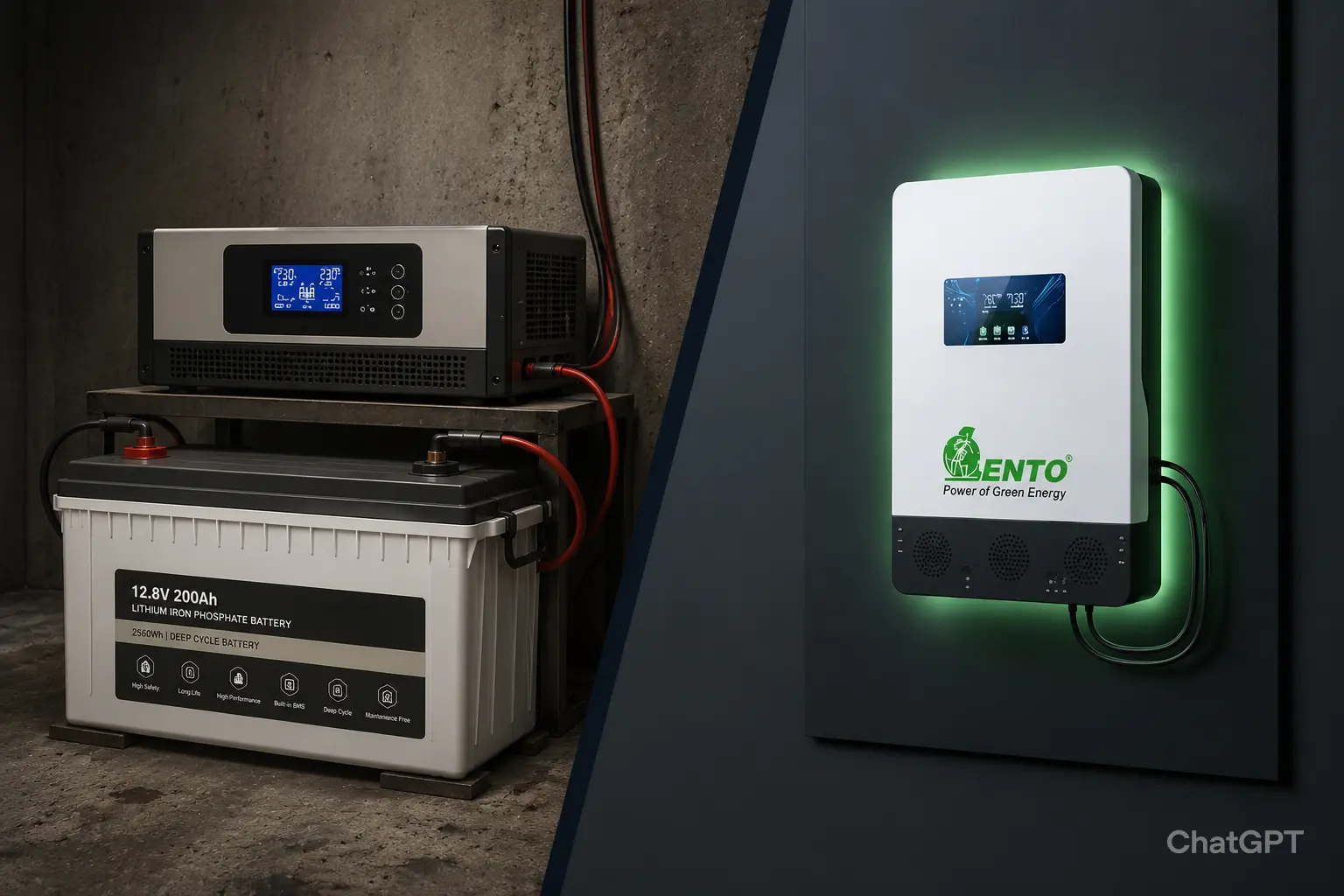
Now picture a different experience. One unit. One price. One installation. One decade of zero maintenance.
That second experience is what Lento Industries Private Limited delivers — and it is precisely why Lento is rapidly earning the title of best inverter company in India for homeowners who want a lithium battery inverter that genuinely solves the power backup problem rather than adding a new one. Whether you are searching for a dependable solar inverter, a smart hybrid solar inverter that charges from rooftop panels, or simply the most reliable power inverter for home that comes with its own lithium ion battery for inverter built in — the best inverter with battery for home in India today is not a combination of two separate products. It is a single Lento unit, engineered as one.
The Problem With "Inverter + Battery" as Two Separate Products
India's inverter market has sold the same formula since the 1980s. Buy an inverter. Buy a battery. Connect them. Maintain the battery. Replace the battery. Repeat.
It works. In the same way a bucket with a hole in it works — technically functional, endlessly frustrating.
Here is what that traditional formula actually costs a household over 10 years:
The inverter unit sits at ₹5,000–9,000. The first tubular battery runs ₹12,000–18,000. By Year 3 or 4, that battery needs replacing — another ₹14,000–19,000. By Year 7 or 8, it needs replacing again. Add maintenance costs, electricity lost to inefficient lead-acid charging, the space the battery occupies, and the time spent managing it — and the "affordable" traditional setup has quietly cost more than a premium lithium solution while delivering an inferior experience every single day.
The best inverter with battery for home is not a cheaper product. It is a smarter one.
How Lento Solved the Inverter-Battery Problem Permanently
Lento's engineering answer was simple in principle and complex in execution: put the battery inside the inverter.
Not as an accessory. Not as an optional upgrade. As a fundamental design decision that changes every aspect of the ownership experience.
Every Lento inbuilt lithium inverter ships as a complete power backup system:
What you get in one box:
- Pure sine wave inverter electronics
- Smart Battery Management System (BMS)
- Inbuilt lithium-ion battery (100AH)
- Solar charge controller (PWM or MPPT on hybrid models)
- All protection systems — overcharge, deep discharge, short circuit, thermal management
What you never need again:
- Separate battery purchase
- Battery installation and wiring
- Distilled water top-ups
- Terminal corrosion cleaning
- Replacement planning every 3 years
- Extra space for a 50-kilogram battery cabinet
This is what separates Lento from every other inverter brand in India selling a box that needs another box to function.
The Three Inbuilt Lithium Inverter Product Lines
Line 1 — Sine Wave Inverter with Inbuilt Lithium Battery
The cleanest power available for home use. Pure sine wave output is identical to the electricity your utility provides — safe for every appliance without exception, from variable-speed ACs to medical equipment to laptops.
|
Model |
Battery Voltage |
Rated Capacity |
Battery Type |
Applications |
|
Li-ion 1100VA/12V |
12.8V |
1100 VA |
Lithium 100AH |
Household & Commercial |
|
Li-ion 2100VA/24V |
25.6V |
2100 VA |
Lithium 100AH |
Commercial, Hybrid Solar |
|
Li-ion 2500VA/24V |
25.6V |
2500 VA |
Lithium 100AH |
Commercial & Household |
Who it is for: Homeowners who want reliable, appliance-safe backup power in the simplest possible form. No solar panels needed. Just plug in, and your home is protected.
Line 2 — Hybrid Solar Inverter with Inbuilt Lithium Battery (Off-Grid PWM)
For homes taking their first step into solar energy. PWM (Pulse Width Modulation) charge control manages energy input from solar panels and the grid simultaneously — automatically prioritising solar when available, grid when not.
|
Model |
Battery Voltage |
Rated Capacity |
Battery Type |
Applications |
|
Li-ion 1100VA/12.8V |
12.8VDC |
1100 VA |
Lithium 100AH |
Household |
|
Li-ion 2100VA/25.6V |
25.6VDC |
2100 VA |
Lithium 100AH |
Household |
|
Li-ion 2500VA/25.6V |
25.6VDC |
2500 VA |
Lithium 100AH |
Household |
Who it is for: Households installing their first rooftop solar setup who want an affordable entry into solar-powered backup without complexity.
Line 3 — Hybrid Solar Inverter with Inbuilt Lithium Battery (Off-Grid MPPT)
Lento's most technically advanced home product. MPPT (Maximum Power Point Tracking) technology continuously monitors and adjusts to extract the maximum possible energy from solar panels — delivering up to 30% more output than PWM in real-world conditions, including cloudy weather, early morning light, and partial shading.
|
Model |
Battery Voltage |
Rated Capacity |
Battery Type |
Applications |
|
Li-ion 1100VA/12V |
12.8V |
1100 VA |
Lithium |
Household |
|
Li-ion 2100VA/24V |
25.6V |
2100 VA |
Lithium |
Household & Commercial |
|
Li-ion 2500VA/24V |
25.6V |
2500 VA |
Lithium |
Household & Commercial |
Who it is for: Homes serious about maximising solar investment. If you have panels installed or are planning a serious solar setup, MPPT pays for its premium through greater energy harvesting from day one.
Where Do Other Brands Stand? An Unsponsored Look
Luminous leads India in inverter distribution volume and has for decades. Their service network is the envy of every competitor — virtually every town in India has a Luminous service point. Their product range is genuinely wide. Their core limitation in 2026 is that the majority of their lineup still routes customers back to lead-acid battery purchases — a model that serves Luminous's recurring revenue well and the customer's long-term budget less so.
Exide has built real engineering credibility over generations of battery manufacturing. Their inverter batteries consistently outperform cheaper alternatives, particularly in high-heat environments. The gap between Exide and Lento is not quality — it is architecture. An Exide system remains two products requiring periodic attention. A Lento system is one product requiring none.
Microtek serves India's price-sensitive markets well and deserves credit for making backup power accessible in smaller cities and towns. For a family needing 3 hours of basic backup — lights, fans, phone charging — Microtek delivers honest value. For households with higher expectations — solar readiness, longer backup, zero maintenance — Microtek's current range does not yet deliver.
Amaron by Amara Raja earns consistent praise for battery performance in extreme temperatures. That is a genuine technical advantage in a country where summer temperatures regularly exceed 45°C. The limitation is that Amaron's battery strength exists within a conventional system architecture that still requires maintenance and eventual replacement.
Su-Kam pioneered off-grid solar inverters in India and brought solar backup to communities that grid infrastructure had not yet reached. Their contribution to rural energy access is real and lasting. Their current product lineup needs modernisation to compete in urban and semi-urban markets where buyers now expect lithium batteries, MPPT charging, and maintenance-free operation as standard.
Livguard has invested effectively in urban brand positioning — modern design, clean interfaces, and growing visibility among tech-aware buyers. They are winning aesthetically. The underlying product architecture, however, still pairs the inverter with an external lead-acid battery. The look has changed; the ownership experience has not.
Which Lento Model Is Right for Your Home?
Answer three questions and the right model finds you:
Do you have rooftop solar panels or plan to install them? — Yes → Choose a Hybrid Solar Inverter (PWM for basic setup, MPPT for maximum efficiency) — No → Choose the Sine Wave Inverter with Inbuilt Lithium Battery
What is your total backup load? — Up to 800W (1–2 BHK basic) → 1100VA model — Up to 1,600W (2–3 BHK standard) → 2100VA model — Up to 2,000W (3–4 BHK or home office) → 2500VA model
How important is energy efficiency from solar panels? — Very important → MPPT Hybrid (up to 30% more solar output) — Moderate → PWM Hybrid (reliable, cost-effective solar integration)
Amazon Availability (Single Unit Purchase)
Lento inverters are available on Amazon, allowing you to:
- Buy single units
- Compare features and pricing
- Check customer reviews
- Get home delivery
This makes Lento a convenient option for the best inverter with battery for home in India.
Read more:-
Lithium ion battery 200ah price in India
Which Inverter is Best for Home Use
Questions Buyers Are Asking — Answered Directly
Q1. Which is the best battery inverter for home?
A pure sine wave inverter with a lithium-ion battery is considered the best option for homes due to better efficiency and longer backup life.
Q2. What size inverter do I need for my home battery?
For most homes, a 900VA–1500VA inverter is suitable, while larger homes may require 2kVA–5kVA systems depending on power usage.
Q3. Is a 150Ah battery enough for a home?
Yes, a 150Ah battery is enough for small to medium homes and can run lights, fans, TV, and basic appliances for several hours.
Q4. How much does an inverter cost for a 2BHK?
An inverter setup for a 2BHK home generally costs between ₹15,000 and ₹60,000 depending on inverter type and battery capacity.
Q5. Which size inverter is best for a home?
A 900VA to 1500VA pure sine wave inverter is ideal for most Indian homes with normal daily power requirements.
Q6. How many hours is a 150Ah battery?
A 150Ah battery typically provides around 4–8 hours of backup depending on the connected load and inverter efficiency.
The Thought That Should Follow You Out of This Article
Every inverter company in India will tell you they make the best product. The ones that truly do show it through design decisions, not marketing claims.
The decision to integrate the battery inside the inverter — to accept the engineering complexity of making one product do what the industry has always asked customers to do themselves — is Lento's clearest proof of intent.
It is not a feature on a spec sheet. It is a statement about what a company believes its customers deserve.
Indian homeowners deserve an inverter with battery that works, lasts, and disappears into the background of their lives. Lento builds exactly that — and has built nothing else.
2026 Lento Industries Private Limited. All rights reserved. Explore the complete range at www.lentoindia.com