Inverter Battery Guide for Indian Homes: Everything You Need to Know
29 May 2026
Picking the right inverter battery is the single most important decision in your home power backup setup — and getting it wrong means frequent replacements, poor backup time, and unnecessary expense. If you want the best inverter battery that delivers reliable power through every outage, this guide is built for you. The best inverter battery for home use in India must match your daily load, tolerate Indian grid conditions, and offer genuine long-term value. In this comprehensive guide, we help you find the best inverter battery in India across all budgets and use cases — covering inverter battery price, tubular battery types, lithium battery inverter systems, and lithium ion battery for inverter applications. We also compare the market-favourite 150ah battery and lay out the real 150 ah battery price across both lead-acid and lithium technologies so you can buy smarter.
What Is an Inverter Battery and How Does It Work?
An inverter battery stores electrical energy during normal grid supply and releases it through an inverter when power goes out. The battery's capacity — measured in ampere hours (AH) — determines how long your appliances will run. A higher AH rating means longer backup time.
The two core technologies dominating the Indian market today are Lead Acid Tubular Batteries and Lithium Ion Batteries (LiFePO4). Understanding the difference between them is the first step to choosing the best inverter battery for your specific situation.
Key parameters every buyer must evaluate:
- Capacity (AH): Defines backup duration. More AH = longer runtime
- Voltage (V): Must match your inverter's input requirement
- C-Rating: Discharge speed — C-10 for heavy loads, C-20 for sustained moderate loads
- Cycle Life: Number of charge-discharge cycles before significant capacity loss
- Maintenance: Tubular requires water top-ups; lithium requires none
- Inverter Battery Price: Upfront cost vs total 10-year ownership cost
Type 1: Lead Acid Tubular Battery (C-10) — India's Most Popular Inverter Battery
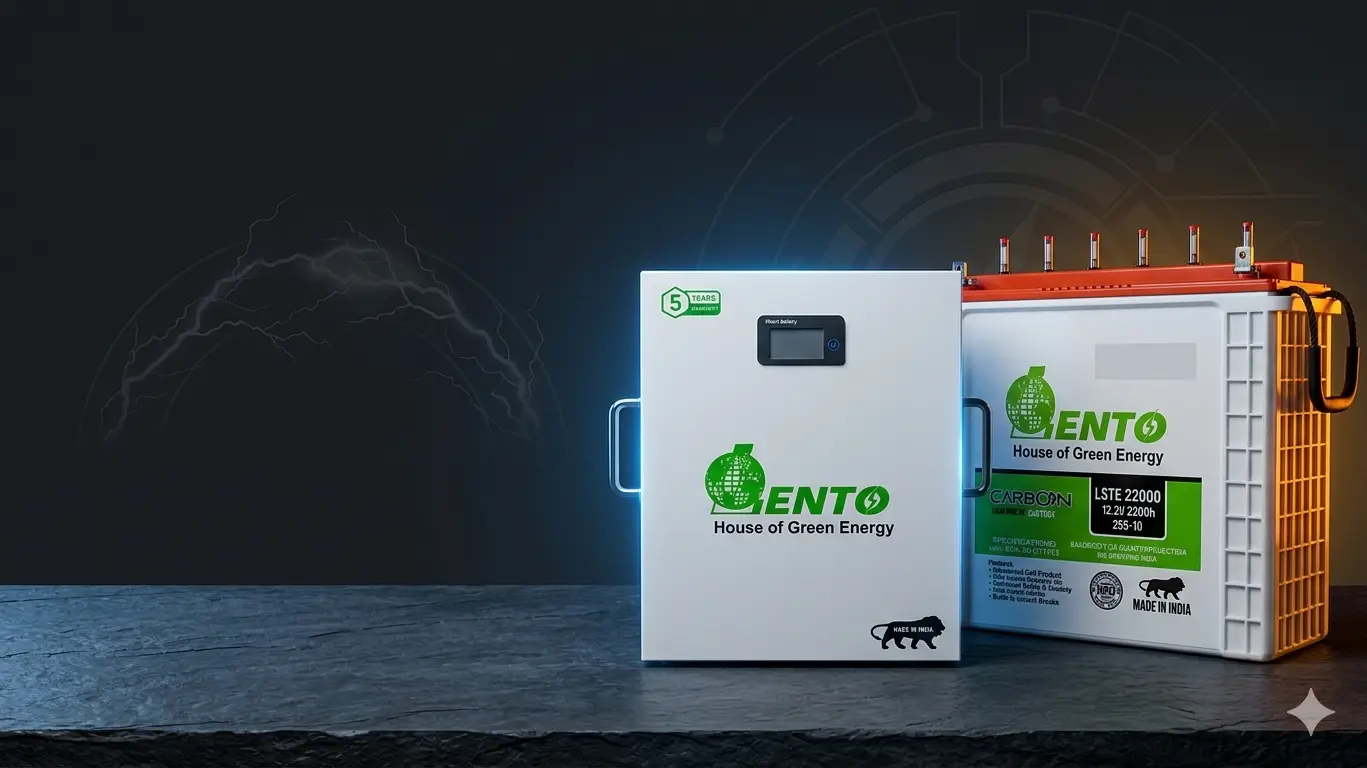
The C-10 tubular battery is the most widely used inverter battery across Indian homes, clinics, and offices. Built for a 10-hour discharge cycle, it handles high loads reliably — making it the default recommendation whenever homeowners ask for the best inverter battery for home use on a budget.
The best inverter battery in India at the 150 AH level — the LSTB C10 16500 — is India's bestselling home backup battery. It comfortably powers fans, lights, a television, and a Wi-Fi router through 6–8 hours of outage. For homes with heavier loads or longer cuts, the 200 AH and 250 AH models step in without compromise.
|
Model |
Voltage |
Capacity |
Net Weight |
Typical Applications |
|
LCTB C10 7000 |
12V |
50 AH |
28 Kg |
Home lights, basic appliances |
|
LSTB C10 12000 |
12V |
100 AH |
51.3 Kg |
Clinics, home backup setups |
|
LSTB C10 16500 |
12V |
150 AH |
59.8 Kg |
Homes, offices, backup systems |
|
LSTB C10 22000 |
12V |
200 AH |
62.5 Kg |
Retail, small healthcare centers |
|
LSTB C10 27000 |
12V |
250 AH |
69.0 Kg |
Commercial spaces, hybrid solar |
|
LSTB C10 32000 |
12V |
300 AH |
75.0 Kg |
Commercial spaces, hybrid solar |
The 150ah battery (LSTB C10 16500) remains the undisputed top-seller — delivering the perfect balance of backup time, footprint, and inverter battery price for a standard 2–3 BHK Indian home.
Type 2: Lead Acid Tubular Battery (C-20) — Optimised for Sustained Low Loads
The C-20 tubular battery operates on a 20-hour discharge cycle, making it better suited for moderate, sustained loads — such as a clinic or office running lights and ceiling fans through a long outage. It delivers slightly higher usable energy under lighter conditions compared to its C-10 equivalent.
The best inverter battery for home in the C-20 range for standard use is again the 150 AH model (LSTB C20 16500), which weighs 58.3 Kg — fractionally lighter than the C-10 equivalent — and fits comfortably in most Indian homes and offices.
|
Model |
Voltage |
Capacity |
Gross Weight |
Typical Applications |
|
LSTB C20 7000 |
12V |
50 AH |
28 Kg |
Home lights, basic appliances |
|
LSTB C20 12000 |
12V |
100 AH |
49.8 Kg |
Clinics, home backup setups |
|
LSTB C20 16500 |
12V |
150 AH |
58.3 Kg |
Homes, offices, backup systems |
|
LSTB C20 22000 |
12V |
200 AH |
61.0 Kg |
Retail, small healthcare centers |
|
LSTB C20 27000 |
12V |
250 AH |
66.0 Kg |
Commercial spaces, hybrid solar |
|
LSTB C20 32000 |
12V |
300 AH |
74.0 Kg |
Commercial spaces, hybrid solar |
Both tubular ranges cover 50 AH to 300 AH — from basic home lighting all the way to large commercial and hybrid solar installations. The right choice between C-10 and C-20 depends entirely on your average appliance load and how quickly the battery needs to discharge.
Type 3: Lithium Ion Battery for Inverter Use (LiFePO4) — The Future Standard
For homeowners and businesses who demand zero maintenance, maximum lifespan, and solar compatibility, the lithium ion battery for inverter systems is the definitive upgrade. Powered by LiFePO4 (lithium iron phosphate) chemistry — the safest and most thermally stable lithium technology available — these batteries deliver 4,000 to 8,000+ charge cycles versus 500–800 for a conventional tubular battery.
A lithium battery inverter setup charges 2–3 times faster, discharges more efficiently across the entire capacity range, and weighs dramatically less than an equivalent lead-acid system. The 12.8V 100 AH LiFePO4 model, for example, weighs just 14 Kg — compared to 51.3 Kg for a lead-acid 100 AH inverter battery.
|
Parameter |
100AH 12.8V |
200AH 12.8V |
100AH 25.6V |
200AH 25.6V |
100AH 51.2V |
200AH 51.2V |
300AH 51.2V |
|
Chemistry |
LiFePO4 |
LiFePO4 |
LiFePO4 |
LiFePO4 |
LiFePO4 |
LiFePO4 |
LiFePO4 |
|
Voltage |
12.8V |
12.8V |
25.6V |
25.6V |
51.2V |
51.2V |
51.2V |
|
Capacity |
100 AH |
200 AH |
100 AH |
200 AH |
100 AH |
200 AH |
300 AH |
|
Energy (Wh) |
1,280 |
2,560 |
2,560 |
5,120 |
5,120 |
10,240 |
15,360 |
|
Weight (Kg) |
14±0.5 |
26±0.5 |
26±0.5 |
49±0.5 |
49±0.5 |
93±0.5 |
152±0.5 |
|
Dimensions (mm) |
338×191×284 |
404×191×454 |
404×191×454 |
640×420×157 |
640×420×157 |
748×450×279 |
748×450×279 |
|
Cycle Life |
≥4,000 |
≥4,000 |
≥4,000 |
≥4,000 |
≥4,000 |
≥4,000 |
≥8,000 |
The flagship 51.2V 300 AH model stands apart with an exceptional ≥8,000 cycle life — the highest in its class — delivering 15,360 Wh of energy for large commercial and solar hybrid applications.
Inverter Battery Price Guide: India 2026
Here is a realistic inverter battery price breakdown across all major types and capacities:
|
Battery Type |
Capacity |
Price Range (INR) |
|
Tubular C-10 / C-20 |
50 AH |
₹4,500 – ₹6,000 |
|
Tubular C-10 / C-20 |
100 AH |
₹8,500 – ₹11,000 |
|
150 ah battery price (Tubular) |
150 AH |
₹11,000 – ₹15,000 |
|
Tubular C-10 / C-20 |
200 AH |
₹15,000 – ₹20,000 |
|
Tubular C-10 / C-20 |
250–300 AH |
₹20,000 – ₹28,000 |
|
LiFePO4 |
100 AH (12.8V) |
₹18,000 – ₹28,000 |
|
LiFePO4 |
200 AH (25.6V) |
₹45,000 – ₹62,000 |
|
LiFePO4 |
200 AH (51.2V) |
₹80,000 – ₹1,10,000 |
|
LiFePO4 |
300 AH (51.2V) |
₹1,40,000 – ₹2,00,000+ |
The 150 ah battery price for a quality tubular inverter battery — India's bestselling capacity — sits between ₹11,000 and ₹15,000. While the lithium battery inverter price is higher upfront, its 10–12 year lifespan versus 3–5 years for tubular makes it far more economical over time.
Best Inverter Battery Recommendation by Use Case
|
Use Case |
Recommended Inverter Battery |
|
Basic home (lights + 1–2 fans) |
Tubular C-10 or C-20 — 50 AH or 100 AH |
|
Standard 2–3 BHK home |
150 AH Tubular (C-10 or C-20) |
|
Heavy load / long outages |
200 AH – 250 AH Tubular |
|
Clinic / small healthcare |
C-20 100 AH or LiFePO4 12.8V 100 AH |
|
Solar hybrid home |
LiFePO4 12.8V 200 AH or 25.6V |
|
Office / retail space |
200–300 AH Tubular or LiFePO4 25.6V |
|
Large commercial / solar farm |
LiFePO4 51.2V 200–300 AH |
Tubular Battery vs Lithium Ion Battery for Inverter: Which Is Better?
|
Feature |
Tubular Battery |
LiFePO4 Lithium Battery |
|
Upfront Cost |
Low |
Higher |
|
Cycle Life |
500–800 |
4,000–8,000+ |
|
Lifespan |
3–5 years |
10–12 years |
|
Maintenance |
Monthly water top-up |
Zero |
|
Weight |
High (50–75 Kg) |
Low (14–49 Kg) |
|
Charge Speed |
Slow |
2–3× faster |
|
Solar Compatible |
Partial |
Fully optimised |
|
Best For |
Budget home backup |
Long-term / solar / commercial |
For buyers who want the absolute best inverter battery in India regardless of upfront cost, LiFePO4 wins on every long-term metric. For budget-conscious homeowners who need reliable backup today, the tubular battery at 150 AH remains India's most trusted choice.
Read more:-
best inverter for home
Top 10 Tubular Battery Companies in India
Lithium inverter Battery price in India
Frequently Asked Questions (FAQs)
Q1. Which battery is best for an inverter?
Lithium-ion batteries are considered the best for inverters because they offer faster charging, longer lifespan, and low maintenance.
Q2. Which is better, a 150Ah or a 200Ah battery?
A 200Ah battery provides longer backup time than a 150Ah battery, making it better for larger loads and extended power cuts.
Q3. Which is India's no. 1 inverter battery?
Luminous is widely regarded as one of India's leading inverter battery brands for reliability and performance.
Q4. Can a 200Ah battery run AC?
Yes, a 200Ah battery can run an AC if paired with the correct inverter capacity and depending on the AC power consumption.
Q5. What are the top 3 battery brands?
Luminous, Exide, and Amaron are among the top battery brands in India for inverter and home backup solutions.
Final Verdict: Choosing the Best Inverter Battery in India
The right inverter battery is the one that precisely matches your load, backup duration, budget, and long-term goals. For the vast majority of Indian homes, the 150 AH tubular battery in C-10 or C-20 rating is the proven, cost-effective choice — India's most trusted inverter battery for good reason. For those who want the best inverter battery in India with zero maintenance, solar compatibility, and a lifespan that outlasts multiple tubular replacements, LiFePO4 lithium ion battery for inverter use is the definitive answer.
Whatever your requirement — from a small 50 AH unit for basic home lighting to a 300 AH LiFePO4 system for commercial solar hybrid use — there is an inverter battery in this range built precisely for your needs.