
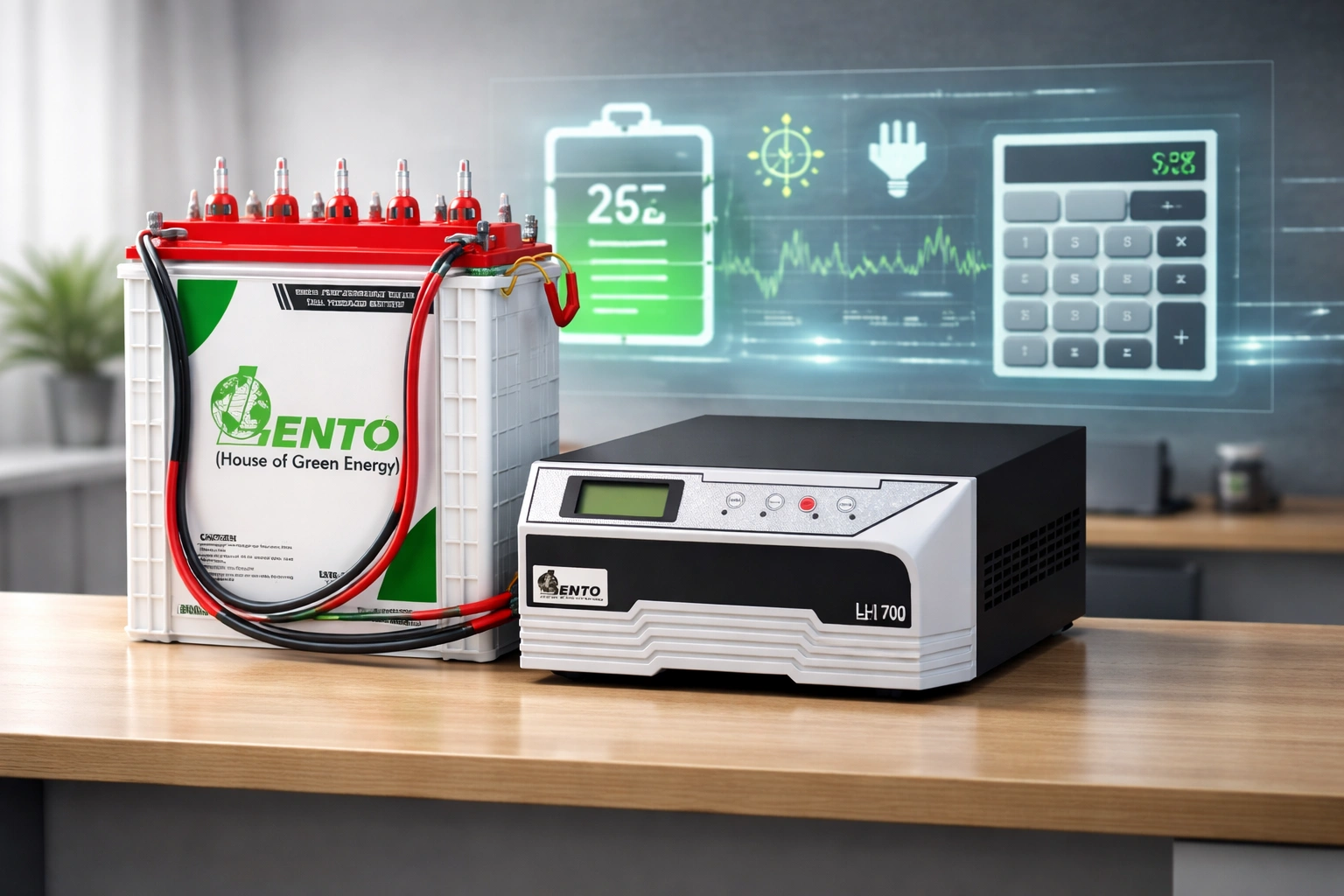
UPS Battery Backup Calculator – New Update
18 December 2025
“How long will my UPS battery actually provide backup?”
This is exactly where the UPS Battery Backup Calculator – New Updated Method becomes essential. Unlike older theoretical calculations, the updated backup calculator focuses on real-world operating conditions, including efficiency losses, battery discharge behavior, and long-term reliability. This ensures that the backup time you calculate is much closer to what you experience during an actual power cut.
In this in-depth blog, I will explain the latest UPS battery backup calculation logic, provide step-by-step working formulas, highlight common calculation mistakes, and help you understand how to select the right battery capacity. I will also explain how Lento Industries Pvt. Ltd. designs high-performance batteries that deliver predictable, stable backup aligned with modern calculation standards.
What Is a UPS Battery Backup Calculator?
A UPS Battery Backup Calculator is a structured method used to estimate the duration for which a UPS system can supply power to connected loads during a power outage. It translates battery specifications and load requirements into a practical time estimate that helps users plan their power backup system accurately.
Modern backup calculators are not limited to simple Ah and voltage values. Instead, they incorporate:
-
Battery usable capacity
-
UPS energy conversion efficiency
-
Load characteristics
-
Safe depth of discharge
The goal is to prevent under-sizing, which leads to insufficient backup, and over-sizing, which increases system cost unnecessarily. Updated calculators bring scientific accuracy to backup planning, especially for professional and commercial applications.
Why the New Update in UPS Battery Backup Calculation Is Necessary
Earlier UPS backup calculations were based on ideal laboratory conditions that rarely exist in real installations. Batteries do not operate at 100% efficiency, nor do UPS systems convert DC power to AC without losses.
The new update is essential because it:
-
Accounts for inverter/UPS conversion losses
-
Respects battery safety limits to extend service life
-
Reflects actual voltage drop under load
-
Provides realistic and achievable backup expectations
By using this updated approach, users can align their backup planning with practical performance rather than theoretical numbers, which is especially important for businesses and critical power environments.
Where Traditional UPS Backup Calculation Methods Fall Short
Older backup formulas assumed that the entire battery capacity was usable and that UPS systems had zero losses. In reality, these assumptions are inaccurate and often misleading.
Traditional calculations ignored:
-
Heat losses inside the UPS
-
Internal battery resistance
-
Battery aging over time
-
Cut-off voltage limitations
As a result, users often experienced 20–40% less backup time than expected. This mismatch between calculated and actual backup is the primary reason why updated calculators are now strongly recommended.
New Updated UPS Battery Backup Calculator Formula (Detailed Explanation)
The modern and practical UPS battery backup formula is:
Backup Time (hours) = (Battery Ah × Battery Voltage × UPS Efficiency × Battery Usable Factor) ÷ Load (Watts)
Each parameter in this formula reflects a real operational constraint and must be understood properly for accurate results.
Battery Capacity (Ah) – Delivered Capacity Matters More Than Rated Capacity
Battery capacity in ampere-hours (Ah) indicates how much current a battery can deliver over a specific time period. However, rated Ah and usable Ah are not always the same, especially under high load conditions.
Low-quality batteries often advertise high Ah ratings but fail to sustain voltage when the load increases. This leads to:
-
Early UPS shutdown
-
Reduced usable backup time
-
Faster battery degradation
At Lento Industries Pvt. Ltd., batteries are engineered using high-purity lead, optimized tubular plate design, and controlled manufacturing processes. This ensures that the usable Ah closely matches the rated Ah, even during extended discharge cycles.
Battery Voltage – Its Role in System Efficiency and Stability
Battery voltage directly impacts the overall efficiency of a UPS system. Higher voltage configurations reduce current flow, minimize losses, and improve system stability.
Common UPS voltage systems include:
-
12V (single battery systems)
-
24V (two-battery configurations)
-
36V and 48V (commercial and industrial UPS systems)
Higher voltage systems are preferred for professional applications because they deliver better efficiency, lower heating, and more consistent backup performance.
UPS Efficiency – The Most Critical Update in Modern Calculations
UPS efficiency represents how effectively the system converts DC battery power into usable AC output. No UPS operates at 100% efficiency.
Typical efficiency ranges:
-
Home inverter UPS: 82%–88%
-
Line-interactive UPS: 80%–85%
-
Online UPS: 78%–90% (depending on design and load level)
Ignoring UPS efficiency can result in significant overestimation of backup time. Updated calculators always include this factor to ensure realistic outcomes.
Battery Usable Factor (Depth of Discharge) – Protecting Battery Life
Modern UPS backup calculations consider that batteries should not be discharged fully on a regular basis. Deep discharges reduce battery life and increase the risk of failure.
Recommended usable capacity:
-
70%–80% for long battery life
By limiting usable capacity, the calculator ensures:
-
Longer battery service life
-
Stable voltage during discharge
-
Consistent backup performance over years
Lento batteries are designed to operate efficiently within this safe discharge window, making them ideal for updated calculation models.
Practical Example Using the Updated UPS Battery Backup Calculator
System Parameters:
-
Battery Capacity: 150Ah
-
Battery Voltage: 12V
-
Connected Load: 600W
-
UPS Efficiency: 85%
-
Battery Usable Factor: 80%
Calculation:
Backup Time = (150 × 12 × 0.85 × 0.8) ÷ 600 = 1224 ÷ 600 = 2.04 hours
This means the system will provide approximately 2 hours of reliable backup, which closely matches real-world performance.
Why Actual UPS Backup Time Can Still Vary
Even with accurate calculations, minor variations can occur due to:
-
Battery age and maintenance condition
-
Ambient temperature
-
Load fluctuations
-
Wiring quality
This is why choosing a high-quality battery is just as important as using the correct calculator.
Role of Battery Quality in Achieving Calculated Backup Time
Inferior batteries often show rapid voltage drop under load, causing UPS systems to shut down earlier than expected. This results in unreliable backup despite correct calculations.
Lento Industries Pvt. Ltd. focuses on:
-
Low internal resistance
-
High cycle life
-
Strong voltage retention
-
Fast recharge capability
These characteristics ensure that the calculated backup time is practically achievable, not just theoretical.
UPS Battery Backup Calculator Applications Across Different Segments
Residential Power Backup
Used for fans, lights, TVs, and routers. Accurate calculation ensures comfort without overspending.
Commercial and Office UPS
Supports computers, networking equipment, and security systems. Updated calculations prevent downtime.
Industrial and Online UPS Systems
Critical loads demand precision. Accurate backup planning avoids operational risk and financial loss.
Why Lento Industries Pvt. Ltd. Is a Trusted Name in UPS Batteries
At Lento Industries Pvt. Ltd., battery design goes beyond specifications on paper. Our products are engineered for real-world backup reliability, consistent performance, and long service life.
Our batteries deliver:
-
True-rated capacity
-
Predictable discharge behavior
-
Compatibility with modern UPS systems
-
Long-term cost efficiency
Final Conclusion
The UPS Battery Backup Calculator – New Update represents a major step forward in power backup planning. By incorporating efficiency losses, usable capacity, and real-world operating conditions, it provides a reliable and realistic estimate of backup time.
However, accurate calculation alone is not enough. The battery must be capable of delivering what the calculator predicts. With Lento Industries Pvt. Ltd., you invest in batteries that transform calculated numbers into dependable power backup performance.
Because true power reliability is not guessed—it is engineered.