
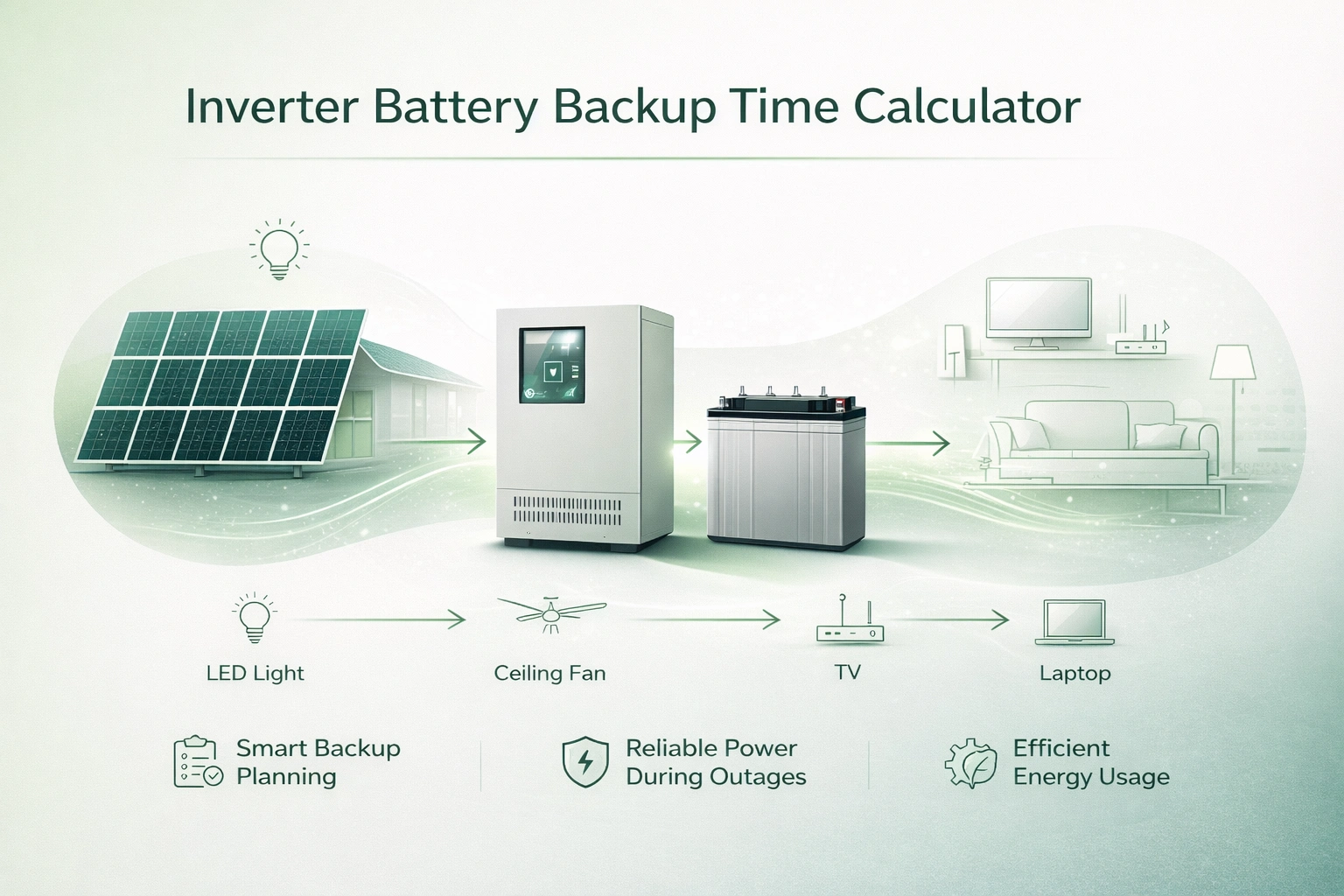
Inverter Battery Backup Time Calculator
18 December 2025
When the power goes out, the first question everyone asks is simple: “How long will my inverter battery last?”
The answer depends on more than just battery capacity. Load size, inverter efficiency, battery type, and real-world usage all play a critical role. This is exactly where an inverter battery backup time calculator becomes essential.
Whether you are a homeowner, business owner, installer, or solar professional, understanding how to accurately calculate inverter backup time helps you design a reliable power system, avoid battery damage, and prevent unnecessary upgrades.
This guide explains inverter battery backup time in clear terms, walks you through the calculation logic, and highlights the practical factors that affect real backup performance.
What Is Inverter Battery Backup Time?
Inverter battery backup time refers to the total duration (in hours) for which an inverter can supply electricity from the battery when grid power is unavailable. It indicates how long your essential appliances—lights, fans, TV, router, or office equipment—will continue running during a power cut.
Backup time is not a fixed value. It varies every time the connected load changes or the battery condition fluctuates.
Why Calculating Backup Time Matters
Many users assume that a higher Ah battery automatically means longer backup. In reality, incorrect calculations are the most common reason behind poor inverter performance.
An accurate inverter battery backup time calculation helps you:
-
Select the correct battery capacity
-
Prevent frequent battery deep discharge
-
Extend battery life
-
Avoid inverter overload
-
Optimize energy usage during outages
For solar-integrated systems, it also helps determine whether your battery bank can support nighttime or cloudy-day loads efficiently.
The Standard Inverter Battery Backup Time Formula
The widely accepted formula used by professionals is:
Backup Time (Hours) = (Battery Voltage × Battery Ah × Efficiency) ÷ Load (Watts)
This formula accounts for real-world energy losses instead of giving an ideal theoretical number.
Understanding Each Component
Battery Voltage
Common inverter systems operate at 12V, 24V, or 48V. Higher voltage systems are generally more efficient and stable for larger loads.
Battery Capacity (Ah)
Ampere-hour rating indicates how much energy the battery can store. Higher Ah means more backup, assuming the load remains constant.
Efficiency Factor
No inverter is 100% efficient. Losses occur during DC-to-AC conversion and battery discharge. Most modern inverters operate between 80% and 90% efficiency.
Load (Watts)
This is the total power consumed by all connected appliances at a given time.
Step-by-Step Backup Time Calculation (Practical Example)
Let’s consider a realistic home scenario.
Step 1: Calculate Total Load
-
4 LED lights (10W each) = 40W
-
3 fans (75W each) = 225W
-
TV = 120W
-
Wi-Fi router = 15W
Total Load = 400W
Step 2: Battery Specifications
-
Battery Voltage: 12V
-
Battery Capacity: 150Ah
-
Battery Type: Tubular
-
Inverter Efficiency: 85%
Step 3: Apply the Formula
Backup Time = (12 × 150 × 0.85) ÷ 400
Backup Time = 1530 ÷ 400
Backup Time ≈ 3.8 hours
This means your inverter system will realistically provide around 3.5–4 hours of backup, not the exaggerated figures often promised.
Key Factors That Affect Inverter Battery Backup Time
1. Battery Capacity and Quality
Two batteries with the same Ah rating can perform very differently depending on plate thickness, manufacturing quality, and age.
2. Connected Load Behavior
Backup time reduces significantly when high-watt appliances such as irons, pumps, or refrigerators are used simultaneously.
3. Battery Type
-
Tubular batteries offer longer backup and better tolerance for deep discharge
-
Lithium-ion batteries deliver higher efficiency, faster charging, and consistent backup
-
SMF batteries are maintenance-free but usually provide shorter backup cycles
4. Inverter Efficiency
Pure sine wave inverters provide better efficiency and protect sensitive electronics, improving real backup performance.
5. Battery Age and Maintenance
Older batteries with sulphation or poor maintenance can lose up to 30% of their effective capacity.
Backup Time Estimates for Common Battery Sizes
These are realistic averages under moderate load conditions:
-
12V 100Ah battery: 2–3 hours (300–400W load)
-
12V 150Ah battery: 3.5–4.5 hours
-
12V 200Ah battery: 5–6 hours
-
24V battery bank: Higher efficiency, suitable for heavy loads and longer backup
Actual results vary based on usage patterns and system design.
How to Increase Inverter Backup Time Effectively
-
Reduce unnecessary loads during outages
-
Replace high-watt appliances with energy-efficient alternatives
-
Upgrade to higher Ah or lithium-ion batteries
-
Maintain proper charging cycles
-
Avoid deep discharging below recommended limits
-
Use solar charging to extend backup duration
Amazon Availability (Single Unit Purchase)
Lento inverters are available on Amazon, allowing you to:
- Buy single units easily
- Compare features and prices
- Read customer reviews
- Get doorstep delivery
This makes it easier to find the best inverter with battery for home in India without hassle.
Final Thoughts
An inverter battery backup time calculator is not just a tool—it is a decision-making guide. It helps you design smarter power systems, protect your investment, and ensure uninterrupted electricity when you need it most.
If you want consistent backup performance, always calculate realistically, choose quality components, and size your system based on actual usage rather than assumptions.
FAQ-
1. What is an inverter battery backup time calculator?
An inverter battery backup time calculator is a tool used to estimate how long an inverter can supply power during an outage based on battery capacity, load consumption, and inverter efficiency. It helps users plan reliable power backup and choose the right battery-inverter combination.
2. How do I calculate inverter backup time manually?
Backup time is calculated using battery voltage, battery capacity (Ah), inverter efficiency, and total load in watts. While calculators simplify the process, manual calculation helps users understand real-world performance and avoid unrealistic expectations.
3. Why does my inverter give less backup than expected?
Reduced backup time is usually caused by higher connected load, battery ageing, low inverter efficiency, improper charging, or frequent deep discharge. Real backup time is often lower than rated values due to unavoidable system losses.
4. Does battery Ah alone decide inverter backup time?
No. Battery Ah is only one factor. Backup time also depends on inverter efficiency, battery voltage, load behavior, battery type, and operating conditions such as temperature and battery health.
5. How does inverter efficiency affect battery backup?
Higher inverter efficiency means less energy loss during DC-to-AC conversion, resulting in longer usable backup time. Pure sine wave inverters generally offer better efficiency than modified or square wave inverters.
6. Which battery type gives the longest inverter backup?
Lithium-ion batteries usually provide the longest usable backup due to higher depth of discharge and efficiency. Tubular batteries offer reliable and consistent backup for frequent power cuts, while SMF batteries provide shorter backup cycles.
7. Can solar panels increase inverter battery backup time?
Yes. Solar panels recharge the battery during the day, reducing discharge and extending available backup time. In solar-hybrid systems, backup duration improves significantly when sunlight is available.
8. Does inverter size affect backup time?
Inverter size does not increase backup time. Backup duration depends on battery capacity and load. A higher-capacity inverter only allows you to connect more appliances, not run them longer.
9. How much load should I connect to get maximum backup?
For optimal backup time, it is recommended to connect only essential appliances such as lights, fans, TV, router, and laptops. Avoid high-wattage devices like irons, heaters, and pumps during outages.
10. What voltage system gives better inverter backup?
Higher voltage systems (24V or 48V) are more efficient and experience lower current losses. They are better suited for higher loads and longer backup requirements compared to 12V systems.
11. How accurate are online inverter backup time calculators?
Online calculators provide reliable estimates when correct inputs are used. However, actual backup may vary due to battery condition, temperature, usage patterns, and real-time load fluctuations.
12. Can old batteries affect backup time calculations?
Yes. As batteries age, their effective capacity decreases. Backup time calculators assume healthy batteries, so old or poorly maintained batteries may deliver significantly less backup than calculated.