
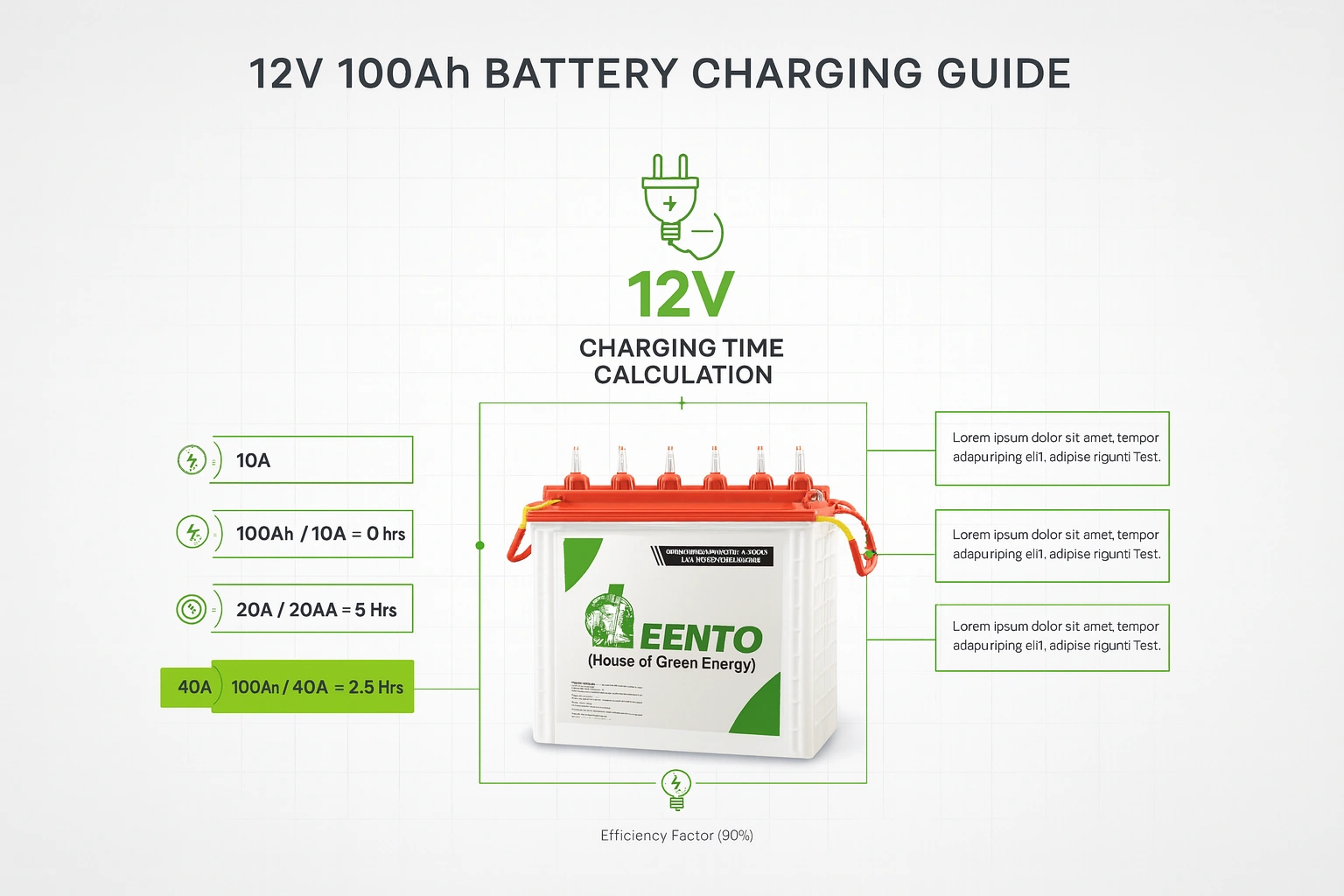
How Long Does It Take to Charge a 12V 100Ah Battery?
10 December 2025
When your inverter shuts down unexpectedly or your solar system fails to deliver backup during a power cut, one question immediately comes to mind: “How long does it take to fully charge a 12V 100Ah battery?”
It might seem like a simple question, but the answer depends on several technical and real-world factors such as charger size, battery type, battery age, and charging method.
In this guide, you will learn the exact formula, real charging time scenarios, expert tips, and the differences between lead-acid and lithium battery charging. By the end, you will know precisely how to calculate your own battery’s charging time and choose the right charger to protect your battery life.
Understanding the Basics: What Does 12V 100Ah Mean?
Before calculating charging time, it’s important to understand what the battery specification means:
-
12V → The nominal voltage of the battery
-
100Ah (Amp-hours) → How much current the battery can provide in one hour
For example:
A 100Ah battery can supply 100 amps for 1 hour, 20 amps for 5 hours, or 10 amps for 10 hours—in theory.
This capacity directly affects the charging duration because a larger Ah rating requires a larger amount of energy to refill.
The Charging Time Formula (Simple & Accurate)
To calculate how long it takes to charge a 12V 100Ah battery, we use the universal calculation:
Charging Time (hours) = Battery Capacity (Ah) ÷ Charger Current (A) × 1.15
The 1.15 factor accounts for power losses and battery inefficiencies.
Example
If you use a 10A charger:
Charging Time = 100Ah ÷ 10A × 1.15
Charging Time = 11.5 hours
This is an ideal estimation, but real-world results may vary based on battery condition and temperature.
Types of Chargers and Their Charging Speeds
Different chargers produce different charging times. Understanding them will help you choose the right one for your needs.
1. Slow Chargers (5A – 10A)
Commonly used in home inverters, these chargers are gentle and safe for lead-acid batteries.
Pros:
-
Prevent overheating
-
Ideal for long-term battery health
-
Low risk of overcharging
Cons:
-
Very slow charging
Charging Time Examples:
-
5A charger → 20–24 hours
-
10A charger → 11–14 hours
2. Medium Chargers (15A – 20A)
A balanced choice for solar systems, automotive chargers, and deep-cycle batteries.
Pros:
-
Faster charging
-
Safe for most batteries
-
Suitable for daily usage
Cons:
-
Require monitoring if not smart chargers
Charging Time Examples:
-
15A charger → 7–9 hours
-
20A charger → 5–7 hours
3. Fast Chargers (30A – 40A)
These are used when you need quick charging, such as RV systems, backup applications, and commercial setups.
Pros:
-
Quick turnaround time
-
Ideal for emergency charging
Cons:
-
Risk of overheating
-
May reduce lead-acid battery life
-
Not suitable for old batteries
Charging Time Examples:
-
30A charger → 3–4 hours
-
40A charger → 2.5–3.5 hours
4. Smart Chargers and MPPT Solar Chargers
These are equipped with intelligent voltage and current control.
Benefits:
-
Automatic cut-off
-
Temperature compensation
-
Safer charging
-
Faster charging due to optimized algorithm
Best For:
-
Lithium batteries
-
Solar systems
-
Expensive deep-cycle batteries
The Three Charging Stages and Why They Matter
Every high-quality charger follows three stages:
1. Bulk Charging (0% to 80%) – Fastest Phase
-
Charger delivers maximum current
-
Battery charges quickly
-
Determines most of the charging duration
At this stage, the battery gains maximum energy in the shortest time.
2. Absorption Charging (80% to 99%) – Slow Phase
-
Charging speed drops
-
Voltage rises and stabilizes
-
Prevents battery damage
Users often assume their battery charges slowly due to this phase, but it is a necessary safety measure.
3. Float Charging (99% to 100%) – Maintenance Phase
-
Keeps battery fully charged
-
Minimal current flow
-
Prevents battery self-discharge
This stage does not add much “usable” charging time but ensures long battery life.
Real-World Charging Time Scenarios
Here are practical examples you can relate to:
Scenario 1: 10A Home Inverter Charger
-
Common in houses
-
Charging time: 12–14 hours
Scenario 2: 20A Automotive Smart Charger
-
Popular with car batteries and solar users
-
Charging time: 6–8 hours
Scenario 3: 30A Fast Charger
-
Used when quick turnaround is needed
-
Charging time: 3–5 hours
Scenario 4: MPPT Solar Charging
-
Depends on sunlight quality
-
On a sunny day: 6–8 hours
-
Cloudy conditions: 10+ hours
Factors That Affect Charging Time
Several hidden factors influence how long your battery takes to charge:
-
Battery age
Older batteries charge slower. -
Depth of Discharge (DoD)
A 50% discharged battery charges faster than a fully empty one. -
Temperature
Extreme cold and heat slow charging. -
Wiring and connection quality
Thin or loose wires cause power loss. -
Battery type
Lithium charges faster than lead-acid. -
State of Health (SoH)
Weak batteries take longer to reach full charge.
Common Mistakes Users Make (And How to Avoid Them)
-
Using an underrated charger
-
Overcharging with non-smart chargers
-
Charging with poor or cheap cables
-
Expecting fast charging in cloudy solar conditions
-
Using an incompatible charger with lithium batteries
Avoid these mistakes to protect your battery’s lifespan.
How to Choose the Right Charger for a 12V 100Ah Battery
To select an ideal charger, follow this rule:
Best Charger Size = 10% to 20% of Battery Ah
This means:
-
Minimum: 10A
-
Ideal: 15A–20A
-
Fast charging: 30A (with caution)
Smart chargers are always recommended for safety and efficiency.
Quick Charging Time Reference Table
| Charger Size | Approx Charging Time |
|---|---|
| 5A | 20–24 hours |
| 10A | 12–14 hours |
| 15A | 8–10 hours |
| 20A | 6–8 hours |
| 30A | 3–5 hours |
Conclusion: Choosing the Right Charger Saves Time and Battery Life
Charging a 12V 100Ah battery doesn’t need to be complicated. Using the correct charger, understanding your battery type, and following the charging formula ensures faster charging, longer battery life, and efficient power backup.
Whether you use the battery for solar systems, UPS, RVs, cars, or home inverters, an optimized charging approach gives you the best performance.
If you still need help selecting the right charger or want a personalized calculation based on your system, feel free to ask.
FAQ-
How long to charge a 12V 100Ah battery?
A 10A charger will nominally take about 10 hours to fully charge a 100Ah battery. In practice, expect 11-12 hours due to efficiency losses and the slowing charge rate as the battery fills. This applies equally to 12V and 48V systems when considering just the current.
What is the 80 20 rule for charging batteries?
The 80/20 rule for lithium batteries recommends: Charge up to 80% for daily use. Charge to 100% only when needed, such as before a long trip or a full discharge cycle. Avoid letting the battery discharge lower than 20%.
Which is better, 100Ah or 200Ah?
A 100Ah battery is great for moderate power requirements, such as short camping trips or running a few small devices. It's more affordable, compact, and easier to store. A 200Ah battery, however, is better for higher energy needs. It's ideal for longer off-grid stays or powering multiple devices simultaneously.
How many solar panels do I need to charge a 100Ah battery in 5 hours?
To determine the number of panels required, we divide the energy consumption (1320Wh) by the energy generated per panel per hour (300W * 0.2 = 60Wh). In this case, we would need approximately 22 panels to charge the 100Ah battery within 5 hours.
Can I leave a 12V battery charging overnight?
Note: Charging batteries overnight or unattended is discouraged. Always follow manufacturer guidelines and ev battery charging best practices to avoid battery degradation and ensure car battery charging safety. Common symptoms of overcharging include: Excessive heat during or after charging.