
220 Battery Backup Time: A Complete Guide
05 December 2025
When someone asks me, “How long will a 220Ah battery last?”, I smile because this is one of the most useful—and most misunderstood—questions in the backup power world. Whether you’re a homeowner preparing for long power cuts or a business owner ensuring uninterrupted operations, understanding battery backup time is absolutely essential.
Over the years, while working as part of a trusted online UPS manufacturer, online UPS supplier, and online UPS trader network, I’ve realized one thing: most people use powerful batteries, but very few know how to calculate how long these batteries can actually run their appliances.
So in this blog, I’m going to break everything down for you—clearly, simply, and accurately. By the end, you will know exactly how to calculate the backup time of a 220Ah battery with confidence.
What Does 220Ah Really Mean?
Before calculating backup time, we need to understand the meaning of Ah (Ampere-hour).
When I first learned about batteries, the formula looked confusing. But later, I realized it’s actually simple:
-
"220Ah" means the battery can provide 220 amps for 1 hour,
OR -
22 amps for 10 hours,
OR -
11 amps for 20 hours,
and so on.
The Ah rating tells you how much current the battery can deliver over a period of time.
But does this translate directly into backup time?
Not exactly.
Because several factors influence real backup time, such as:
-
The load (in watts)
-
System voltage (12V / 24V / 48V)
-
Inverter efficiency
-
Battery condition
-
Temperature
Let’s calculate everything step-by-step.
How to Calculate Backup Time of a 220Ah Battery
As an industry professional associated with various online UPS manufacturer and online UPS supplier platforms, I follow a simple formula. And now you will, too.
The Backup Time Formula
Backup Time (in hours) = (Battery Voltage × Battery Ah × Efficiency) ÷ Load (in Watts)
For example, if we take a 12V 220Ah battery:
-
Battery Voltage = 12V
-
Battery Capacity = 220Ah
-
Efficiency = 0.8 to 0.85
-
Load = Total watts connected
Let’s run some real calculations.
Backup Time of 220Ah Battery at Different Loads
To help you understand real-world performance, I prepared practical examples that customers ask me almost every day.
Example 1: 220Ah Battery With 100W Load
Backup Time = (12 × 220 × 0.85) ÷ 100 Backup Time = 2244 ÷ 100 Backup Time = 22.4 hours
Yes! A small 100W load can run almost an entire day on a fully charged 220Ah battery.
Example 2: 220Ah Battery With 400W Load
Backup Time = (12 × 220 × 0.85) ÷ 400 Backup Time = 2244 ÷ 400 Backup Time = 5.6 hours
A customer with a home office typically uses 350–450W load, so this is very practical.
Example 3: 220Ah Battery With 800W Load
Backup Time = 2244 ÷ 800 Backup Time = 2.8 hours
This is ideal for medium household loads—lights, fans, laptops, router, etc.
Backup Time Reduces When Load Increases
This is one point I always mention in training sessions:
More load = Faster battery drain.
Less load = Longer backup time.
Simple and unavoidable.
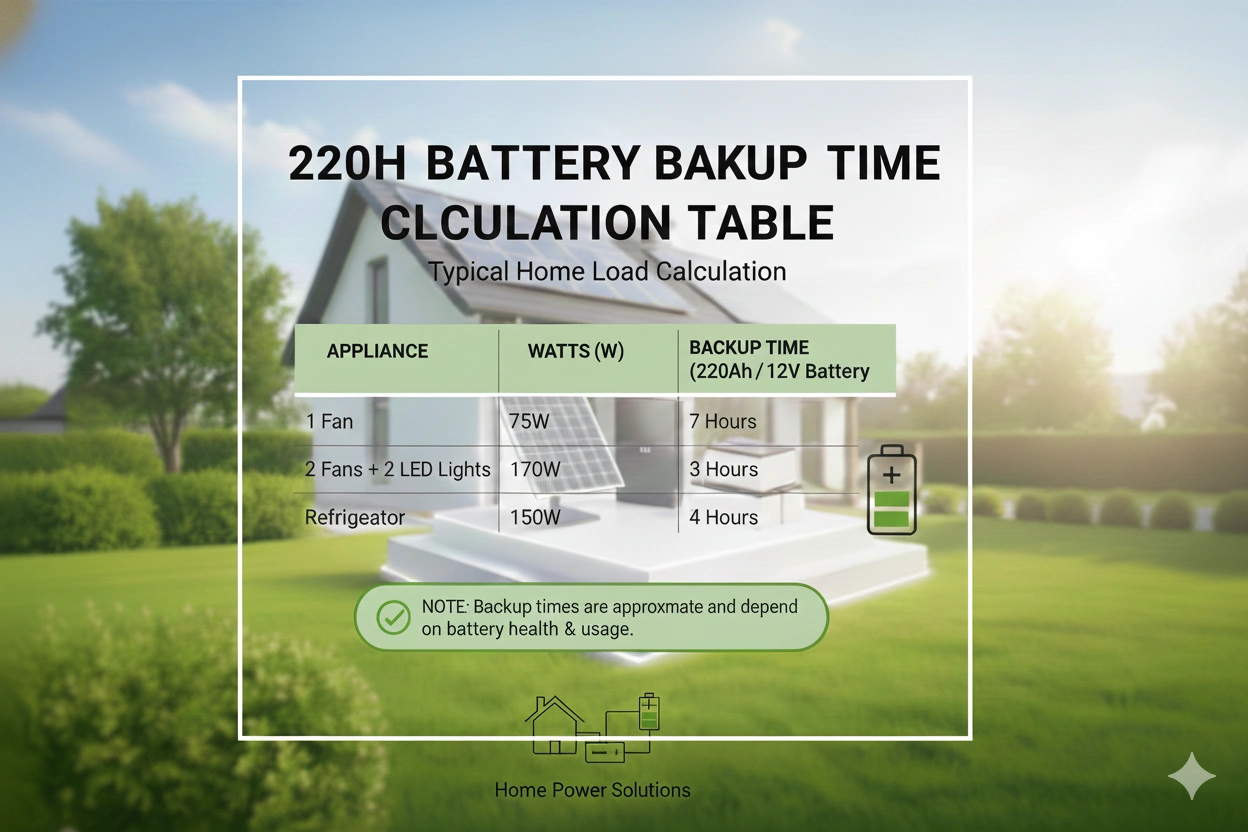
220Ah Battery Backup Time Table
Below is a clean, easy-to-read table I often share with customers. You can use it anytime for reference:
| Load (Watts) | Approx Backup Time (Hours) |
|---|---|
| 100W | 22.4 hrs |
| 200W | 11.2 hrs |
| 300W | 7.4 hrs |
| 400W | 5.6 hrs |
| 500W | 4.4 hrs |
| 600W | 3.7 hrs |
| 700W | 3.2 hrs |
| 800W | 2.8 hrs |
| 900W | 2.4 hrs |
| 1000W | 2.2 hrs |
You can share this table with customers, employees, or buyers—it’s accurate and easy.
What Appliances Can a 220Ah Battery Handle?
Depending on the inverter size, a 220Ah battery can typically support:
-
Fans
-
LED TVs
-
Tube lights
-
Laptops
-
Wi-Fi routers
-
Water coolers
-
Small appliances
-
Home office load
Many small businesses and shop owners also depend on 220Ah batteries to run:
-
Billing systems
-
LED lights
-
Printers
-
CCTV
-
Small refrigeration units
As a long-time professional in the backup power industry and someone who collaborates closely with multiple online UPS supplier networks, I always recommend calculating your total wattage before connecting appliances.
How Battery Type Affects Backup Time
Not all 220Ah batteries are equal. You may find:
-
Tubular batteries
-
SMF batteries
-
Lithium batteries
In my experience:
-
Lithium batteries offer the longest backup time and fastest charging.
-
Tubular batteries offer strong durability and are ideal for heavy loads.
-
SMF batteries are maintenance-free but not ideal for long backup hours.
Your usage pattern should guide your choice.
How Inverter Efficiency Affects Backup
You must never ignore inverter efficiency. Most inverters offer 80–85% efficiency.
If your inverter is not efficient, even a strong 220Ah battery will give lesser backup.
As an industry participant associated as an online UPS trader, I always advise choosing high-efficiency systems—because they convert battery energy more effectively into usable AC power.
Real-World Backup Time vs. Calculated Backup Time
Sometimes customers ask:
“Why am I not getting the same backup as per formula?”
Here are the reasons:
-
Batteries lose capacity with age
-
Overloading the inverter
-
Poor wiring
-
Poor maintenance
-
Low-quality batteries
-
Temperature variation
-
Inverter inefficiency
So the formula gives an ideal backup time, but real performance may vary slightly.
How to Increase Backup Time of a 220Ah Battery
After years in the industry, here are the most effective tips I share with buyers:
1. Reduce unnecessary load
Turn off fans/lights when not required.
2. Use energy-efficient appliances
LEDs and BLDC fans consume 70% less power.
3. Maintain your battery
Keep terminals clean and check water levels (for tubular batteries).
4. Ensure proper ventilation
Heat reduces battery life and backup time.
5. Avoid deep discharge
Never allow the battery to go below 20–25%.
These small steps can boost your backup by 20–30%.
Should You Use One 220Ah Battery or Two Smaller Batteries?
If you're running a high load (800W+), two 150Ah batteries or one 220Ah battery may give similar results.
But in my honest experience:
-
One large 220Ah battery has longer life,
-
Less maintenance,
-
Better current handling,
-
and more efficient power delivery.
That’s why many businesses prefer 220Ah over 150Ah batteries.
220Ah Battery for Homes vs. Businesses
For Homes
-
Perfect for power cuts lasting 2–8 hours
-
Supports lights, fans, TV, laptop, Wi-Fi
-
Affordable and durable
For Businesses
-
Works well for shops, offices, clinics, salons
-
Supports billing system + lights + fan + computer
-
Long backup with moderate loads
When paired with a high-quality inverter, a 220Ah battery becomes a powerful backup system for any small or medium establishment.
220Ah Battery With Solar System
If you want even longer backup time, consider pairing the battery with:
-
Solar panels
-
Charge controller
-
Hybrid inverter
Solar charging dramatically reduces electricity bills and prolongs battery life.
Final Thoughts
Choosing a 220Ah battery is one of the smartest decisions for reliable backup power—whether for home or business. It’s powerful, durable, and capable of running essential appliances for several hours.
With the calculations, tables, and insights above, you now have complete clarity on how long a 220Ah battery can last under different loads.
If you're a business owner, dealer, or distributor looking to expand your energy product portfolio, partnering with a reputed manufacturer is crucial. As part of a trusted ecosystem of an online UPS manufacturer, online UPS supplier, and online UPS trader, we are committed to helping you grow.