
200Ah Battery: How Many Hours Backup?
05 December 2025
200Ah Battery Backup Time: How Many Hours Will It Last?
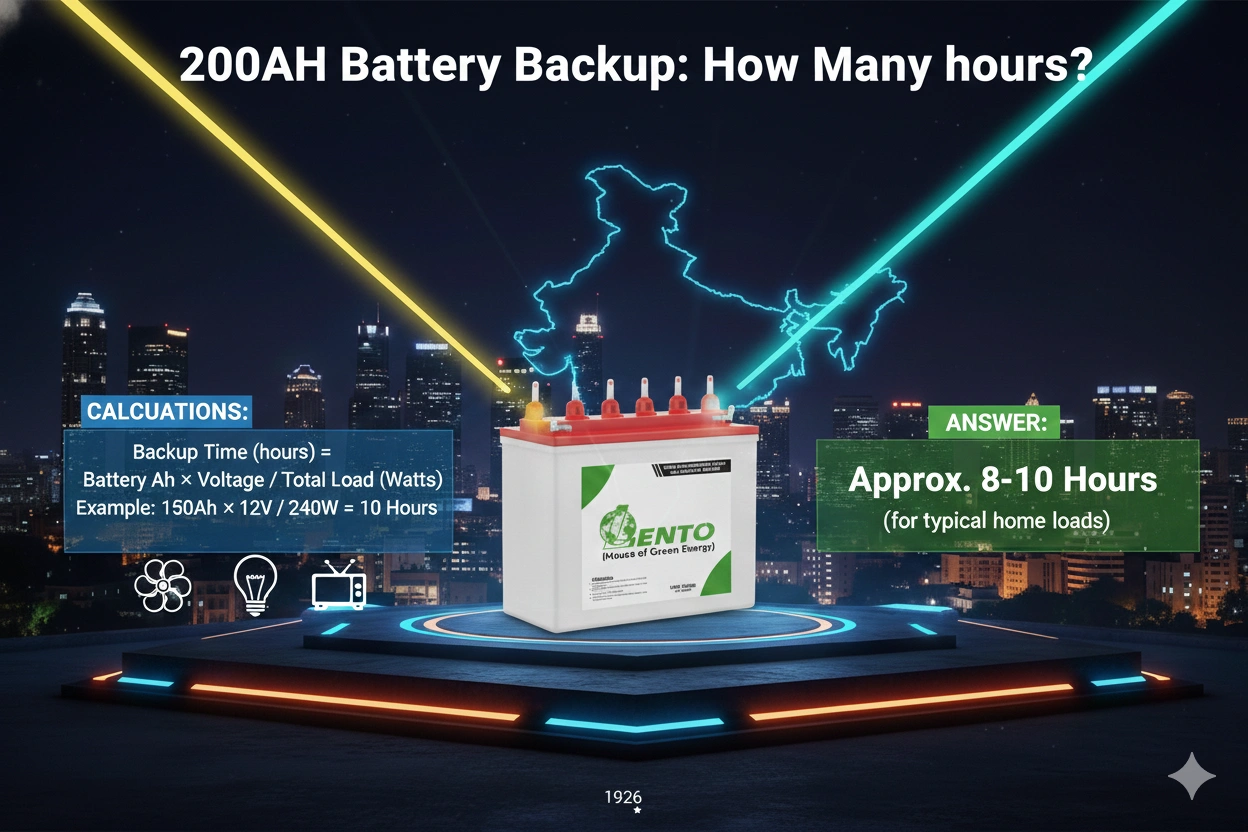
A 200Ah battery can provide different backup times depending on the connected load, battery voltage, battery type, inverter efficiency and depth of discharge. For example, a 200Ah, 12V lead-acid battery may provide several hours of backup for fans and lights, but the backup time will decrease when you connect more appliances.
If you are planning to buy a 200Ah battery for your home, shop, office or solar inverter, this guide explains how to calculate backup time, compare different loads and choose a suitable battery.
You can also read our guide on how to choose an inverter and battery for home to understand how to match your battery capacity with your power requirements.
How Many Hours of Backup Does a 200Ah Battery Give?
A 200Ah battery does not provide a fixed number of backup hours. The result depends mainly on how much power your appliances consume and how much of the battery's rated capacity can be used.
For a typical 200Ah, 12V lead-acid battery, the following table provides simplified estimates using 50% depth of discharge and 85% inverter efficiency.
| Connected load | Estimated backup time |
|---|---|
| 100W | Around 10 hours |
| 200W | Around 5 hours |
| 300W | Around 3.4 hours |
| 400W | Around 2.5 hours |
| 500W | Around 2 hours |
| 600W | Around 1.7 hours |
| 800W | Around 1.3 hours |
| 1,000W | Around 1 hour |
These are theoretical planning estimates, not guaranteed backup times. Actual results can be lower because of battery condition, discharge rate, temperature, inverter consumption and the battery manufacturer's specifications. Lead-acid battery capacity can also decrease when it is discharged quickly under a heavy load.
What Does a 200Ah Battery Mean?
Ah stands for ampere-hour and describes a battery's rated charge capacity under specified testing conditions.
A 200Ah battery commonly used in a home inverter system has a nominal voltage of 12V. Its theoretical energy capacity is:
Battery energy = Voltage × Capacity
12V × 200Ah = 2,400Wh, or 2.4kWh
However, you should not assume that all 2,400Wh will be available to power appliances. A lead-acid battery's usable energy depends on the recommended discharge limit, while the inverter also consumes some energy during operation.
Battery chemistry matters, too. A 200Ah lead-acid battery and a 200Ah lithium battery may have different usable capacities, charging requirements and operating characteristics.
For another battery-capacity comparison, read our guide to the best inverter for a 100Ah lithium battery.
How to Calculate the Backup Time of a 200Ah Battery
You can estimate battery backup using this formula:
Backup time (hours) = Usable battery energy (Wh) × Inverter efficiency ÷ Connected load (W)
For example, consider a 200Ah, 12V lead-acid battery.
- Rated battery energy: 200Ah × 12V = 2,400Wh
- Assumed usable portion at 50% discharge: 1,200Wh
- Assumed inverter efficiency: 85%
- Estimated energy available to the load: 1,200Wh × 0.85 = 1,020Wh
If your connected appliances consume 200W:
1,020Wh ÷ 200W = approximately 5.1 hours
This calculation is useful for initial planning. Actual backup depends on the battery's rated performance, operating conditions and the load profile.
200Ah Battery Backup Examples for Home Appliances
Your total appliance load determines how quickly the battery discharges. Before estimating backup, add the wattage of the appliances you expect to run simultaneously.
1. Fans and LED lights
Suppose you run two fans rated at 60W each and four LED lights rated at 9W each.
- Two fans: 120W
- Four LED lights: 36W
- Total connected load: 156W
Using the example above, with approximately 1,020Wh available to the load:
1,020Wh ÷ 156W = approximately 6.5 hours
This is an estimate. Actual fan consumption varies by model and speed setting.
2. Fans, lights and a television
Suppose your total load is 250W.
1,020Wh ÷ 250W = approximately 4.1 hours
Your actual backup will depend on the power consumption of the television, fans and other connected devices.
3. Fans, lights, television and a refrigerator
A refrigerator's power consumption changes as its compressor switches on and off. Its starting demand can also be higher than its running demand.
Calculate the average running load of all connected appliances and check that the inverter can handle the refrigerator's starting surge. A 200Ah battery may provide less backup than a simple calculation suggests when the load is high or frequently fluctuates.
4. A shop or small office
Computers, printers, routers, lighting and other equipment can create a different load profile from household appliances. For business equipment, calculate the combined wattage and required backup duration before choosing a battery and inverter.
If your equipment requires a more controlled power supply, explore Lento's Online UPS options. Select a system based on equipment load, runtime requirements and the manufacturer's compatibility specifications.
What Factors Affect 200Ah Battery Backup Time?
1. Battery type
Battery chemistry and construction affect usable capacity, charging behaviour, maintenance and service life.
- Tubular lead-acid battery: Commonly used in home inverter systems. Many models require periodic electrolyte-level checks and appropriate ventilation.
- Flat-plate lead-acid battery: Performance and service life depend on its design, quality and usage conditions.
- Lithium battery: Usable capacity, charging controls and maintenance requirements differ from those of lead-acid batteries. Compatibility with the inverter is essential.
Do not assume that every tubular battery will provide more backup than every other battery. Compare the manufacturer's capacity ratings, discharge recommendations and warranty conditions.
2. Battery age and condition
A battery's available capacity generally decreases as it ages. Poor maintenance, unsuitable charging and repeated deep discharges can also affect performance.
If your battery is providing much less backup than it used to, check its condition and charging system rather than assuming that the inverter is the only problem.
3. Inverter efficiency and standby consumption
The inverter converts the battery's DC power into AC power for your appliances. Some energy is lost during this conversion, and the inverter may consume power even when the connected load is low.
For a more detailed selection guide, read how to choose an inverter and battery for home.
4. Depth of discharge
Depth of discharge (DoD) describes how much of the battery's capacity has been used.
For example, using 50% of a 2,400Wh nominal battery represents 1,200Wh before accounting for conversion losses. The recommended discharge limit depends on the battery type and model.
Follow the battery manufacturer's guidance rather than assuming that a battery should always be discharged completely.
5. Connected load and starting current
The more power your appliances consume, the shorter the backup time. Motors, refrigerators and pumps may also draw a higher current when starting.
Choose an inverter that supports both the continuous load and the starting demand of the appliances you plan to use.
6. Charging quality and temperature
Incorrect charging settings, incomplete charging and unsuitable operating temperatures can affect battery performance and service life. Use a compatible charger and follow the manufacturer's installation and maintenance instructions.
Is a 200Ah Battery Enough for Home Use?
A 200Ah battery can be suitable for many small and medium-sized homes, particularly when the main requirements are fans, LED lights, a television and internet equipment.
However, the correct battery capacity depends on two questions:
- How much load do you need to run? Add the wattage of the appliances that will operate together.
- How long must they run during a power cut? Estimate the required energy and allow for inverter losses and the battery's recommended discharge limit.
A 200Ah battery may be sufficient for a moderate load but may not provide the desired backup if you run several high-power appliances simultaneously.
Read our guide to the best inverter for home use in India with battery price for more information on choosing a home backup system.
Is a 200Ah Battery Suitable for a Solar Inverter?
A 200Ah battery can be used in a compatible solar inverter system, but the battery capacity alone does not determine how well the system will perform.
Consider these factors before buying:
- Battery voltage and inverter battery-voltage requirements
- Solar panel wattage and configuration
- Solar charge controller type and charging limits
- Daily energy consumption
- Available sunlight and the time required to recharge the battery
- Battery chemistry and charging compatibility
An MPPT solar inverter can adjust the operating point of compatible solar panels to harvest available solar power efficiently under suitable conditions. However, actual charging performance depends on panel output, sunlight, system design and the inverter's specifications.
Explore Lento's off-grid solar inverter with MPPT technology to review the available models and compatibility details.
How Long Does a 200Ah Battery Last Before Replacement?
Battery service life is different from backup time. Backup time tells you how long the battery can run appliances on a charge; service life refers to how long the battery remains usable over months or years.
There is no single lifespan that applies to every 200Ah battery. Service life depends on battery construction, operating temperature, charging practices, depth of discharge, maintenance and usage frequency.
Before buying, compare the manufacturer's stated design life, warranty terms and maintenance requirements. A longer warranty does not automatically guarantee a particular service life.
How to Get Better Backup from a 200Ah Battery
Follow these practical steps to help your battery deliver reliable performance:
- Switch off appliances that are not needed during a power cut.
- Use energy-efficient LED lighting.
- Avoid connecting loads beyond the inverter's rated capacity.
- Keep the battery charged according to the manufacturer's instructions.
- For lead-acid batteries, check electrolyte levels only where applicable and as instructed by the manufacturer.
- Keep the battery in a suitable, ventilated location.
- Use compatible charging equipment and inverter settings.
- Arrange a battery health check if backup drops noticeably.
How to Choose the Right Inverter for a 200Ah Battery
A 200Ah battery is only one part of the backup system. Before selecting an inverter, check:
Inverter capacity: The inverter must support the combined running wattage and the starting demand of connected appliances.
Battery voltage: Confirm whether the inverter requires a 12V, 24V or another battery configuration. One 12V battery cannot directly replace a required 24V battery bank.
Battery compatibility: Check whether the inverter supports the battery chemistry and charging profile you plan to use.
Backup requirement: Calculate the energy required for your expected load and duration, allowing for conversion losses and usable battery capacity.
Solar compatibility: If you want solar charging, check the supported solar input, maximum PV voltage, charging current and panel configuration.
You can compare options in our inverter price guide for India and latest inverter price list. Confirm current prices, model availability and specifications before purchasing.
Frequently Asked Questions
1. Is a 200Ah battery good for home?
Yes, a 200Ah battery can provide longer backup for home appliances than a 150Ah battery at the same voltage. Lento offers battery solutions for compatible home inverter systems.
2. Which is better, a 150Ah or a 200Ah battery?
A 200Ah battery generally provides more backup, while a 150Ah battery may be sufficient for lighter loads and shorter backup needs. The right choice depends on your power consumption and budget.
3. How long will a 200 amp battery last?
A 200Ah battery’s backup time depends on its voltage, battery chemistry, usable capacity and connected load. A higher load will generally reduce the backup time.
4. How long will a 200Ah battery last with a 100W load?
A 12V, 200Ah battery has a nominal capacity of 2,400Wh. At a 100W load, the theoretical runtime is 24 hours; actual backup will be lower due to inverter losses and usable battery capacity.
5. Which brand of 200 amp battery is best?
The right brand depends on battery chemistry, warranty, cycle life and inverter compatibility. Lento and other established battery brands can be compared based on your backup requirements and budget.
6. Can a 150Ah battery run AC?
Yes, a 150Ah battery may run an AC if the inverter supports its starting surge and the battery can supply the required power. Runtime depends on the AC’s wattage, battery voltage and usable capacity.
Conclusion
A 200Ah battery can be a practical choice for home, shop and small-office backup, but its runtime depends on the load and the amount of energy that can safely be used.
For a typical 200Ah, 12V lead-acid battery, a simplified estimate using 50% depth of discharge and 85% inverter efficiency gives around five hours at a 200W load and around 2.5 hours at a 400W load. Real-world results may differ.
Calculate your expected load, check battery and inverter compatibility, and compare the manufacturer's specifications before making a purchase. For more help, explore Lento's inverter and battery product information and related buying guides.