
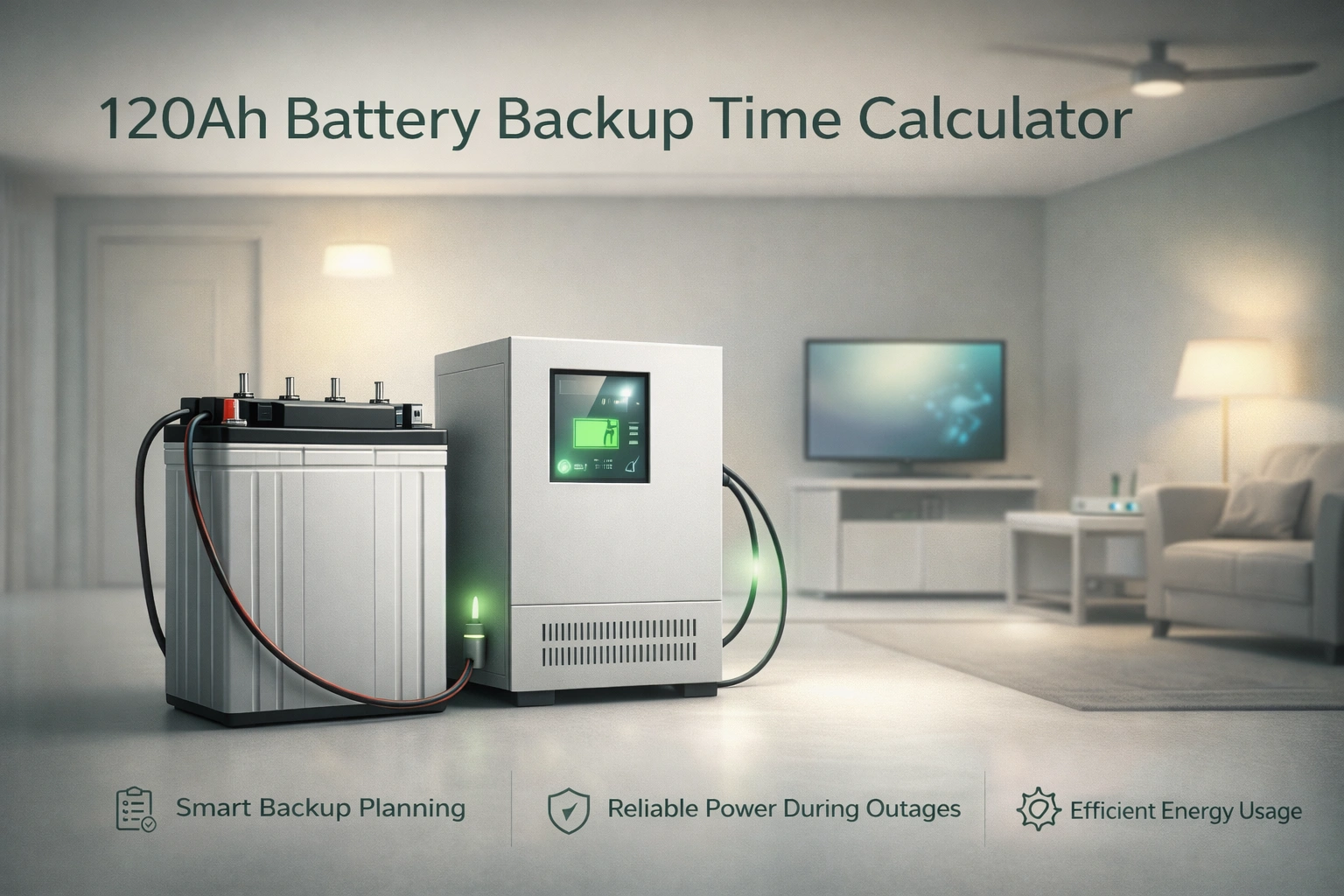
120Ah Battery Backup Time Calculator
18 December 2025
Power backup has become a basic necessity rather than a luxury. Whether you live in a city with frequent outages or a semi-urban area with unstable electricity supply, an inverter system backed by a 120Ah battery is one of the most commonly chosen solutions. However, the most frequent question users ask is simple yet crucial: how long will a 120Ah battery actually last during a power cut?
This is where a 120Ah Battery Backup Time Calculator becomes essential. It helps you realistically estimate backup duration based on load, inverter efficiency, and battery characteristics—so you are not disappointed during real outages.
This blog explains the concept in a clear, practical, and human way, without unnecessary technical jargon, while still maintaining technical accuracy.
Understanding What a 120Ah Battery Means in Real Life
A 120Ah (Ampere-hour) battery indicates the amount of electrical charge the battery can deliver over time. In simple terms, it reflects how much energy is stored inside the battery and how long it can power connected appliances.
120Ah batteries are widely used because they strike a balance between:
-
Reasonable cost
-
Adequate backup time
-
Compatibility with most 800VA–1kVA inverters
They are commonly available in 12V configuration, which is standard for residential inverter systems.
Why You Need a 120Ah Battery Backup Time Calculator
Many users make the mistake of assuming that a higher Ah battery automatically means “all-day backup.” In reality, backup time depends on multiple dynamic factors. A calculator helps eliminate assumptions and gives clarity before installation.
Using a backup time calculator helps you:
-
Avoid overloading the inverter
-
Decide how many appliances to run during outages
-
Prevent deep discharge of the battery
-
Increase battery lifespan
-
Choose between single or multiple battery setups
For installers and dealers, it also helps in setting correct customer expectations, which is critical for long-term trust.
Key Factors That Decide 120Ah Battery Backup Time
Backup time is not a fixed number. It changes depending on how the system is used.
1. Total Load in Watts
The combined wattage of all appliances connected to the inverter directly impacts backup duration. Lower load equals longer backup.
Common appliance consumption:
-
LED light: very low consumption
-
Ceiling fan: moderate consumption
-
TV and router: moderate
-
Refrigerator, iron, pump: high consumption
Running only essential appliances dramatically improves backup time.
2. Battery Voltage
Most 120Ah batteries operate at 12 volts, but if batteries are connected in series for higher voltage systems, the calculations change accordingly.
3. Inverter Efficiency
No inverter converts DC battery power into AC electricity without losses. Typical efficiency ranges from 80% to 90%. A higher-efficiency inverter delivers longer usable backup.
4. Battery Type
Different battery technologies deliver different usable capacities even at the same Ah rating.
-
Tubular batteries: reliable and durable
-
Flat plate batteries: economical but shorter life
-
SMF batteries: maintenance-free
-
Lithium-ion batteries: highest usable capacity and efficiency
5. Battery Health and Maintenance
A new, well-maintained battery provides closer to its rated capacity, while an old or poorly maintained battery delivers significantly less backup.
Typical Backup Duration from a 120Ah Battery
Under normal household usage, a single 120Ah battery can generally provide:
-
3 to 5 hours of backup for essential loads
-
Longer backup if only lights and fans are used
-
Shorter backup if load increases
This makes it ideal for homes that experience short to medium-duration power cuts.
Practical Appliance Load Scenarios
Understanding real usage scenarios helps more than theoretical numbers.
Low Load Scenario
-
3 LED lights
-
2 fans
-
1 Wi-Fi router
This setup can give extended backup because the power draw remains minimal.
Medium Load Scenario
-
4 lights
-
3 fans
-
1 TV
-
1 router
This is the most common household usage pattern and offers balanced backup.
High Load Scenario
-
Multiple fans
-
TV
-
Refrigerator
Backup time drops significantly, and frequent use of heavy appliances is not recommended with a single 120Ah battery.
120Ah Battery for Home Inverter Systems
For residential inverter setups, a 120Ah battery is often paired with:
-
800VA inverter
-
900VA inverter
-
1kVA inverter
It works best when the inverter is not pushed to its maximum limit continuously. Keeping load under control improves both backup time and battery life.
Using a 120Ah Battery with Solar Inverters
A 120Ah battery can also be used in solar inverter systems, but charging dynamics change.
Key points to consider:
-
Solar panel capacity must be sufficient
-
Proper charge controller is essential
-
Regular full charging improves battery health
In solar setups, a 120Ah battery works well for daytime energy storage and evening backup, especially in off-grid or hybrid systems.
How to Increase Backup Time of a 120Ah Battery
Instead of immediately upgrading battery capacity, smart usage can make a noticeable difference.
-
Replace all conventional bulbs with LEDs
-
Switch off non-essential appliances during outages
-
Use energy-efficient fans
-
Ensure inverter ventilation
-
Avoid running heavy loads
-
Maintain proper electrolyte levels in tubular batteries
-
Do not allow frequent deep discharge
These small steps significantly improve real-world performance.
Tubular vs Lithium 120Ah Battery: Backup Comparison
While both may be rated at 120Ah, performance differs.
Tubular batteries:
-
Affordable
-
Proven technology
-
Require maintenance
Lithium batteries:
-
Higher usable capacity
-
Faster charging
-
Zero maintenance
-
Longer lifespan
Lithium batteries generally deliver longer effective backup despite similar Ah ratings, making them suitable for premium or solar applications.
Is a Single 120Ah Battery Enough for You?
A single 120Ah battery is suitable if:
-
Your power cuts are short
-
Your appliance usage is controlled
-
You only need backup for essentials
If you experience:
-
Long outages
-
High appliance load
-
Commercial usage
Then a higher Ah system or multiple battery configuration may be more appropriate.
Common Mistakes to Avoid
-
Running high-power appliances continuously
-
Choosing battery only by price
-
Ignoring inverter efficiency
-
Not considering future load increase
-
Skipping regular maintenance
Avoiding these mistakes ensures reliable backup and longer system life.
FAQs: 120Ah Battery Backup Time Calculator
How many hours backup does a 120Ah battery give?
Typically, 3–5 hours depending on load, inverter efficiency, and battery condition.
Can a 120Ah battery run a refrigerator?
Occasional use is possible, but continuous operation is not recommended as it reduces backup drastically.
Is 120Ah battery enough for a 1kVA inverter?
Yes, it is commonly used with 1kVA inverters for basic household loads.
Does inverter brand affect backup time?
Yes. Higher efficiency inverters deliver better usable backup.
Can I add another 120Ah battery later?
Yes. Batteries can be added in parallel or series if the inverter supports it.
Is 120Ah battery good for solar systems?
Yes, when paired with correctly sized solar panels and charge controllers.
Which battery type gives the longest backup at 120Ah?
Lithium-ion batteries provide higher usable energy and longer effective backup.
Final Conclusion
A 120Ah Battery Backup Time Calculator is an essential planning tool for anyone installing or upgrading an inverter system. It helps convert technical specifications into real-life expectations—so you know exactly what your system can and cannot handle.
Instead of relying on assumptions, calculating backup time ensures smarter energy usage, better appliance management, and longer battery life. Whether for home backup or solar applications, understanding your 120Ah battery’s true capability is the foundation of reliable power planning.