
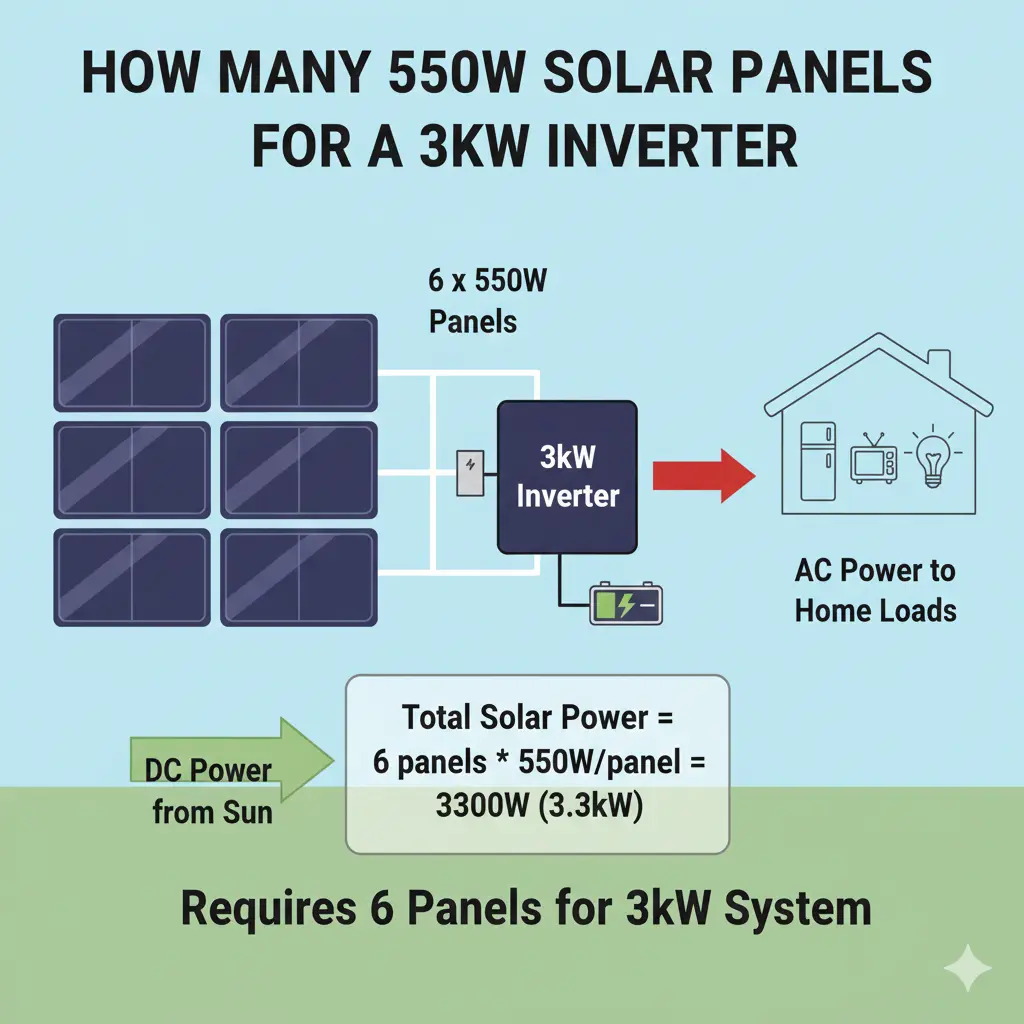
How Many 550W Solar Panels for a 3kW Inverter
03 January 2026
When people start planning a solar power system, one of the first questions I hear is: how many 550W solar panels for a 3kW inverter are actually needed? It sounds like a simple calculation, but in real installations, it involves more than just dividing numbers. Both home users and business owners want a system that works efficiently, delivers consistent output, and justifies the investment.
In this blog, I’ll explain the answer clearly, based on real-world solar design experience. I’ll walk you through panel capacity, inverter limits, system losses, and practical considerations so you can make an informed decision with confidence.
Why Panel-to-Inverter Sizing Matters in Solar Systems
A solar inverter and solar panels must work in balance. If the panel capacity is too low, the inverter never reaches its potential. If panel capacity is too high, energy may be wasted or the system may face efficiency losses.
Understanding how many 550W solar panels for a 3kW inverter are required helps ensure optimal power generation, system safety, and long-term reliability. Proper sizing also improves return on investment, which is equally important for residential and commercial users.
Understanding the Capacity of a 3kW Solar Inverter
A 3kW inverter is designed to handle a maximum output of around 3,000 watts under ideal conditions. This means it can safely convert DC power from solar panels into AC power up to this limit.
In daily operation, the inverter output varies depending on sunlight, temperature, and system efficiency. It rarely operates at peak capacity for the entire day. This is why panel sizing often slightly exceeds inverter rating.
What Does a 550W Solar Panel Actually Deliver?
A 550W solar panel is rated under standard test conditions. In real outdoor conditions, factors like heat, dust, shading, and installation angle reduce actual output.
On average, a 550W panel may deliver around 75–85% of its rated capacity during peak sunlight hours. This practical output is what designers consider while calculating how many panels are needed for a 3kW inverter.
Direct Calculation: How Many 550W Panels for a 3kW Inverter
Let’s start with simple math. A 3kW inverter equals 3,000 watts.
If you divide 3,000 by 550, the result is approximately 5.45. Since you cannot install half a panel, the practical answer is either five or six panels.
In most real installations, six 550W solar panels are used with a 3kW inverter. This gives a total panel capacity of 3.3kW, which helps compensate for system losses and ensures the inverter operates efficiently.
Why Six Panels Are Often Better Than Five
Many users ask whether five panels are enough. Technically, five 550W panels provide 2.75kW, which is slightly below inverter capacity. While this setup works, it does not fully utilize the inverter.
Six panels provide a small oversizing margin. This improves energy harvest during non-ideal sunlight conditions, such as early mornings, cloudy days, and winter months. Oversizing within limits is a common and recommended practice in solar system design.
Role of Solar Losses in Panel Calculation
Solar systems face unavoidable losses. These include cable losses, inverter efficiency losses, temperature losses, and dust accumulation.
When calculating how many 550W solar panels for a 3kW inverter, these losses must be considered. Installing six panels helps offset these reductions and delivers closer-to-expected daily energy output.
Ignoring losses often leads to underperforming systems and disappointed users.
Panel Configuration and Voltage Compatibility
Panel count is not the only factor. Voltage compatibility between panels and inverter also matters. Panels are connected in series or parallel to meet the inverter’s input voltage range.
A professional design ensures that six 550W panels are arranged correctly so the inverter operates within safe voltage and current limits. Improper configuration can reduce efficiency or cause system faults.
Energy Generation Expectations from This Setup
With six 550W panels and a 3kW inverter, users can expect strong daily generation, depending on location and sunlight hours.
In good solar regions, this setup can generate enough power to support common household loads like lighting, fans, refrigerators, televisions, and office equipment. For small businesses, it can support workstations, networking devices, and essential machinery.
At lento, solar inverter systems are designed keeping these practical performance expectations in focus.
Is This Setup Suitable for Homes?
For homes, six 550W panels with a 3kW inverter is a balanced and popular configuration. It offers sufficient generation without requiring excessive roof space.
This setup works well for households aiming to reduce electricity bills while maintaining backup capability when paired with batteries.
Is This Setup Suitable for Small Businesses?
Small offices, clinics, retail stores, and workshops often choose this configuration as well. It offers a good balance between generation capacity and investment.
Businesses benefit from reduced grid dependence and predictable energy output, especially during peak working hours.
Roof Space Consideration for 550W Panels
A 550W solar panel is physically larger than lower-wattage panels. On average, six such panels require moderate roof space with proper spacing for airflow and maintenance.
Before finalizing the system, roof orientation, shading, and structural strength should be evaluated. These factors directly influence system performance.
Future Expansion and Scalability
Some users plan future expansion when installing a 3kW inverter. While six panels are ideal now, future load growth may require system upgrades.
In such cases, planning for higher inverter capacity or modular expansion helps avoid redesign costs later. Discussing future needs during initial planning is always a smart approach.
Quality Components Make the Difference
Even the best calculation fails if components are unreliable. Panel quality, inverter efficiency, and installation standards all affect real-world results.
Choosing trusted manufacturers and system integrators ensures that calculated performance matches actual output over the system’s lifespan. Lento focuses on delivering dependable solar inverter solutions designed for long-term use.
Lento India – Global B2B Solar Exporter
Lento India proudly exports solar and power solutions to 24 countries including Mexico, Chile, Peru, Ecuador, Dominican Republic, Afghanistan, Nigeria, Iraq, Uganda, Yemen, Syria, Iran, Oman, Morocco, Egypt, and Kuwait.
We supply solar panels, tubular batteries, SMF batteries, inverters, and Online UPS systems to global distributors, OEMs, and large-scale installers.
Lento India – Powering industries, homes, and communities across continents with trust and technology.
Conclusion: The Right Number of Panels Ensures the Right Performance
So, how many 550W solar panels for a 3kW inverter are ideal? In most cases, six panels provide the best balance of performance, efficiency, and reliability. This configuration accounts for real-world losses, improves energy generation, and ensures the inverter operates optimally.
Whether you are a homeowner or a business owner, correct solar sizing is the foundation of a successful solar investment. With proper planning and quality solutions from lento, solar power becomes a dependable asset rather than a guessing game.
👉 Become our distributor in your state.
FAQs
1. How many 550W solar panels are required for a 3kW inverter?
Usually, six 550W solar panels are recommended for optimal performance.
2. Can five 550W panels work with a 3kW inverter?
Yes, but inverter capacity will not be fully utilized.
3. Is oversizing panels harmful to the inverter?
No, slight oversizing within limits improves performance.
4. Why are six panels better than exact matching?
They compensate for system and environmental losses.
5. Does panel wattage affect inverter selection?
Yes, panel wattage directly influences inverter sizing.
6. How much roof space is needed for six 550W panels?
Moderate roof space is required due to larger panel size.
7. Can this setup support battery backup?
Yes, it works well with battery-based solar systems.
8. Is this configuration suitable for small offices?
Yes, it is commonly used in small commercial setups.
9. Do weather conditions affect panel output?
Yes, sunlight availability impacts daily generation.
10. Should I consult a professional before installation?
Yes, professional design ensures safety and efficiency.